Published by:
CGP EDU Academic Team
Published on: September 12, 2026
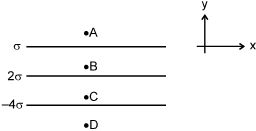
If three infinite charged sheets of uniform surface charge densities σ, 2 σ and –4 σ are placed as shown in figure, then find out electric field intensities at points A, B, C and D.
Text Solution
Verified by ExpertsThe correct answer is:
A
Step 1: Understanding the electric field due to infinite sheets
For an infinite charged sheet with surface charge density σ, the electric field produced is given by:
$$E = \frac{\sigma}{2\epsilon_0}$$
where ${\epsilon_0}$ is the permittivity of free space.
Step 2: Electric field directions
1. For the sheet with charge density σ (at point A), the electric field points away from the sheet. Hence, it contributes an electric field going upwards (positive y-direction).
2. For the sheet with charge density 2σ (at point B), it also points away from the sheet, adding another electric field upwards above point B.
3. For the sheet with charge density -4σ (at point C), the electric field points towards the sheet (downwards), contributing to the electric field at point D.
Step 3: Calculating electric fields at points A, B, C, and D
1. **At point A**:
Only the sheet with charge density σ affects point A, giving:
$$E_A = \frac{\sigma}{2\epsilon_0} (upward)$$
2. **At point B**:
Both σ and 2σ contribute upwards and have magnitudes:
$$E_B = \frac{\sigma}{2\epsilon_0} + \frac{2\sigma}{2\epsilon_0} = \frac{3\sigma}{2\epsilon_0} (upward)$$
3. **At point C**:
Here, conduct for sheet σ (upward) and 2σ (upward) as well as -4σ (downward):
$$E_C = \frac{\sigma}{2\epsilon_0} + \frac{2\sigma}{2\epsilon_0} - \frac{4\sigma}{2\epsilon_0} = -\frac{\sigma}{2\epsilon_0} (downward)$$
4. **At point D**:
The fields from σ, 2σ and -4σ sheets affect point D as follows:
$$E_D = \frac{\sigma}{2\epsilon_0} + \frac{2\sigma}{2\epsilon_0} - \frac{4\sigma}{2\epsilon_0} = -\frac{\sigma}{2\epsilon_0} (downward)$$
Summary of Electric Fields:
- E_A: upward, $$\frac{\sigma}{2\epsilon_0}$$
- E_B: upward, $$\frac{3\sigma}{2\epsilon_0}$$
- E_C: downward, $$-\frac{\sigma}{2\epsilon_0}$$
- E_D: downward, $$-\frac{\sigma}{2\epsilon_0}$$
Thus, based on point A, B being the maximum (upward), and point C, D being the negative field (downward). Therefore, the correct answer is A.
For an infinite charged sheet with surface charge density σ, the electric field produced is given by:
$$E = \frac{\sigma}{2\epsilon_0}$$
where ${\epsilon_0}$ is the permittivity of free space.
Step 2: Electric field directions
1. For the sheet with charge density σ (at point A), the electric field points away from the sheet. Hence, it contributes an electric field going upwards (positive y-direction).
2. For the sheet with charge density 2σ (at point B), it also points away from the sheet, adding another electric field upwards above point B.
3. For the sheet with charge density -4σ (at point C), the electric field points towards the sheet (downwards), contributing to the electric field at point D.
Step 3: Calculating electric fields at points A, B, C, and D
1. **At point A**:
Only the sheet with charge density σ affects point A, giving:
$$E_A = \frac{\sigma}{2\epsilon_0} (upward)$$
2. **At point B**:
Both σ and 2σ contribute upwards and have magnitudes:
$$E_B = \frac{\sigma}{2\epsilon_0} + \frac{2\sigma}{2\epsilon_0} = \frac{3\sigma}{2\epsilon_0} (upward)$$
3. **At point C**:
Here, conduct for sheet σ (upward) and 2σ (upward) as well as -4σ (downward):
$$E_C = \frac{\sigma}{2\epsilon_0} + \frac{2\sigma}{2\epsilon_0} - \frac{4\sigma}{2\epsilon_0} = -\frac{\sigma}{2\epsilon_0} (downward)$$
4. **At point D**:
The fields from σ, 2σ and -4σ sheets affect point D as follows:
$$E_D = \frac{\sigma}{2\epsilon_0} + \frac{2\sigma}{2\epsilon_0} - \frac{4\sigma}{2\epsilon_0} = -\frac{\sigma}{2\epsilon_0} (downward)$$
Summary of Electric Fields:
- E_A: upward, $$\frac{\sigma}{2\epsilon_0}$$
- E_B: upward, $$\frac{3\sigma}{2\epsilon_0}$$
- E_C: downward, $$-\frac{\sigma}{2\epsilon_0}$$
- E_D: downward, $$-\frac{\sigma}{2\epsilon_0}$$
Thus, based on point A, B being the maximum (upward), and point C, D being the negative field (downward). Therefore, the correct answer is A.
Prepare Smarter with CGP Edu
Get practice questions, solutions, and test series in one place.
Write a Review
Share your experience with this question and solution.
Commentary
Send your comment, doubt, correction, or feedback to admin.
Similar Questions
Explore conceptually related problems
A charge q is placed at the center of the line joining two equal charges Q. The system of the three…
Inside a hollow charged spherical conductor, the potential
Two small spheres each carrying a charge q are placed r meter apart. If one of the spheres is taken…
The electric charge in uniform motion produces
Two charged spheres of radii 10 cm and 15 cm are connected by a thin wire. No current will flow, if…
The electric field inside a spherical shell of uniform surface charge density is