Published by:
CGP EDU Academic Team
Published on: September 12, 2026
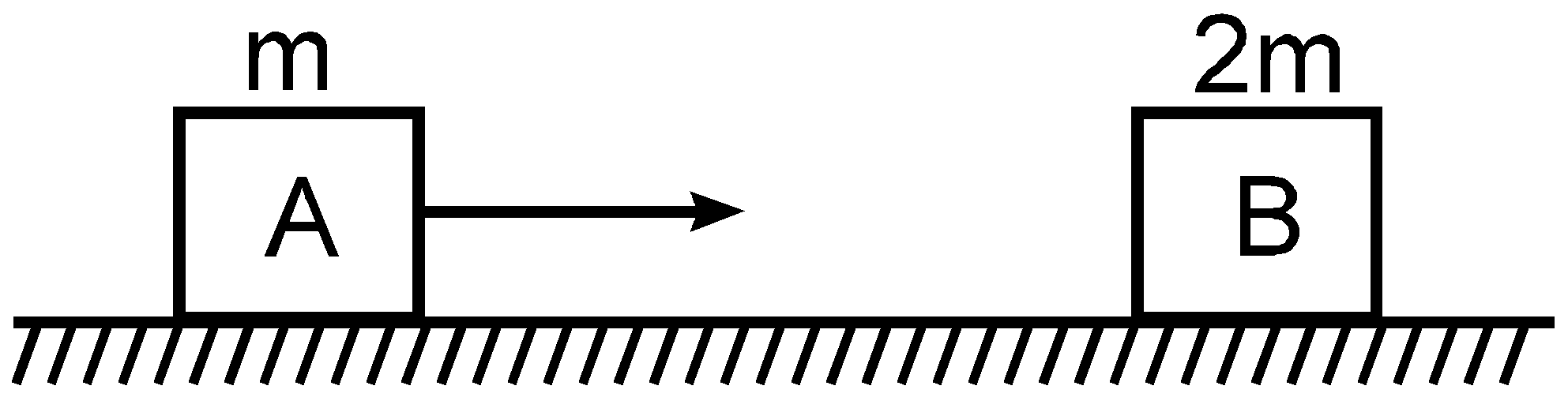
In the figure shown the block A collides head on with another block B at rest. Mass of B is twice the mass of A. The block A stops after collision. The co-efficient of restitution is :
Text Solution
Verified by ExpertsThe correct answer is:
A
Step 1: Understand the scenario
Let the mass of block A be represented as m, and thus the mass of block B will be 2m (since it is stated that the mass of B is twice that of A).
Step 2: Apply conservation of momentum
Before the collision, let's assume block A is moving with velocity V, and block B is at rest (velocity = 0). Therefore, the total momentum before the collision is:
$$ p_{initial} = mV + 2m(0) = mV $$
After the collision, block A comes to rest (final velocity = 0), and block B moves with a velocity (V'). Using conservation of momentum:
$$ mV = 2mV' $$
Simplifying this gives:
$$ V' = \frac{V}{2} $$
Step 3: Apply the coefficient of restitution (e)
The coefficient of restitution is defined as the relative velocity of separation to the relative velocity of approach. Mathematically, it is given as:
$$ e = \frac{V'_{B} - V'_{A}}{V_{A} - V_{B}} $$
Where:
- $V'_{A} = 0$, since A stops after collision.
- $V'_{B} = V' = \frac{V}{2}$, as derived.
The velocities before the collision are:
- $V_{A} = V$ (for A)
- $V_{B} = 0$ (for B)
Now substituting these values into the equation:
$$ e = \frac{\frac{V}{2} - 0}{V - 0} = \frac{\frac{V}{2}}{V} = \frac{1}{2} $$
Conclusion
Therefore, the coefficient of restitution is:
Answer: A: 0.5.
Let the mass of block A be represented as m, and thus the mass of block B will be 2m (since it is stated that the mass of B is twice that of A).
Step 2: Apply conservation of momentum
Before the collision, let's assume block A is moving with velocity V, and block B is at rest (velocity = 0). Therefore, the total momentum before the collision is:
$$ p_{initial} = mV + 2m(0) = mV $$
After the collision, block A comes to rest (final velocity = 0), and block B moves with a velocity (V'). Using conservation of momentum:
$$ mV = 2mV' $$
Simplifying this gives:
$$ V' = \frac{V}{2} $$
Step 3: Apply the coefficient of restitution (e)
The coefficient of restitution is defined as the relative velocity of separation to the relative velocity of approach. Mathematically, it is given as:
$$ e = \frac{V'_{B} - V'_{A}}{V_{A} - V_{B}} $$
Where:
- $V'_{A} = 0$, since A stops after collision.
- $V'_{B} = V' = \frac{V}{2}$, as derived.
The velocities before the collision are:
- $V_{A} = V$ (for A)
- $V_{B} = 0$ (for B)
Now substituting these values into the equation:
$$ e = \frac{\frac{V}{2} - 0}{V - 0} = \frac{\frac{V}{2}}{V} = \frac{1}{2} $$
Conclusion
Therefore, the coefficient of restitution is:
Answer: A: 0.5.
Prepare Smarter with CGP Edu
Get practice questions, solutions, and test series in one place.
Write a Review
Share your experience with this question and solution.
Commentary
Send your comment, doubt, correction, or feedback to admin.
Similar Questions
Explore conceptually related problems
A bullet of mass m = 50 gm strikes ( Δ t ≈ 0)a sand bag of mass M = 5 kg hanging from a fixed point…
In the arrangement shown, the pendulum on the left is pulled aside. It is then released and allowed…
There are hundred identical sliders equally spaced on a frictionless track as shown in the figure. …
A solid iron ball A of radius r collides head on with another stationary solid iron ball B of radiu…
A particle of mass m moves with velocity v 0 = 20 m/sec towards a large wall that is moving with ve…
Two perfectly elastic balls of same mass m are moving with velocities u 1 and u 2 . They collide he…