
NCERT Solutions for Class 11 Physics Chapter 11, Thermodynamics, have been carefully prepared by experienced physics teachers to help students understand every concept clearly. Before attempting the NCERT questions, students should study the chapter theory thoroughly, including thermal equilibrium, the zeroth law of thermodynamics, heat, work, internal energy, the first law of thermodynamics and thermodynamic processes. These step-by-step solutions simplify both conceptual and numerical problems and are useful for school exams, NEET and JEE preparation. Students can also access complete NCERT solutions for all Class 11 Physics chapters in PDF format.
Class 11 Physics Chapter 11 Overview
The Thermodynamics chapter explains the relationship between heat, work, temperature and internal energy. Students learn about thermal equilibrium, the zeroth law, the first law and the second law of thermodynamics. The chapter covers important thermodynamic processes such as isothermal, adiabatic, isobaric and isochoric processes. It also discusses heat engines, refrigerators, reversible and irreversible processes, and the efficiency of thermal systems.
NCERT Solutions CLASS 11 PHYSICS CHAPTER 11: Thermodynamics
Question 11.1.
A geyser heats water flowing at the rate of $3.0\text{ litres per minute}$ from $27^\circ\text{C}$ to $77^\circ\text{C}$. If the geyser operates on a gas burner, what is the rate of consumption of the fuel if its heat of combustion is $4.0 \times 10^4\text{ J/g}$?
Solution :
Water is flowing at a rate of $3.0\text{ litre/min}$.
The geyser heats the water, raising the temperature from $27^\circ\text{C}$ to $77^\circ\text{C}$.
Initial temperature, $T_1 = 27^\circ\text{C}$
Final temperature, $T_2 = 77^\circ\text{C}$
$$\therefore \text{Rise in temperature, } \Delta T = T_2 – T_1 = 77 – 27 = 50^\circ\text{C}$$
Heat of combustion $= 4 \times 10^4\text{ J/g}$
Specific heat of water, $c = 4.2\text{ J g}^{-1}\text{ }^\circ\text{C}^{-1}$
Mass of flowing water, $m = 3.0\text{ litre/min} = 3000\text{ g/min}$
Total heat used, $\Delta Q = mc \Delta T = 3000 \times 4.2 \times 50 = 6.3 \times 10^5\text{ J/min}$
$$\therefore \text{Rate of consumption} = \frac{6.3 \times 10^5}{4 \times 10^4} = 15.75\text{ g/min}.$$
Question 11.2.
What amount of heat must be supplied to $2.0 \times 10^{-2}\text{ kg}$ of nitrogen (at room temperature) to raise its temperature by $45^\circ\text{C}$ at constant pressure? (Molecular mass of $\text{N}_2 = 28$; $R = 8.3\text{ J mol}^{-1}\text{ K}^{-1}$.)
Solution :
Mass of nitrogen, $m = 2.0 \times 10^{-2}\text{ kg} = 20\text{ g}$
Rise in temperature, $\Delta T = 45^\circ\text{C}$
Molecular mass of $\text{N}_2$, $M = 28$
Universal gas constant, $R = 8.3\text{ J mol}^{-1}\text{ K}^{-1}$
Number of moles, $n = \frac{m}{M} = \frac{2 \times 10^{-2} \times 10^3}{28} \approx 0.714$
Molar specific heat at constant pressure for nitrogen, $C_p = \left(\frac{7}{2}\right)R = \left(\frac{7}{2}\right) \times 8.3 = 29.05\text{ J mol}^{-1}\text{ K}^{-1}$
The total amount of heat to be supplied is given by the relation:
$$\Delta Q = n C_P \Delta T = 0.714 \times 29.05 \times 45 = 933.38\text{ J}$$
Therefore, the amount of heat to be supplied is $933.38\text{ J}$.
Question 11.3.
Explain why
a. Two bodies at different temperatures $T_1$ and $T_2$ if brought in thermal contact do not necessarily settle to the mean temperature $(T_1 + T_2)/2$.
b. The coolant in a chemical or a nuclear plant (i.e., the liquid used to prevent the different parts of a plant from getting too hot) should have high specific heat.
c. Air pressure in a car tyre increases during driving.
d. The climate of a harbour town is more temperate than that of a town in a desert at the same latitude.
Solution :
a. In thermal contact, heat flows from the body at higher temperature to the body at lower temperature till temperatures become equal. The final temperature can be the mean temperature $(T_1 + T_2)/2$ only when thermal capacities of the two bodies are equal.
b. This is because heat absorbed by a substance is directly proportional to the specific heat of the substance.
c. During driving, the temperature of air inside the tyre increases due to motion. According to Charles’s law, $P \propto T$. Therefore, air pressure inside the tyre increases.
d. This is because in a harbour town, the relative humidity is more than in a desert town. Hence, the climate of a harbour town is without extremes of hot and cold.
Question 11.4.
A cylinder with a movable piston contains $3\text{ moles}$ of hydrogen at standard temperature and pressure. The walls of the cylinder are made of a heat insulator, and the piston is insulated by having a pile of sand on it. By what factor does the pressure of the gas increase if the gas is compressed to half its original volume?
Solution :
The cylinder is completely insulated from its surroundings. As a result, no heat is exchanged between the system (cylinder) and its surroundings. Thus, the process is adiabatic.
Initial pressure inside the cylinder $= P_1$
Final pressure inside the cylinder $= P_2$
Initial volume inside the cylinder $= V_1$
Final volume inside the cylinder $= V_2$
Ratio of specific heats, $\gamma = 1.4$
For an adiabatic process, we have:
$$P_1 V_1^\gamma = P_2 V_2^\gamma$$
The final volume is compressed to half of its initial volume.
$$\therefore V_2 = \frac{V_1}{2}$$
$$P_1 V_1^\gamma = P_2 \left(\frac{V_1}{2}\right)^\gamma$$
$$\frac{P_2}{P_1} = \frac{V_1^\gamma}{(V_1 / 2)^\gamma} = 2^\gamma = 2^{1.4} = 2.639$$
Hence, the pressure increases by a factor of $2.639$.
Question 11.5.
In changing the state of a gas adiabatically from an equilibrium state A to another equilibrium state B, an amount of work equal to $22.3\text{ J}$ is done on the system. If the gas is taken from state A to B via a process in which the net heat absorbed by the system is $9.35\text{ cal}$, how much is the net work done by the system in the latter case? (Take $1\text{ cal} = 4.19\text{ J}$)
Solution :
The work done ($W$) on the system while the gas changes from state A to state B is $22.3\text{ J}$.
This is an adiabatic process. Hence, change in heat is zero.
$$\therefore \Delta Q = 0$$
$$\Delta W = -22.3\text{ J (Since the work is done on the system)}$$
From the first law of thermodynamics, we have:
$$\Delta Q = \Delta U + \Delta W$$
Where $\Delta U$ = Change in the internal energy of the gas
$$\therefore \Delta U = \Delta Q – \Delta W = 0 – (-22.3) = +22.3\text{ J}$$
When the gas goes from state A to state B via a process, the net heat absorbed by the system is:
$$\Delta Q = 9.35\text{ cal} = 9.35 \times 4.19 = 39.1765\text{ J}$$
$$\Delta Q = \Delta U + \Delta W \implies \Delta W = \Delta Q – \Delta U = 39.1765 – 22.3 = 16.8765\text{ J}$$
Therefore, $16.88\text{ J}$ of work is done by the system.
Question 11.6.
Two cylinders A and B of equal capacity are connected to each other via a stopcock. A contains a gas at standard temperature and pressure. B is completely evacuated. The entire system is thermally insulated. The stopcock is suddenly opened. Answer the following:
a. What is the final pressure of the gas in A and B?
b. What is the change in internal energy of the gas?
c. What is the change in the temperature of the gas?
d. Do the intermediate states of the system (before settling to the final equilibrium state) lie on its P-V-T surface?
Solution :
a. When the stopcock is suddenly opened, the volume available to the gas at $1\text{ atmospheric pressure}$ will become two times. Therefore, pressure will decrease to one-half, i.e., $0.5\text{ atmosphere}$.
b. There will be no change in the internal energy of the gas as no work is done on/by the gas.
c. Since no work is being done by the gas during the expansion of the gas, the temperature of the gas will not change at all.
d. No, because the process called free expansion is rapid and cannot be controlled. The intermediate states are non-equilibrium states and do not satisfy the gas equation. In due course, the gas does return to an equilibrium state.
Question 11.7.
A steam engine delivers $5.4 \times 10^8\text{ J}$ of work per minute and services $3.6 \times 10^9\text{ J}$ of heat per minute from its boiler. What is the efficiency of the engine? How much heat is wasted per minute?
Solution :
Work done by the steam engine per minute, $W = 5.4 \times 10^8\text{ J}$
Heat supplied from the boiler, $H = 3.6 \times 10^9\text{ J}$
Efficiency of the engine $= \frac{\text{Output energy}}{\text{Input energy}}$
$$\therefore \eta = \frac{W}{H} = \frac{5.4 \times 10^8}{3.6 \times 10^9} = 0.15$$
Hence, the percentage efficiency of the engine is $15\%$.
$$\text{Amount of heat wasted} = 3.6 \times 10^9 – 5.4 \times 10^8 = 30.6 \times 10^8 = 3.06 \times 10^9\text{ J}$$
Therefore, the amount of heat wasted per minute is $3.06 \times 10^9\text{ J}$.
Question 11.8.
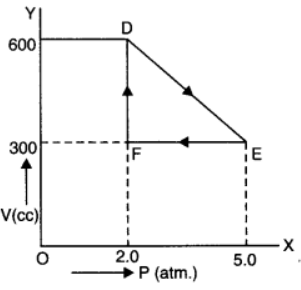
A thermodynamic system is taken from an original state to an intermediate state by the linear process shown in Fig. (12.13).
Its volume is then reduced to the original value from E to F by an isobaric process. Calculate the total work done by the gas from D to E to F.
Solution :
Total work done by the gas from D to E to F $=$ Area of $\Delta\text{DEF}$
$$\text{Area of } \Delta\text{DEF} = \left(\frac{1}{2}\right) \times \text{DE} \times \text{EF}$$
Where,
$\text{DF} = \text{Change in pressure} = 600\text{ N/m}^2 – 300\text{ N/m}^2 = 300\text{ N/m}^2$
$\text{FE} = \text{Change in volume} = 5.0\text{ m}^3 – 2.0\text{ m}^3 = 3.0\text{ m}^3$
$$\text{Area of } \Delta\text{DEF} = \left(\frac{1}{2}\right) \times 300 \times 3 = 450\text{ J}$$
Therefore, the total work done by the gas from D to E to F is $450\text{ J}$.
Additional Question 1
An electric heater supplies heat to a system at a rate of $100\text{ W}$. If system performs work at a rate of $75\text{ Joules per second}$. At what rate is the internal energy increasing?
Solution :
Heat is supplied to the system at a rate of $100\text{ W}$.
$$\therefore \text{Heat supplied, } Q = 100\text{ J/s}$$
The system performs at a rate of $75\text{ J/s}$.
$$\therefore \text{Work done, } W = 75\text{ J/s}$$
From the first law of thermodynamics, we have:
$$Q = U + W$$
Where $U$ = Internal energy
$$\therefore U = Q – W = 100 – 75 = 25\text{ J/s} = 25\text{ W}$$
Therefore, the internal energy of the given electric heater increases at a rate of $25\text{ W}$.
Additional Question 2
A refrigerator is to maintain eatables kept inside at $9^\circ\text{C}$. If room temperature is $36^\circ\text{C}$, calculate the coefficient of performance.
Solution :
$$\text{Temperature inside the refrigerator, } T_1 = 9^\circ\text{C} = 282\text{ K}$$
$$\text{Room temperature, } T_2 = 36^\circ\text{C} = 309\text{ K}$$
$$\text{Coefficient of performance} = \frac{T_1}{T_2 – T_1} = \frac{282}{309 – 282} = \frac{282}{27} \approx 10.44$$
Therefore, the coefficient of performance of the given refrigerator is $10.44$.
Why Class 11 Physics Chapter 11 Matters in NEET and JEE
Class 11 Physics Chapter 11, Thermodynamics, is important for NEET and JEE because it explains the relationship between heat, work, temperature and internal energy. Students learn about thermal equilibrium, state variables, thermodynamic systems and the laws that govern the transfer and conversion of energy. These concepts are essential for understanding heat engines, refrigerators, gases and several advanced topics in physics and chemistry.
NEET frequently includes direct conceptual and formula-based questions involving the zeroth law, first law, thermodynamic processes, heat engines and the second law of thermodynamics. JEE commonly asks numerical and graphical questions based on pressure-volume diagrams, work done by gases, changes in internal energy and combinations of thermodynamic processes. Students must understand the sign convention for heat and work and identify whether a process is isothermal, adiabatic, isobaric or isochoric. Strong knowledge of formulas, graphs and process conditions helps students solve examination questions accurately.
Preparation Tips for Class 11 Physics Chapter 11
Begin by understanding the meaning of a thermodynamic system, surroundings and boundary. Learn the difference between open, closed and isolated systems. Study state variables such as pressure, volume, temperature and internal energy, and understand the concept of thermal equilibrium.
Revise the zeroth law of thermodynamics, which forms the basis of temperature measurement. Understand that two systems in thermal equilibrium with a third system are also in thermal equilibrium with each other.
Study the first law of thermodynamics carefully:
$$\Delta Q = \Delta U + \Delta W$$
Here, $\Delta Q$ is the heat supplied to the system, $\Delta U$ is the change in internal energy and $\Delta W$ is the work done by the system. Follow the selected sign convention consistently while solving numerical problems.
Prepare a comparison table of the important thermodynamic processes:
– **Isothermal process:** Temperature remains constant and, for an ideal gas, $\Delta U = 0$.
– **Adiabatic process:** No heat is exchanged, so $\Delta Q = 0$.
– **Isochoric process:** Volume remains constant, so $\Delta W = 0$.
– **Isobaric process:** Pressure remains constant and $\Delta W = P\Delta V$.
– **Cyclic process:** The system returns to its initial state, so the total change in internal energy is zero.
Practise calculating work done from pressure-volume graphs. The area under a $P\text{-}V$ curve represents the work done by the gas during the process.
Understand the second law of thermodynamics and why heat cannot be completely converted into work in a cyclic process. Study heat engines, refrigerators and their performance using:
$$\text{Efficiency of a heat engine: } \eta = \frac{W}{Q_h}$$
$$\text{Coefficient of performance of a refrigerator: } \text{COP} = \frac{Q_c}{W}$$
Revise reversible and irreversible processes, Carnot engine concepts, important diagrams and NCERT examples. Complete the NCERT exercises before attempting NEET and JEE previous-year questions.
FAQs
1. What are the most important topics in Class 11 Physics Chapter 11?
The most important topics include thermal equilibrium, the zeroth law, heat, work, internal energy, the first law of thermodynamics, thermodynamic processes, pressure-volume diagrams, heat engines, refrigerators and the second law of thermodynamics.
2. What is thermodynamics?
Thermodynamics is the branch of physics that studies the relationship between heat, work, temperature and energy in a system. It explains how energy is transferred and transformed during physical processes.
3. What is a thermodynamic system?
A thermodynamic system is a selected quantity of matter or a region of space studied for changes in pressure, volume, temperature and energy. Everything outside the system is called its surroundings.
4. What is the zeroth law of thermodynamics?
The zeroth law states that if two systems are separately in thermal equilibrium with a third system, they are also in thermal equilibrium with each other. This law provides the basis for measuring temperature.
5. What is internal energy?
Internal energy is the total microscopic kinetic and potential energy of all the particles present in a thermodynamic system. It is a state function and depends on the condition of the system.
6. What is the first law of thermodynamics?
The first law is based on the conservation of energy. It states that the heat supplied to a system is used to increase its internal energy and perform external work:
$$\Delta Q = \Delta U + \Delta W$$
7. What is an isothermal process?
An isothermal process is a thermodynamic process in which the temperature remains constant. For an ideal gas, internal energy depends only on temperature, so the change in internal energy is zero.
8. What is an adiabatic process?
An adiabatic process is one in which no heat is exchanged between the system and its surroundings. Therefore:
$$\Delta Q = 0$$
Any work done during the process changes the internal energy of the system.
9. What is the second law of thermodynamics?
The second law states that heat cannot flow spontaneously from a colder body to a hotter body and that no cyclic heat engine can convert all absorbed heat completely into work.
10. Is Class 11 Physics Chapter 11 important for NEET and JEE?
Yes. Thermodynamics is an important chapter for NEET and JEE. Questions are commonly based on the first law, thermodynamic processes, $P\text{-}V$ graphs, heat engines, refrigerators and the second law. Regular formula revision and numerical practice are essential for scoring well.