
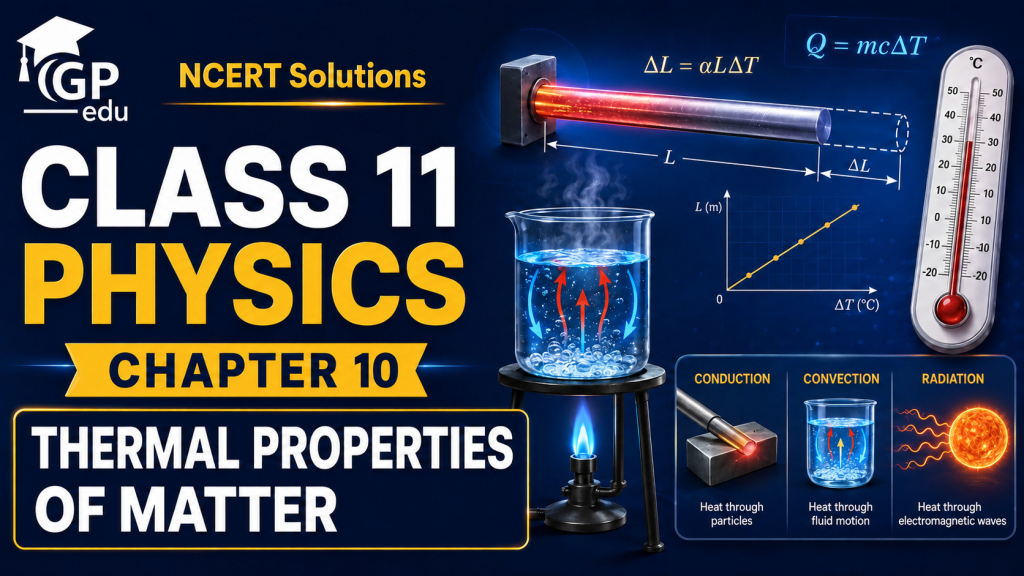
NCERT Solutions for Class 11 Physics Chapter 10, Thermal Properties of Matter, have been carefully prepared by experienced physics teachers to help students understand every concept clearly. Before attempting the NCERT questions, students should study the chapter theory thoroughly, including thermal expansion, calorimetry, specific heat capacity, change of state, heat transfer and Newton’s law of cooling. These step-by-step solutions simplify both conceptual and numerical problems and are useful for school exams, NEET and JEE preparation. Students can also access complete NCERT solutions for all Class 11 Physics chapters in PDF format.
Class 11 Physics Chapter 10 Overview
The Thermal Properties of Matter chapter explains how materials respond to changes in temperature. Students learn about heat, temperature, thermal expansion, specific heat capacity and calorimetry. The chapter covers heat transfer through conduction, convection and radiation, along with Newton’s law of cooling. It also discusses changes of state, latent heat and the practical applications of thermal properties in daily life and engineering.
NCERT CLASS 11 PHYSICS CHAPTER 10: Thermal Properties of Matter
Question 10.1.
The triple points of neon and carbon dioxide are $24.57\text{ K}$ and $216.55\text{ K}$ respectively. Express these temperatures on the Celsius and Fahrenheit scales.
Solution :
Kelvin and Celsius scales are related as:
$$T_C = T_K – 273.15 \quad \dots\text{(i)}$$
Celsius and Fahrenheit scales are related as:
$$T_F = \left(\frac{9}{5}\right)T_C + 32 \quad \dots\text{(ii)}$$
For neon:
$$T_K = 24.57\text{ K}$$
$$\therefore T_C = 24.57 – 273.15 = -248.58^\circ\text{C}$$
$$T_F = \left(\frac{9}{5}\right)T_C + 32 = \left(\frac{9}{5}\right) \times (-248.58) + 32 = -415.44^\circ\text{F}$$
For carbon dioxide:
$$T_K = 216.55\text{ K}$$
$$\therefore T_C = 216.55 – 273.15 = -56.60^\circ\text{C}$$
$$T_F = \left(\frac{9}{5}\right)T_C + 32 = \left(\frac{9}{5}\right) \times (-56.60) + 32 = -69.88^\circ\text{F}$$
Question 10.2.
Two absolute scales A and B have triple points of water defined to be $200\text{ A}$ and $350\text{ B}$. What is the relation between $T_A$ and $T_B$?
Solution :
Triple point of water on absolute scale A, $T_1 = 200\text{ A}$
Triple point of water on absolute scale B, $T_2 = 350\text{ B}$
Triple point of water on Kelvin scale, $T_K = 273.15\text{ K}$
The temperature $273.15\text{ K}$ on Kelvin scale is equivalent to $200\text{ A}$ on absolute scale A.
$$T_1 = T_K \implies 200\text{ A} = 273.15\text{ K} \implies \text{A} = \frac{273.15}{200}$$
The temperature $273.15\text{ K}$ on Kelvin scale is equivalent to $350\text{ B}$ on absolute scale B.
$$T_2 = T_K \implies 350\text{ B} = 273.15\text{ K} \implies \text{B} = \frac{273.15}{350}$$
$T_A$ is triple point of water on scale A, and $T_B$ is triple point of water on scale B.
$$\frac{273.15}{200} \times T_A = \frac{273.15}{350} \times T_B$$
Therefore, the ratio $T_A : T_B$ is given as $4 : 7$.
Question 10.3.
The electrical resistance in ohms of a certain thermometer varies with temperature according to the approximate law:
$$R = R_0[1 + \alpha(T – T_0)]$$
The resistance is $101.6\text{ }\Omega$ at the triple-point of water $273.16\text{ K}$, and $165.5\text{ }\Omega$ at the normal melting point of lead ($600.5\text{ K}$). What is the temperature when the resistance is $123.4\text{ }\Omega$?
Solution :
It is given that:
$$R = R_0[1 + \alpha(T – T_0)] \quad \dots\text{(i)}$$
Where,
$R_0$ and $T_0$ are the initial resistance and temperature respectively
$R$ and $T$ are the final resistance and temperature respectively
$\alpha$ is a constant
At the triple point of water, $T_0 = 273.15\text{ K}$ (or $273.16\text{ K}$ as given)
Resistance of lead, $R_0 = 101.6\text{ }\Omega$
At normal melting point of lead, $T = 600.5\text{ K}$
Resistance of lead, $R = 165.5\text{ }\Omega$
Substituting these values in equation (i), we get:
$$165.5 = 101.6[1 + \alpha(600.5 – 273.15)]$$
$$1.629 = 1 + \alpha(327.35)$$
$$\therefore \alpha = \frac{0.629}{327.35} = 1.92 \times 10^{-3}\text{ K}^{-1}$$
For resistance, $R_1 = 123.4\text{ }\Omega$:
$$123.4 = 101.6[1 + 1.92 \times 10^{-3}(T – 273.15)]$$
Solving for $T$, we get:
$$T = 384.61\text{ K}.$$
Question 10.4.
Answer the following:
a. The triple-point of water is a standard fixed point in modern thermometry. Why? What is wrong in taking the melting point of ice and the boiling point of water as standard fixed points (as was originally done in the Celsius scale)?
b. There were two fixed points in the original Celsius scale as mentioned above which were assigned the number $0^\circ\text{C}$ and $100^\circ\text{C}$ respectively. On the absolute scale, one of the fixed points is the triple-point of water, which on the Kelvin absolute scale is assigned the number $273.16\text{ K}$. What is the other fixed point on this (Kelvin) scale?
c. The absolute temperature (Kelvin scale) $T$ is related to the temperature $t_c$ on the Celsius scale by $t_c = T – 273.15$. Why do we have $273.15$ in this relation, and not $273.16$?íd
d. What is the temperature of the triple-point of water on an absolute scale whose unit interval size is equal to that of the Fahrenheit scale?
Solution :
a. The triple point of water has a unique value of $273.16\text{ K}$. At particular values of volume and pressure, the triple point of water is always $273.16\text{ K}$. The melting point of ice and boiling point of water do not have particular values because these points depend on pressure.
b. The absolute zero or $0\text{ K}$ is the other fixed point on the Kelvin absolute scale.
c. The temperature $273.16\text{ K}$ is the triple point of water. It is not the melting point of ice. The temperature $0^\circ\text{C}$ on Celsius scale is the melting point of ice. Its corresponding value on Kelvin scale is $273.15\text{ K}$. Hence, absolute temperature (Kelvin scale) $T$, is related to temperature $t_c$, on Celsius scale as $t_c = T – 273.15$.
d. Let $T_F$ be the temperature on Fahrenheit scale and $T_K$ be the temperature on absolute scale. Both the temperatures can be related as:
$$\frac{T_F – 32}{180} = \frac{T_K – 273.15}{100} \quad \dots\text{(i)}$$
Let $T_{F1}$ and $T_{K1}$ be another set of temperatures:
$$\frac{T_{F1} – 32}{180} = \frac{T_{K1} – 273.15}{100} \quad \dots\text{(ii)}$$
It is given that $T_{K1} – T_K = 1\text{ K}$. Subtracting equation (i) from equation (ii):
$$\frac{T_{F1} – T_F}{180} = \frac{T_{K1} – T_K}{100} = \frac{1}{100}$$
$$T_{F1} – T_F = \frac{1 \times 180}{100} = \frac{9}{5}$$
Triple point of water $= 273.16\text{ K}$
$$\therefore \text{Triple point of water on absolute scale} = 273.16 \times \left(\frac{9}{5}\right) = 491.69\text{ F (or units)}$$
Question 10.5.
Two ideal gas thermometers A and B use oxygen and hydrogen respectively. The following observations are made:
| Temperature | Pressure thermometer A | Pressure thermometer B |
|---|---|---|
| Triple-point of water | $1.250 \times 10^5\text{ Pa}$ | $0.200 \times 10^5\text{ Pa}$ |
| Normal melting point of sulphur | $1.797 \times 10^5\text{ Pa}$ | $0.287 \times 10^5\text{ Pa}$ |
a. What is the absolute temperature of normal melting point of sulphur as read by thermometers A and B?
b. What do you think is the reason behind the slight difference in answers of thermometers A and B? (The thermometers are not faulty). What further procedure is needed in the experiment to reduce the discrepancy between the two readings?
Solution :
a. Triple point of water, $T = 273.16\text{ K}$.
At this temperature, pressure in thermometer A, $P_A = 1.250 \times 10^5\text{ Pa}$
Let $T_1$ be the normal melting point of sulphur. At this temperature, pressure in thermometer A, $P_1 = 1.797 \times 10^5\text{ Pa}$
According to Charles’ law:
$$\frac{P_A}{T} = \frac{P_1}{T_1} \implies T_1 = \frac{P_1 T}{P_A} = \frac{1.797 \times 10^5 \times 273.16}{1.250 \times 10^5} \approx 392.69\text{ K}$$
At triple point $273.16\text{ K}$, pressure in thermometer B, $P_B = 0.200 \times 10^5\text{ Pa}$
At temperature $T_1$, pressure in thermometer B, $P_2 = 0.287 \times 10^5\text{ Pa}$
$$\frac{P_B}{T} = \frac{P_2}{T_1} \implies T_1 = \left(\frac{0.287 \times 10^5}{0.200 \times 10^5}\right) \times 273.16 \approx 391.98\text{ K}$$
b. The oxygen and hydrogen gas present in thermometers A and B respectively are not perfect ideal gases. Hence, there is a slight difference between the readings. To reduce the discrepancy, the experiment should be carried out under low-pressure conditions where gases behave as ideal gases.
Question 10.6.
A steel tape $1\text{ m}$ long is correctly calibrated for a temperature of $27.0^\circ\text{C}$. The length of a steel rod measured by this tape is found to be $63.0\text{ cm}$ on a hot day when the temperature is $45.0^\circ\text{C}$. What is the actual length of the steel rod on that day? What is the length of the same steel rod on a day when the temperature is $27.0^\circ\text{C}$? Coefficient of linear expansion of steel $= 1.20 \times 10^{-5}\text{ K}^{-1}$.
Solution :
$$\text{Length of the steel tape at temperature } T = 27^\circ\text{C}, \quad l = 1\text{ m} = 100\text{ cm}$$
$$\text{At temperature } T_1 = 45^\circ\text{C}, \text{ the length of the steel rod measured, } l_1 = 63\text{ cm}$$
$$\text{Coefficient of linear expansion of steel, } \alpha = 1.20 \times 10^{-5}\text{ K}^{-1}$$
Let $l’$ be the length of the steel tape at $45^\circ\text{C}$:
$$l’ = l + \alpha l(T_1 – T) = 100 + 1.20 \times 10^{-5} \times 100(45 – 27) = 100.0216\text{ cm}$$
$$\text{Actual length } l_2 = \left(\frac{100.0216}{100}\right) \times 63 = 63.0136\text{ cm}$$
Therefore, the actual length of the rod at $45.0^\circ\text{C}$ is $63.0136\text{ cm}$. Its length at $27.0^\circ\text{C}$ is $63.0\text{ cm}$.
Question 10.7.
A large steel wheel is to be fitted on to a shaft of the same material. At $27^\circ\text{C}$, the outer diameter of the shaft is $8.70\text{ cm}$ and the diameter of the central hole in the wheel is $8.69\text{ cm}$. The shaft is cooled using ‘dry ice’. At what temperature of the shaft does the wheel slip on the shaft? Assume coefficient of linear expansion of the steel to be constant over the required temperature range: $\alpha_{\text{steel}} = 1.20 \times 10^{-5}\text{ K}^{-1}$.
Solution :
$$\text{Initial temperature } T = 27^\circ\text{C} = 300\text{ K}$$
$$\text{Outer diameter of the shaft } d_1 = 8.70\text{ cm}$$
$$\text{Diameter of hole in wheel } d_2 = 8.69\text{ cm}$$
$$\alpha_{\text{steel}} = 1.20 \times 10^{-5}\text{ K}^{-1}$$
Change in diameter required, $\Delta d = 8.69 – 8.70 = -0.01\text{ cm}$
$$\Delta d = d_1 \alpha_{\text{steel}}(T_1 – T) \implies -0.01 = 8.70 \times 1.20 \times 10^{-5}(T_1 – 300)$$
$$T_1 – 300 = -95.78 \implies T_1 = 204.21\text{ K} = -68.95^\circ\text{C}$$
Therefore, the wheel will slip on the shaft when the temperature of the shaft is $-69^\circ\text{C}$.
Question 10.8.
A hole is drilled in a copper sheet. The diameter of the hole is $4.24\text{ cm}$ at $27.0^\circ\text{C}$. What is the change in the diameter of the hole when the sheet is heated to $227^\circ\text{C}$? Coefficient of linear expansion of copper $= 1.70 \times 10^{-5}\text{ K}^{-1}$.
Solution :
$$\text{Initial temperature, } T_1 = 27.0^\circ\text{C}, \quad d_1 = 4.24\text{ cm}$$
$$\text{Final temperature, } T_2 = 227^\circ\text{C}, \quad \alpha_{\text{Cu}} = 1.70 \times 10^{-5}\text{ K}^{-1}$$
Using superficial expansion ($\beta = 2\alpha$):
$$\frac{d_2^2 – d_1^2}{d_1^2} = 2\alpha(T_2 – T_1) \implies d_2^2 = d_1^2[2\alpha(T_2 – T_1) + 1]$$
$$d_2^2 = (4.24)^2 [2 \times 1.70 \times 10^{-5} (227 – 27) + 1] \approx 18.1 \implies d_2 \approx 4.2544\text{ cm}$$
$$\text{Change in diameter} = d_2 – d_1 = 4.2544 – 4.24 = 0.0144\text{ cm} = 1.44 \times 10^{-2}\text{ cm}.$$
Question 10.9.
A brass wire $1.8\text{ m}$ long at $27^\circ\text{C}$ is held taut with little tension between two rigid supports. If the wire is cooled to a temperature of $-39^\circ\text{C}$, what is the tension developed in the wire, if its diameter is $2.0\text{ mm}$? Co-efficient of linear expansion of brass $= 2.0 \times 10^{-5}\text{ K}^{-1}$; Young’s modulus of brass $= 0.91 \times 10^{11}\text{ Pa}$.
Solution :
$$T_1 = 27^\circ\text{C}, \quad L = 1.8\text{ m}, \quad T_2 = -39^\circ\text{C}, \quad d = 2.0 \times 10^{-3}\text{ m}$$
$$\alpha = 2.0 \times 10^{-5}\text{ K}^{-1}, \quad Y = 0.91 \times 10^{11}\text{ Pa}$$
$$\Delta L = \alpha L(T_2 – T_1) = \frac{FL}{A Y} \implies F = \alpha(T_2 – T_1) \pi Y \left(\frac{d}{2}\right)^2$$
$$F = 2 \times 10^{-5} \times (-39 – 27) \times 3.14 \times 0.91 \times 10^{11} \times \left(\frac{2 \times 10^{-3}}{2}\right)^2 \approx -3.8 \times 10^2\text{ N}$$
The negative sign indicates inward tension. Magnitude is $3.8 \times 10^2\text{ N}$.
Question 10.10.
A brass rod of length $50\text{ cm}$ and diameter $3.0\text{ mm}$ is joined to a steel rod of the same length and diameter. What is the change in length of the combined rod at $250^\circ\text{C}$, if the original lengths are at $40.0^\circ\text{C}$? Is there a ‘thermal stress’ developed at the junction? The ends of the rod are free to expand ($\alpha_{\text{brass}} = 2.0 \times 10^{-5}\text{ K}^{-1}$, $\alpha_{\text{steel}} = 1.2 \times 10^{-5}\text{ K}^{-1}$).
Solution :
$$\Delta T = 250 – 40 = 210^\circ\text{C}, \quad l_1 = l_2 = 50\text{ cm}$$
$$\Delta l_1 = l_1 \alpha_1 \Delta T = 50 \times (2.0 \times 10^{-5}) \times 210 = 0.2205\text{ cm}$$
$$\Delta l_2 = l_2 \alpha_2 \Delta T = 50 \times (1.2 \times 10^{-5}) \times 210 = 0.126\text{ cm}$$
$$\text{Total change in length} = \Delta l_1 + \Delta l_2 = 0.2205 + 0.126 = 0.346\text{ cm}$$
Since the ends are free to expand, **no thermal stress** is developed at the junction.
Question 10.11.
The coefficient of volume expansion of glycerin is $49 \times 10^{-5}\text{ K}^{-1}$. What is the fractional change in its density for a $30^\circ\text{C}$ rise in temperature?
Solution :
$$\alpha_V = 49 \times 10^{-5}\text{ K}^{-1}, \quad \Delta T = 30^\circ\text{C}$$
$$\text{Fractional change in density} = \frac{\Delta\rho}{\rho} \approx \alpha_V \Delta T = 49 \times 10^{-5} \times 30 = 1.47 \times 10^{-2}.$$
Question 10.12.
A $10\text{ kW}$ drilling machine is used to drill a bore in a small aluminium block of mass $8.0\text{ kg}$. How much is the rise in temperature of the block in $2.5\text{ minutes}$, assuming $50\%$ of power is used up in heating the machine itself or lost to the surroundings. Specific heat of aluminium $= 0.91\text{ J g}^{-1}\text{ K}^{-1}$.
Solution :
$$P = 10\text{ kW} = 10 \times 10^3\text{ W}, \quad m = 8.0\text{ kg} = 8 \times 10^3\text{ g}, \quad t = 2.5 \times 60 = 150\text{ s}$$
$$\text{Useful energy } \Delta Q = 50\% \times (Pt) = 0.50 \times 10 \times 10^3 \times 150 = 7.5 \times 10^5\text{ J}$$
$$\Delta T = \frac{\Delta Q}{mc} = \frac{7.5 \times 10^5}{8 \times 10^3 \times 0.91} \approx 103^\circ\text{C}.$$
Question 10.13.
A copper block of mass $2.5\text{ kg}$ is heated in a furnace to a temperature of $500^\circ\text{C}$ and then placed on a large ice block. What is the maximum amount of ice that can melt? (Specific heat of copper $= 0.39\text{ J g}^{-1}\text{ K}^{-1}$; heat of fusion of water $= 335\text{ J g}^{-1}$).
Solution :
$$m = 2.5\text{ kg} = 2500\text{ g}, \quad \Delta T = 500^\circ\text{C}, \quad c = 0.39\text{ J/g K}, \quad L = 335\text{ J/g}$$
$$\text{Heat lost } Q = mc\Delta T = 2500 \times 0.39 \times 500 = 487500\text{ J}$$
$$\text{Mass of melted ice } m_{\text{ice}} = \frac{Q}{L} = \frac{487500}{335} \approx 1455.22\text{ g} = 1.46\text{ kg}.$$
Question 10.14.
In an experiment on the specific heat of a metal, a $0.20\text{ kg}$ block of the metal at $150^\circ\text{C}$ is dropped in a copper calorimeter (of water equivalent $0.025\text{ kg}$) containing $150\text{ cm}^3$ of water at $27^\circ\text{C}$. The final temperature is $40^\circ\text{C}$. Compute the specific heat of the metal. If heat losses to the surroundings are not negligible, is your answer greater or smaller than the actual value for specific heat of the metal?
Solution :
$$\text{Mass of metal } m = 0.20\text{ kg} = 200\text{ g}, \quad T_1 = 150^\circ\text{C}, \quad T_2 = 40^\circ\text{C}$$
$$\text{Water equivalent of calorimeter } m’ = 25\text{ g}, \quad \text{Mass of water } M = 150\text{ g}$$
$$\text{Heat lost by metal} = (M + m’)c_w \Delta T_{\text{water}} \implies 200 \times C \times (150 – 40) = (150 + 25) \times 4.186 \times (40 – 27)$$
$$C \approx 0.43\text{ J g}^{-1}\text{ K}^{-1}$$
If heat losses to surroundings are not negligible, the calculated specific heat will be **smaller** than the actual value.
Question 10.15.
Given below are observations on molar specific heats at room temperature of some common gases.
| Gas | Molar Specific Heat $C_V$ ($\text{cal mol}^{-1}\text{ K}^{-1}$) |
|---|---|
| Chlorine | $6.17$ |
| Oxygen | $5.02$ |
| Carbon monoxide | $5.01$ |
| Nitric oxide | $4.99$ |
| Nitrogen | $4.97$ |
| Hydrogen | $4.87$ |
The measured molar specific heats of these gases are markedly different from those for monatomic gases. Typically, molar specific heat of a monatomic gas is $2.92\text{ cal/mol K}$. Explain this difference. What can you infer from the somewhat larger (than the rest) value for chlorine?
Solution :
The gases listed are diatomic. Besides translational degrees of freedom, they possess rotational degrees of freedom, which require more heat energy to raise their temperature. For chlorine, the larger value indicates that at room temperature, its vibrational modes also start contributing to the specific heat capacity.
Question 10.16.
A child running a temperature of $101^\circ\text{F}$ is given an antipyrin which causes an increase in the rate of evaporation of sweat from his body. If the fever is brought down to $98^\circ\text{F}$ in $20\text{ min}$, what is the average rate of extra evaporation caused, by the drug? Assume the evaporation mechanism to be the only way by which heat is lost. The mass of the child is $30\text{ kg}$. The specific heat of human body is approximately the same as that of water, and latent heat of evaporation of water at that temperature is about $580\text{ cal g}^{-1}$.
Solution :
$$\Delta T = (101 – 98) \times \frac{5}{9} = \frac{5}{3}^\circ\text{C}, \quad m = 30\text{ kg} = 30,000\text{ g}, \quad L = 580\text{ cal/g}$$
$$\text{Heat lost } Q = mc\Delta T = 30,000 \times 1 \times \left(\frac{5}{3}\right) = 50,000\text{ cal}$$
$$\text{Mass of evaporated water } m_1 = \frac{Q}{L} = \frac{50000}{580} \approx 86.2\text{ g}$$
$$\text{Average rate of evaporation} = \frac{86.2\text{ g}}{20\text{ min}} \approx 4.3\text{ g/min}.$$
Question 10.17.
A ‘thermacole’ icebox is a cheap and efficient method for storing small quantities of cooked food in summer in particular. A cubical icebox of side $30\text{ cm}$ has a thickness of $5.0\text{ cm}$. If $4.0\text{ kg}$ of ice is put in the box, estimate the amount of ice remaining after $6\text{ h}$. The outside temperature is $45^\circ\text{C}$, and co-efficient of thermal conductivity of thermacole is $0.01\text{ J s}^{-1}\text{ m}^{-1}\text{ K}^{-1}$. [Heat of fusion of water $= 335 \times 10^3\text{ J kg}^{-1}$]
Solution :
$$s = 0.3\text{ m}, \quad l = 0.05\text{ m}, \quad t = 6 \times 3600 = 21600\text{ s}, \quad \Delta T = 45^\circ\text{C}, \quad K = 0.01$$
$$\text{Surface area } A = 6s^2 = 6 \times (0.3)^2 = 0.54\text{ m}^2$$
$$\text{Heat transferred } Q = \frac{KA\Delta T t}{l} = \frac{0.01 \times 0.54 \times 45 \times 21600}{0.05} = 104976\text{ J}$$
$$\text{Ice melted} = \frac{Q}{L} = \frac{104976}{335 \times 10^3} \approx 0.313\text{ kg}$$
$$\text{Ice remaining} = 4 – 0.313 = 3.687\text{ kg}.$$
Question 10.18.
A brass boiler has a base area of $0.15\text{ m}^2$ and thickness $1.0\text{ cm}$. It boils water at the rate of $6.0\text{ kg/min}$ when placed on a gas stove. Estimate the temperature of the part of the flame in contact with the boiler. Thermal conductivity of brass $= 109\text{ J s}^{-1}\text{ m}^{-1}\text{ K}^{-1}$; Heat of vaporisation of water $= 2256 \times 10^3\text{ J kg}^{-1}$.
Solution :
$$A = 0.15\text{ m}^2, \quad l = 0.01\text{ m}, \quad \frac{dm}{dt} = \frac{6\text{ kg}}{60\text{ s}} = 0.1\text{ kg/s}$$
$$Q = \frac{KA(T_1 – T_2)t}{l} = mL \implies (T_1 – 100) = \frac{mLl}{KAt} = \frac{0.1 \times 2256 \times 10^3 \times 0.01}{109 \times 0.15} \approx 137.98^\circ\text{C}$$
$$T_1 = 137.98 + 100 = 237.98^\circ\text{C}.$$
Question 10.19.
Explain why:
a. a body with large reflectivity is a poor emitter
b. a brass tumbler feels much colder than a wooden tray on a chilly day
c. an optical pyrometer calibrated for an ideal black body radiation gives too low a value for the temperature of a red hot iron piece in the open, but gives a correct value for the temperature when the same piece is in the furnace
d. the earth without its atmosphere would be inhospitably cold
e. heating systems based on circulation of steam are more efficient in warming a building than those based on circulation of hot water.
Solution :
a. Good reflectors are poor absorbers, and by Kirchhoff’s law, poor absorbers are poor emitters.
b. Brass is a good conductor of heat, conducting body heat away rapidly, whereas wood is a poor conductor.
c. In the open, background radiation is reflected from the iron surface, lowering the pyrometer reading compared to the enclosed furnace.
d. The atmosphere traps outgoing infrared radiation via the greenhouse effect, keeping Earth warm.
e. Steam contains additional latent heat ($\approx 540\text{ cal/g}$), releasing more heat upon condensation than hot water cooling down.
Question 10.20.
A body cools from $80^\circ\text{C}$ to $50^\circ\text{C}$ in $5\text{ minutes}$. Calculate the time it takes to cool from $60^\circ\text{C}$ to $30^\circ\text{C}$. The temperature of the surroundings is $20^\circ\text{C}$.
Solution :
Using Newton’s law of cooling $\frac{T_1 – T_2}{t} = K\left(\frac{T_1 + T_2}{2} – T_0\right)$:
$$\frac{80 – 50}{5} = K\left(\frac{80 + 50}{2} – 20\right) \implies 6 = K(45) \implies K = \frac{2}{15}\text{ min}^{-1}$$
For cooling from $60^\circ\text{C}$ to $30^\circ\text{C}$ ($T_0 = 20^\circ\text{C}$, average temperature $= 45^\circ\text{C}$):
$$\frac{60 – 30}{t} = \frac{2}{15}(45 – 20) \implies \frac{30}{t} = \frac{2}{15}(25) = \frac{10}{3} \implies t = 9\text{ minutes}.$$
Additional Question 1
Answer the following questions based on the $P\text{-}T$ phase diagram of carbon dioxide:
a. At what temperature and pressure can the solid, liquid and vapour phases of $\text{CO}_2$ co-exist in equilibrium?
b. What is the effect of decrease of pressure on the fusion and boiling point of $\text{CO}_2$?=
c. What are the critical temperature and pressure for $\text{CO}_2$? What is their significance?
d. Is $\text{CO}_2$ solid, liquid or gas at (a) $-70^\circ\text{C}$ under $1\text{ atm}$, (b) $-60^\circ\text{C}$ under $10\text{ atm}$, (c) $15^\circ\text{C}$ under $56\text{ atm}$?
Solution :
The P-T phase diagram for CO 2 is shown in the following figure:
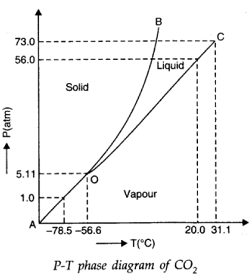
a. At the triple point: temperature $=-56.6^\circ\text{C}$ and pressure $= 5.11\text{ atm}$.
b. Both fusion and boiling points decrease with a decrease in pressure.
c. Critical temperature $= 31.1^\circ\text{C}$, critical pressure $= 73.0\text{ atm}$. Above this temperature, $\text{CO}_2$ cannot be liquefied regardless of pressure.
d. (a) Vapour/gas, (b) Solid, (c) Liquid.
Additional Question 2
Answer the following questions based on the $P\text{-}T$ phase diagram of $\text{CO}_2$:
a. $\text{CO}_2$ at $1\text{ atm}$ pressure and temperature $-60^\circ\text{C}$ is compressed isothermally. Does it go through a liquid phase?
b. What happens when $\text{CO}_2$ at $4\text{ atm}$ pressure is cooled from room temperature at constant pressure?
c. Describe qualitatively the changes in a given mass of solid $\text{CO}_2$ at $10\text{ atm}$ pressure and temperature $-65^\circ\text{C}$ as it is heated up to room temperature at constant pressure.
d. $\text{CO}_2$ is heated to a temperature $70^\circ\text{C}$ and compressed isothermally. What changes in its properties do you expect to observe?
Solution :
The P-T phase diagram for CO 2 is shown in the following figure:
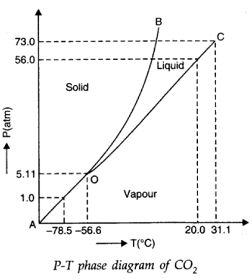
a. **No**, it condenses directly from vapour to solid.
b. It condenses directly into solid without passing through the liquid phase.
c. Solid $\text{CO}_2$ first melts into liquid, and upon further heating, vaporizes into gas.
d. Since $70^\circ\text{C}$ exceeds the critical temperature, $\text{CO}_2$ remains in the vapor state and cannot be liquefied by compression alone.
Why Class 11 Physics Chapter 10 Matters in NEET and JEE
Class 11 Physics Chapter 10, Thermal Properties of Matter, is important for NEET and JEE because it explains how substances respond to changes in temperature and how heat is transferred from one body to another. Students learn about temperature measurement, thermal expansion, specific heat capacity, calorimetry, change of state and different modes of heat transfer. These concepts are also useful for understanding Thermodynamics and the Kinetic Theory of Gases.
NEET frequently includes direct conceptual and formula-based questions involving thermal expansion, calorimetry, latent heat, heat transfer and Newton’s law of cooling. JEE commonly asks numerical and application-based questions related to expansion of solids and liquids, heat exchange, phase changes, conduction and radiation. Students must clearly understand the difference between heat and temperature and apply the principle of conservation of heat correctly. Strong knowledge of formulas, graphs, units and sign conventions helps students solve questions accurately.
Preparation Tips for Class 11 Physics Chapter 10
Begin by understanding the difference between heat and temperature. Study the Celsius, Fahrenheit and Kelvin temperature scales and learn how to convert temperature from one scale to another.
Revise the basic temperature relations:
$$T_K = T_C + 273.15$$
$$T_F = \frac{9}{5}T_C + 32$$
Study thermal expansion carefully. Learn the coefficients of linear, superficial and volume expansion:
$$\Delta L = \alpha L \Delta T$$
$$\Delta A = \beta A \Delta T$$
$$\Delta V = \gamma V \Delta T$$
For an isotropic solid, $\beta = 2\alpha$ and $\gamma = 3\alpha$.
Understand specific heat capacity and calorimetry using $Q = mc\Delta T$, applying the principle of heat exchange ($\text{Heat lost} = \text{Heat gained}$).
Study change of state and latent heat using $Q = mL$.
Study the three modes of heat transfer (conduction, convection, radiation). For heat conduction through a uniform slab:
$$\frac{Q}{t} = \frac{KA(T_1 – T_2)}{L}$$
Study Newton’s law of cooling and complete all NCERT examples and exercises before attempting NEET and JEE previous-year questions.
FAQs
1. What are the most important topics in Class 11 Physics Chapter 10?
The most important topics include temperature scales, thermal expansion, specific heat capacity, calorimetry, change of state, latent heat, heat transfer, thermal conductivity, radiation and Newton’s law of cooling.
2. What is the difference between heat and temperature?
Heat is the energy transferred from a body at a higher temperature to a body at a lower temperature. Temperature measures the degree of hotness or coldness of a body and determines the direction of heat flow.
3. What is thermal expansion?
Thermal expansion is the increase in the dimensions of a material when its temperature rises. It may occur as linear expansion, superficial expansion or volume expansion.
4. What is the coefficient of linear expansion?
The coefficient of linear expansion is the fractional change in length per unit rise in temperature:
$$\alpha = \frac{\Delta L}{L \Delta T}$$
Its SI unit is $\text{K}^{-1}$.
5. What is specific heat capacity?
Specific heat capacity is the amount of heat required to raise the temperature of unit mass of a substance by one kelvin:
$$c = \frac{Q}{m\Delta T}$$
Its SI unit is $\text{J kg}^{-1}\text{ K}^{-1}$.
6. What is the principle of calorimetry?
The principle of calorimetry states that in an isolated system, the heat lost by hotter bodies is equal to the heat gained by colder bodies until thermal equilibrium is reached.
7. What is latent heat?
Latent heat is the heat absorbed or released by a substance during a change of state without any change in temperature:
$$Q = mL$$
8. What are the three modes of heat transfer?
The three modes of heat transfer are conduction, convection and radiation. Conduction mainly occurs through solids, convection occurs through fluids, and radiation does not require any material medium.
9. What is Newton’s law of cooling?
Newton’s law of cooling states that the rate of loss of heat from a body is directly proportional to the temperature difference between the body and its surroundings, provided the temperature difference is small.
10. Is Class 11 Physics Chapter 10 important for NEET and JEE?
Yes. Thermal Properties of Matter is important for NEET and JEE. Questions are commonly based on thermal expansion, calorimetry, latent heat, heat conduction, radiation and Newton’s law of cooling. Regular formula revision and numerical practice are essential for scoring well.