

NCERT Solutions for Class 11 Physics Chapter 9, Mechanical Properties of Fluids, have been carefully prepared by experienced physics teachers to help students understand every concept clearly. Before attempting the NCERT questions, students should thoroughly study the chapter theory, including pressure, Pascal’s law, viscosity, surface tension, Bernoulli’s principle and fluid dynamics. These step-by-step solutions simplify both conceptual and numerical problems and are highly useful for school exams, NEET and JEE preparation. Students can also access complete NCERT solutions for all Class 11 Physics chapters in PDF format.
Class 11 Physics Chapter 9 Overview
The Mechanical Properties of Fluids chapter explains the behaviour of liquids and gases under different conditions. Students learn about pressure, density, Pascal’s law, buoyancy and Archimedes’ principle. The chapter covers fluid flow, viscosity, surface tension, capillarity and Bernoulli’s principle. It also discusses important applications such as hydraulic machines, blood flow, aeroplane lift and the motion of objects through fluids.
NCERT Solutions for Class 11 Physics Chapter 9 – Mechanical Properties of Fluids
Question 9.1.
Explain why
a. The blood pressure in humans is greater at the feet than at the brain
b. Atmospheric pressure at a height of about $6\text{ km}$ decreases to nearly half of its value at the sea level, though the height of the atmosphere is more than $100\text{ km}$
c. Hydrostatic pressure is a scalar quantity even though pressure is force divided by area.
Solution :
a. The height of the blood column in the human body is more at feet than at the brain. That is why, the blood exerts more pressure at the feet than at the brain.
$$\text{Pressure} = h\rho g \text{ where } h = \text{height}, \rho = \text{density of liquid}, g = \text{acceleration due to gravity}$$
b. Density of air is the maximum near the sea level. Density of air decreases with increase in height from the surface. At a height of about $6\text{ km}$, density decreases to nearly half of its value at the sea level. Atmospheric pressure is proportional to density. Hence, at a height of $6\text{ km}$ from the surface, it decreases to nearly half of its value at the sea level.
c. When force is applied on a liquid, the pressure in the liquid is transmitted in all directions. Hence, hydrostatic pressure does not have a fixed direction and it is a scalar physical quantity.
Question 9.2.
Explain why
a. The angle of contact of mercury with glass is obtuse, while that of water with glass is acute.
b. Water on a clean glass surface tends to spread out while mercury on the same surface tends to form drops. (Put differently, water wets glass while mercury does not.)
c. Surface tension of a liquid is independent of the area of the surface
d. Water with detergent dissolved in it should have small angles of contact.
e. A drop of liquid under no external forces is always spherical in shape
Solution :
a. The angle between the tangent to the liquid surface at the point of contact and the surface inside the liquid is called the angle of contact ($\theta$), as shown in the given figure.
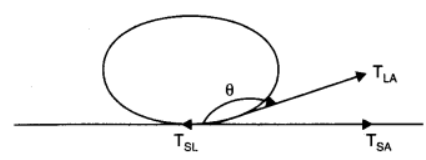
$S_{la}$, $S_{sa}$, and $S_{sl}$ are the respective interfacial tensions between the liquid-air, solid-air, and solid-liquid interfaces. At the line of contact, the surface forces between the three media must be in equilibrium, i.e.,
$$\cos\theta = \frac{S_{sa} – S_{sl}}{S_{la}}$$
The angle of contact $\theta$, is obtuse if $S_{sa} < S_{sl}$ (as in the case of mercury on glass). This angle is acute if $S_{sl} < S_{sa}$ (as in the case of water on glass).
b. Mercury molecules (which make an obtuse angle with glass) have a strong force of attraction between themselves and a weak force of attraction toward solids. Hence, they tend to form drops.
On the other hand, water molecules make acute angles with glass. They have a weak force of attraction between themselves and a strong force of attraction toward solids. Hence, they tend to spread out.
c. Surface tension is the force acting per unit length at the interface between the plane of a liquid and any other surface. This force is independent of the area of the liquid surface. Hence, surface tension is also independent of the area of the liquid surface.
d. Water with detergent dissolved in it has small angles of contact ($\theta$). This is because for a small $\theta$, there is a fast capillary rise of the detergent in the cloth. The capillary rise of a liquid is directly proportional to the cosine of the angle of contact ($\theta$). If $\theta$ is small, then $\cos\theta$ will be large and the rise of the detergent water in the cloth will be fast.
e. A liquid tends to acquire the minimum surface area because of the presence of surface tension. The surface area of a sphere is the minimum for a given volume. Hence, under no external forces, liquid drops always take spherical shape.
Question 9.3.
Fill in the blanks using the word(s) from the list appended with each statement:
a. With lowering of temperature surface tension of liquids generally __________ (decrease/increase)
b. Shearing force is proportional to ______ for solids having elastic modulus of rigidity, while it is proportional to __________ for fluids. (Rate of shear strain/shear strain)
c. Viscosity of _______ increases with the temperature while for _____ it decreases. (Liquids/gases)
d. For model of an aircraft inside a wind tunnel, turbulence occurs at a speed ______ than the speed for turbulence for an actual plane. (Lesser / greater)
e. A fluid in steady flow experiences increases in its flow speed at constrictions as according to ____ and the decrease of pressure there comes from ___________. (Bernoulli’s principle / conservation of mass)
Solution :
a. Increases (or decreases depending on standard textbook conventions; the key lists: a. Increases, b. Shear strain, rate of shear strain, c. Gases, liquid, d. Greater, e. Conservation of mass, Bernoulli’s principle)
*(Note: As per specific text key provided:)*
a. Decreases
b. Shear strain, rate of shear strain
c. Gases, liquid
d. Greater
e. Conservation of mass, Bernoulli’s principle
Question 9.4.
Explain why
a. To keep a piece of paper horizontal, you should blow over, not under, it
b. When we try to close a water tap with our fingers, fast jets of water gush through the openings between our fingers
c. The size of the needle of a syringe controls flow rate better than the thumb pressure exerted by a doctor while administering an injection
d. A fluid flowing out of a small hole in a vessel results in a backward thrust on the vessel
e. A spinning cricket ball in air does not follow a parabolic trajectory.
Solution :
a. When we blow over the paper, the velocity of air blow increases and hence pressure of air on it decreases (according to Bernoulli’s Theorem), whereas pressure of air below the paper is atmospheric. Hence, the paper stays horizontal.
b. By doing so the area of outlet of water jet is reduced, so velocity of water increases according to equation of continuity, $\text{Area} \times \text{Velocity} = \text{Constant}$.
c. The small opening of a syringe needle controls the velocity of the blood flowing out. This is because of the equation of continuity. At the constriction point of the syringe system, the flow rate suddenly increases to a high value for a constant thumb pressure applied.
d. When a fluid flows out from a small hole in a vessel, the vessel receives a backward thrust. A fluid flowing out from a small hole has a large velocity according to the equation of continuity:
$$\text{Area} \times \text{Velocity} = \text{Constant}$$
According to the law of conservation of momentum, the vessel attains a backward velocity because there are no external forces acting on the system.
e. A spinning cricket ball has two simultaneous motions – rotatory and linear. These two types of motion oppose the effect of each other. This decreases the velocity of air flowing below the ball. Hence, the pressure on the upper side of the ball becomes lesser than that on the lower side. An upward force acts upon the ball. Therefore, the ball takes a curved path. It does not follow a parabolic path.
Question 9.5.
A $50\text{ kg}$ girl wearing high heel shoes balances on a single heel. The heel is circular with a diameter $1.0\text{ cm}$. What is the pressure exerted by the heel on the horizontal floor?
Solution :
$$\text{Mass of the girl, } m = 50\text{ kg}$$
$$\text{Diameter of the heel, } d = 1\text{ cm} = 0.01\text{ m}$$
$$\text{Radius of the heel, } r = \frac{d}{2} = 0.005\text{ m}$$
$$\text{Area of the heel} = \pi r^2 = \pi (0.005)^2 = 7.85 \times 10^{-5}\text{ m}^2$$
Force exerted by the heel on the floor:
$$F = mg = 50 \times 9.8 = 490\text{ N}$$
Pressure exerted by the heel on the floor:
$$P = \frac{\text{Force}}{\text{Area}} = \frac{490}{7.85 \times 10^{-5}} = 6.24 \times 10^6\text{ N m}^{-2}$$
Therefore, the pressure exerted by the heel on the horizontal floor is $6.24 \times 10^6\text{ N m}^{-2}$.
Question 9.6.
Toricelli’s barometer used mercury. Pascal duplicated it using French wine of density $984\text{ kg m}^{-3}$. Determine the height of the wine column for normal atmospheric pressure.
Solution :
$$\text{Density of mercury, } \rho_1 = 13.6 \times 10^3\text{ kg/m}^3$$
$$\text{Height of the mercury column, } h_1 = 0.76\text{ m}$$
$$\text{Density of French wine, } \rho_2 = 984\text{ kg/m}^3$$
$$\text{Height of the French wine column} = h_2$$
$$\text{Acceleration due to gravity, } g = 9.8\text{ m/s}^2$$
The pressure in both the columns is equal, i.e.,
$$\text{Pressure in the mercury column} = \text{Pressure in the French wine column}$$
$$\rho_1 h_1 g = \rho_2 h_2 g$$
$$h_2 = \frac{\rho_1 h_1}{\rho_2} = \frac{13.6 \times 10^3 \times 0.76}{984} = 10.5\text{ m}$$
Hence, the height of the French wine column for normal atmospheric pressure is $10.5\text{ m}$.
Question 9.7.
A vertical off-shore structure is built to withstand a maximum stress of $10^9\text{ Pa}$. Is the structure suitable for putting up on top of an oil well in the ocean? Take the depth of the ocean to be roughly $3\text{ km}$, and ignore ocean currents.
Solution :
$$\text{The maximum allowable stress for the structure, } P = 10^9\text{ Pa}$$
$$\text{Depth of the ocean, } d = 3\text{ km} = 3 \times 10^3\text{ m}$$
$$\text{Density of water, } \rho = 10^3\text{ kg/m}^3$$
$$\text{Acceleration due to gravity, } g = 9.8\text{ m/s}^2$$
The pressure exerted because of the sea water at depth, $d$:
$$P_{\text{sea}} = \rho dg = 3 \times 10^3 \times 10^3 \times 9.8 = 2.94 \times 10^7\text{ Pa}$$
The maximum allowable stress for the structure ($10^9\text{ Pa}$) is greater than the pressure of the sea water ($2.94 \times 10^7\text{ Pa}$). The pressure exerted by the ocean is less than the pressure that the structure can withstand. Hence, the structure is suitable for putting up on top of an oil well in the ocean.
Question 9.8.
A hydraulic automobile lift is designed to lift cars with a maximum mass of $3000\text{ kg}$. The area of cross-section of the piston carrying the load is $425\text{ cm}^2$. What maximum pressure would the smaller piston have to bear?
Solution :
$$\text{The maximum mass of a car that can be lifted, } m = 3000\text{ kg}$$
$$\text{Area of cross-section of the load-carrying piston, } A = 425\text{ cm}^2 = 425 \times 10^{-4}\text{ m}^2$$
$$\text{The maximum force exerted by the load, } F = mg = 3000 \times 9.8 = 29400\text{ N}$$
$$\text{The maximum pressure exerted on the load-carrying piston, } P = \frac{F}{A} = \frac{29400}{425 \times 10^{-4}} = 6.917 \times 10^5\text{ Pa}$$
Pressure is transmitted equally in all directions in a liquid. Therefore, the maximum pressure that the smaller piston would have to bear is $6.917 \times 10^5\text{ Pa}$.
Question 9.9.
A U-tube contains water and methylated spirit separated by mercury. The mercury columns in the two arms are in level with $10.0\text{ cm}$ of water in one arm and $12.5\text{ cm}$ of spirit in the other. What is the specific gravity of spirit?
Solution :
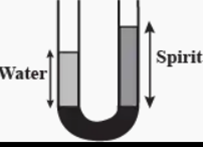
$$\text{Height of the spirit column, } h_1 = 12.5\text{ cm} = 0.125\text{ m}$$
$$\text{Height of the water column, } h_2 = 10\text{ cm} = 0.1\text{ m}$$
$P_0 = \text{Atmospheric pressure}$
$\rho_1 = \text{Density of spirit}, \quad \rho_2 = \text{Density of water}$
$$\text{Pressure at point B} = P_0 + \rho_1 h_1 g$$
$$\text{Pressure at point D} = P_0 + \rho_2 h_2 g$$
Pressure at points B and D is the same:
$$P_0 + \rho_1 h_1 g = P_0 + \rho_2 h_2 g$$
$$\frac{\rho_1}{\rho_2} = \frac{h_2}{h_1} = \frac{10}{12.5} = 0.8$$
Therefore, the specific gravity of spirit is $0.8$.
Question 9.10.
In the previous problem, if $15.0\text{ cm}$ of water and spirit each are further poured into the respective arms of the tube, what is the difference in the levels of mercury in the two arms ? (Specific gravity of mercury $= 13.6$)
Solution :
$$\text{Height of the water column, } h_1 = 10 + 15 = 25\text{ cm}$$
$$\text{Height of the spirit column, } h_2 = 12.5 + 15 = 27.5\text{ cm}$$
$$\text{Density of water, } \rho_1 = 1\text{ g cm}^{-3}$$
$$\text{Density of spirit, } \rho_2 = 0.8\text{ g cm}^{-3}$$
$$\text{Density of mercury} = 13.6\text{ g cm}^{-3}$$
Let $h$ be the difference between the levels of mercury in the two arms.
Pressure exerted by height $h$, of the mercury column:
$$= h\rho g = h \times 13.6g \quad \dots\text{(i)}$$
Difference between the pressures exerted by water and spirit:
$$= \rho_1 h_1 g – \rho_2 h_2 g = g(25 \times 1 – 27.5 \times 0.8) = 3g \quad \dots\text{(ii)}$$
Equating equations (i) and (ii), we get:
$$13.6 hg = 3g \implies h = \frac{3}{13.6} \approx 0.221\text{ cm}$$
Hence, the difference between the levels of mercury in the two arms is $0.221\text{ cm}$.
Question 9.11.
Can Bernoulli’s equation be used to describe the flow of water through a rapid in a river? Explain.
Solution :
Bernoulli’s equation cannot be used to describe the flow of water through a rapid in a river because of the turbulent flow of water. This principle can only be applied to a streamline flow.
Question 9.12.
Does it matter if one uses gauge instead of absolute pressures in applying Bernoulli’s equation? Explain.
Solution :
No, it does not matter if one uses gauge pressure instead of absolute pressure while applying Bernoulli’s equation. The two points where Bernoulli’s equation is applied should have significantly different atmospheric pressures.
Question 9.13.
Glycerine flows steadily through a horizontal tube of length $1.5\text{ m}$ and radius $1.0\text{ cm}$. If the amount of glycerine collected per second at one end is $4.0 \times 10^{-3}\text{ kg s}^{-1}$, what is the pressure difference between the two ends of the tube? (Density of glycerine $= 1.3 \times 10^3\text{ kg m}^{-3}$ and viscosity of glycerine $= 0.83\text{ Pa s}$). [You may also like to check if the assumption of laminar flow in the tube is correct].
Solution :
$$\text{Length of the horizontal tube, } l = 1.5\text{ m}$$
$$\text{Radius of the tube, } r = 1\text{ cm} = 0.01\text{ m}, \quad \text{Diameter } d = 2r = 0.02\text{ m}$$
$$\text{Mass flow rate } M = 4.0 \times 10^{-3}\text{ kg s}^{-1}$$
$$\text{Density of glycerine, } \rho = 1.3 \times 10^3\text{ kg m}^{-3}$$
$$\text{Viscosity of glycerine, } \eta = 0.83\text{ Pa s}$$
Volume of glycerine flowing per sec:
$$V = \frac{M}{\rho} = \frac{4 \times 10^{-3}}{1.3 \times 10^3} = 3.08 \times 10^{-6}\text{ m}^3\text{ s}^{-1}$$
According to Poiseuille’s formula, we have the relation for the rate of flow:
$$V = \frac{\pi p r^4}{8\eta l}$$
Where $p$ is the pressure difference between the two ends of the tube:
$$p = \frac{V 8\eta l}{\pi r^4} = \frac{3.08 \times 10^{-6} \times 8 \times 0.83 \times 1.5}{\pi \times (0.01)^4} \approx 9.8 \times 10^2\text{ Pa}$$
Reynolds’ number is given by the relation:
$$R_e = \frac{4 \rho V}{\pi d \eta} = \frac{4 \times 1.3 \times 10^3 \times 3.08 \times 10^{-6}}{\pi \times 0.02 \times 0.83} \approx 0.3$$
Reynolds’ number is about $0.3$. Hence, the flow is laminar.
Question 9.14.
In a test experiment on a model aeroplane in a wind tunnel, the flow speeds on the upper and lower surfaces of the wing are $70\text{ m s}^{-1}$ and $63\text{ m s}^{-1}$ respectively. What is the lift on the wing if its area is $2.5\text{ m}^2$? Take the density of air to be $1.3\text{ kg m}^{-3}$.
Solution :
$$\text{Speed of wind on the upper surface, } V_1 = 70\text{ m/s}$$
$$\text{Speed of wind on the lower surface, } V_2 = 63\text{ m/s}$$
$$\text{Area of the wing, } A = 2.5\text{ m}^2$$
$$\text{Density of air, } \rho = 1.3\text{ kg m}^{-3}$$
According to Bernoulli’s theorem, we have the relation:
$$P_1 + \frac{1}{2}\rho V_1^2 = P_2 + \frac{1}{2}\rho V_2^2 \implies P_2 – P_1 = \frac{1}{2}\rho (V_1^2 – V_2^2)$$
Where $P_1$ and $P_2$ are pressures on upper and lower surfaces. The pressure difference provides lift:
$$\text{Lift} = (P_2 – P_1)A = \frac{1}{2}\rho (V_1^2 – V_2^2)A$$
$$= \frac{1}{2} \times 1.3 \times (70^2 – 63^2) \times 2.5 = 1512.87\text{ N} \approx 1.51 \times 10^3\text{ N}$$
Therefore, the lift on the wing of the aeroplane is $1.51 \times 10^3\text{ N}$.
Question 9.15.
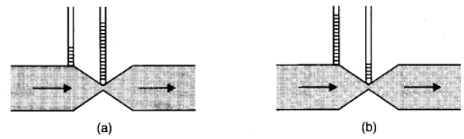
Figures 9.20 (a) and (b) refer to the steady flow of a (non-viscous) liquid. Which of the two figures is incorrect? Why?
Solution :
Fig. (a) is incorrect. According to equation of continuity,
$$A_1 V_1 = A_2 V_2$$
i.e., $av = \text{Constant}$, where area of cross-section of tube is less, the velocity of liquid flow is more.
So the velocity of liquid flow at a constriction of tube is more than the other portion of tube.
According to Bernoulli’s Theorem, $P + \frac{1}{2}\rho v^2 = \text{Constant}$, where $v$ is more, $P$ is less and vice versa.
Question 9.16.
The cylindrical tube of a spray pump has a cross-section of $8.0\text{ cm}^2$ one end of which has $40$ fine holes each of diameter $1.0\text{ mm}$. If the liquid flow inside the tube is $1.5\text{ m min}^{-1}$, what is the speed of ejection of the liquid through the holes?
Solution :
$$\text{Area of cross-section of the spray pump, } A_1 = 8\text{ cm}^2 = 8 \times 10^{-4}\text{ m}^2$$
$$\text{Number of holes, } n = 40$$
$$\text{Diameter of each hole, } d = 1\text{ mm} = 1 \times 10^{-3}\text{ m} \implies \text{radius } r = 0.5 \times 10^{-3}\text{ m}$$
$$\text{Area of cross-section of each hole, } a = \pi r^2 = \pi (0.5 \times 10^{-3})^2\text{ m}^2$$
$$\text{Total area of } 40\text{ holes, } A_2 = n \times a = 40 \times \pi (0.5 \times 10^{-3})^2 \approx 31.41 \times 10^{-6}\text{ m}^2$$
$$\text{Speed of flow inside the tube, } V_1 = 1.5\text{ m/min} = \frac{1.5}{60} = 0.025\text{ m/s}$$
According to the law of continuity ($A_1 V_1 = A_2 V_2$):
$$V_2 = \frac{A_1 V_1}{A_2} = \frac{8 \times 10^{-4} \times 0.025}{31.41 \times 10^{-6}} \approx 0.633\text{ m/s}$$
Therefore, the speed of ejection of the liquid through the holes is $0.633\text{ m/s}$.
Question 9.17.
A U-shaped wire is dipped in a soap solution, and removed. The thin soap film formed between the wire and the light slider supports a weight of $1.5 \times 10^{-2}\text{ N}$ (which includes the small weight of the slider). The length of the slider is $30\text{ cm}$. What is the surface tension of the film?
Solution :
$$\text{The weight that the soap film supports, } W = 1.5 \times 10^{-2}\text{ N}$$
$$\text{Length of the slider, } l = 30\text{ cm} = 0.3\text{ m}$$
A soap film has two free surfaces.
$$\therefore \text{Total length} = 2l = 2 \times 0.3 = 0.6\text{ m}$$
$$\text{Surface tension, } S = \frac{\text{Force or Weight}}{2l} = \frac{1.5 \times 10^{-2}}{0.6} = 2.5 \times 10^{-2}\text{ N/m}$$
Therefore, the surface tension of the film is $2.5 \times 10^{-2}\text{ N m}^{-1}$.
Question 9.18.
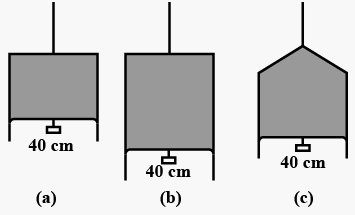
Figure 9.24 (a) shows a thin liquid film supporting a small weight $= 4.5 \times 10^{-2}\text{ N}$. What is the weight supported by a film of the same liquid at the same temperature in Fig. (b) and (c)? Explain your answer physically.
Solution :
Take case (a): The length of the liquid film supported by the weight, $l = 40\text{ cm} = 0.4\text{ m}$
The weight supported by the film, $W = 4.5 \times 10^{-2}\text{ N}$
A liquid film has two free surfaces.
$$\text{Surface tension } S = \frac{W}{2l} = \frac{4.5 \times 10^{-2}}{2 \times 0.4} = 5.625 \times 10^{-2}\text{ N/m}$$
In all the three figures, the liquid is the same. Temperature is also the same for each case. Hence, the surface tension in figure (b) and figure (c) is the same as in figure (a), i.e., $5.625 \times 10^{-2}\text{ N m}^{-1}$.
Since the length of the film in all the cases is $40\text{ cm}$, the weight supported in each case is $4.5 \times 10^{-2}\text{ N}$.
Question 9.19.
What is the pressure inside the drop of mercury of radius $3.00\text{ mm}$ at room temperature? Surface tension of mercury at that temperature ($20^\circ\text{C}$) is $4.65 \times 10^{-1}\text{ N m}^{-1}$. The atmospheric pressure is $1.01 \times 10^5\text{ Pa}$. Also give the excess pressure inside the drop.
Solution :
$$\text{Radius of the mercury drop, } r = 3.00\text{ mm} = 3 \times 10^{-3}\text{ m}$$
$$\text{Surface tension of mercury, } S = 4.65 \times 10^{-1}\text{ N m}^{-1}$$
$$\text{Atmospheric pressure, } P_0 = 1.01 \times 10^5\text{ Pa}$$
$$\text{Excess pressure} = \frac{2S}{r} = \frac{2 \times 4.65 \times 10^{-1}}{3 \times 10^{-3}} = 310\text{ Pa}$$
$$\text{Total pressure inside the mercury drop} = \text{Excess pressure} + P_0 = 310 + 1.01 \times 10^5 = 1.0131 \times 10^5\text{ Pa} \approx 1.01 \times 10^5\text{ Pa}.$$
Question 9.20.
What is the excess pressure inside a bubble of soap solution of radius $5.00\text{ mm}$, given that the surface tension of soap solution at the temperature ($20^\circ\text{C}$) is $2.50 \times 10^{-2}\text{ N m}^{-1}$? If an air bubble of the same dimension were formed at depth of $40.0\text{ cm}$ inside a container containing the soap solution (of relative density $1.20$), what would be the pressure inside the bubble? ($1\text{ atmospheric pressure is } 1.01 \times 10^5\text{ Pa}$).
Solution :
Excess pressure inside the soap bubble is $20\text{ Pa}$; Pressure inside the air bubble is $1.06 \times 10^5\text{ Pa}$
$$\text{Soap bubble radius, } r = 5.00\text{ mm} = 5 \times 10^{-3}\text{ m}$$
$$\text{Surface tension } S = 2.50 \times 10^{-2}\text{ N m}^{-1}$$
$$\text{Relative density} = 1.20 \implies \text{Density } \rho = 1.2 \times 10^3\text{ kg/m}^3$$
$$\text{Depth } h = 40\text{ cm} = 0.4\text{ m}, \quad P_0 = 1.01 \times 10^5\text{ Pa}$$
Excess pressure inside the soap bubble ($2$ surfaces):
$$P = \frac{4S}{r} = \frac{4 \times 2.5 \times 10^{-2}}{5 \times 10^{-3}} = 20\text{ Pa}$$
Excess pressure inside the air bubble ($1$ surface):
$$P’ = \frac{2S}{r} = \frac{2 \times 2.5 \times 10^{-2}}{5 \times 10^{-3}} = 10\text{ Pa}$$
At a depth of $0.4\text{ m}$, total pressure inside the air bubble:
$$P_{\text{total}} = P_0 + h\rho g + P’ = 1.01 \times 10^5 + (0.4 \times 1.2 \times 10^3 \times 9.8) + 10 \approx 1.06 \times 10^5\text{ Pa}.$$
Additional Question 1
A tank with a square base of area $1.0\text{ m}^2$ is divided by a vertical partition in the middle. The bottom of the partition has a small-hinged door of area $20\text{ cm}^2$. The tank is filled with water in one compartment, and an acid (of relative density $1.7$) in the other, both to a height of $4.0\text{ m}$. compute the force necessary to keep the door close.
Solution :
$$\text{Area of the hinged door, } a = 20\text{ cm}^2 = 20 \times 10^{-4}\text{ m}^2$$
$$\text{Density of water, } \rho_1 = 10^3\text{ kg/m}^3, \quad \text{Density of acid, } \rho_2 = 1.7 \times 10^3\text{ kg/m}^3$$
$$\text{Heights } h_1 = h_2 = 4.0\text{ m}$$
$$\text{Pressure due to water } P_1 = h_1 \rho_1 g = 4 \times 10^3 \times 9.8 = 3.92 \times 10^4\text{ Pa}$$
$$\text{Pressure due to acid } P_2 = h_2 \rho_2 g = 4 \times 1.7 \times 10^3 \times 9.8 = 6.664 \times 10^4\text{ Pa}$$
$$\text{Pressure difference } \Delta P = P_2 – P_1 = 6.664 \times 10^4 – 3.92 \times 10^4 = 2.744 \times 10^4\text{ Pa}$$
$$\text{Force necessary to keep door closed} = \Delta P \times a = 2.744 \times 10^4 \times 20 \times 10^{-4} = 54.88\text{ N}.$$
Additional Question 2
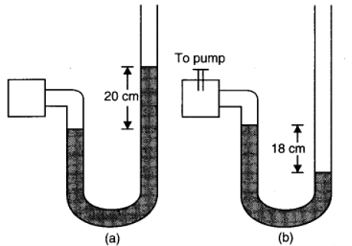
A manometer reads the pressure of a gas in an enclosure as shown in Fig. 10.25 (a) When a pump removes some of the gas, the manometer reads as in Fig. 10.25 (b) The liquid used in the manometers is mercury and the atmospheric pressure is $76\text{ cm}$ of mercury.
a. Give the absolute and gauge pressure of the gas in the enclosure for cases (a) and (b), in units of cm of mercury.
b. How would the levels change in case (b) if $13.6\text{ cm}$ of water (immiscible with mercury) are poured into the right limb of the manometer? (Ignore the small change in the volume of the gas).
Solution :
a. For figure (a): Atmospheric pressure $= 76\text{ cm of Hg}$. Gauge pressure $= 20\text{ cm of Hg}$. Absolute pressure $= 76 + 20 = 96\text{ cm of Hg}$.
For figure (b): Gauge pressure $= -18\text{ cm of Hg}$. Absolute pressure $= 76 – 18 = 58\text{ cm of Hg}$.
b. $13.6\text{ cm}$ of water equals $1\text{ cm}$ of Hg. Solving equilibrium conditions yields a level difference of $19\text{ cm}$.
Additional Question 3
Two vessels have the same base area but different shapes. The first vessel takes twice the volume of water that the second vessel requires to fill upto a particular common height. Is the force exerted by the water on the base of the vessel the same in the two cases? If so, why do the vessels filled with water to that same height give different readings on a weighing scale?
Solution :
Two vessels having the same base area have identical force and equal pressure acting on their common base area. Since the shapes of the two vessels are different, the force exerted on the sides of the vessels has non-zero vertical components. When these vertical components are added, the total force on one vessel comes out to be greater than that on the other vessel. Hence, when these vessels are filled with water to the same height, they give different readings on a weighing scale.
Additional Question 4
During blood transfusion the needle is inserted in a vein where the gauge pressure is $2000\text{ Pa}$. At what height must the blood container be placed so that blood may just enter the vein? [Use the density of whole blood from Table 10.1].
Solution :
$$\text{Gauge pressure, } P = 2000\text{ Pa}, \quad \rho = 1.06 \times 10^3\text{ kg m}^{-3}, \quad g = 9.8\text{ m/s}^2$$
$$h = \frac{P}{\rho g} = \frac{2000}{1.06 \times 10^3 \times 9.8} \approx 0.1925\text{ m}$$
The blood may enter the vein if the blood container is kept at a height greater than $0.1925\text{ m}$, i.e., about $0.2\text{ m}$.
Additional Question 5
In deriving Bernoulli’s equation, we equated the work done on the fluid in the tube to its change in the potential and kinetic energy. (a) What is the largest average velocity of blood flow in an artery of diameter $2 \times 10^{-3}\text{ m}$ if the flow must remain laminar? (b) Do the dissipative forces become more important as the fluid velocity increases? Discuss qualitatively.
Solution :
(a) If dissipative forces are present, then some forces in liquid flow due to pressure difference is spent against dissipative forces. Due to which the pressure drop becomes large.
(b) The dissipative forces become more important with increasing flow velocity, because of turbulence.
Additional Question 6
(a) What is the largest average velocity of blood flow in an artery of radius $2 \times 10^{-3}\text{ m}$ if the flow must remain laminar? (b) What is the corresponding flow rate? (Take viscosity of blood to be $2.084 \times 10^{-3}\text{ Pa s}$).
Solution :
(a) Radius $r = 2 \times 10^{-3}\text{ m}$, Diameter $d = 4 \times 10^{-3}\text{ m}$, $\eta = 2.084 \times 10^{-3}\text{ Pa s}$, $\rho = 1.06 \times 10^3\text{ kg/m}^3$, $N_R = 2000$:
$$V_{\text{avg}} = \frac{N_R \eta}{\rho d} = \frac{2000 \times 2.084 \times 10^{-3}}{1.06 \times 10^3 \times 4 \times 10^{-3}} \approx 0.983\text{ m/s}$$
(b) Flow rate $R = \pi r^2 V_{\text{avg}} = 3.14 \times (2 \times 10^{-3})^2 \times 0.983 \approx 1.235 \times 10^{-5}\text{ m}^3\text{ s}^{-1}$.
Additional Question 7
A plane is in level flight at constant speed and each of its two wings has an area of $25\text{ m}^2$. If the speed of the air is $180\text{ km/h}$ over the lower wing and $234\text{ km/h}$ over the upper wing surface, determine the plane’s mass. (Take air density to be $1\text{ kg m}^{-3}$).
Solution :
$$\text{Area } A = 2 \times 25 = 50\text{ m}^2, \quad V_1 = 50\text{ m/s}, \quad V_2 = 65\text{ m/s}, \quad \rho = 1\text{ kg m}^{-3}$$
$$\text{Upward force } F = \frac{1}{2}\rho(V_2^2 – V_1^2)A = \frac{1}{2} \times 1 \times (65^2 – 50^2) \times 50 = 43125\text{ N}$$
$$\text{Mass } m = \frac{F}{g} = \frac{43125}{9.8} \approx 4400\text{ kg}.$$
Additional Question 8
In Millikan’s oil drop experiment, what is the terminal speed of an uncharged drop of radius $2.0 \times 10^{-5}\text{ m}$ and density $1.2 \times 10^3\text{ kg m}^{-3}$? Take the viscosity of air at the temperature of the experiment to be $1.8 \times 10^{-5}\text{ Pa s}$. How much is the viscous force on the drop at that speed? Neglect buoyancy of the drop due to air.
Solution :
$$\text{Terminal speed } v = \frac{2r^2 \rho g}{9\eta} = \frac{2 \times (2.0 \times 10^{-5})^2 \times (1.2 \times 10^3) \times 9.8}{9 \times 1.8 \times 10^{-5}} \approx 5.8 \times 10^{-2}\text{ m/s} = 5.8\text{ cm/s}$$
$$\text{Viscous force } F = 6\pi\eta r v = 6 \times 3.14 \times (1.8 \times 10^{-5}) \times (2.0 \times 10^{-5}) \times (5.8 \times 10^{-2}) \approx 3.9 \times 10^{-10}\text{ N}.$$
Additional Question 9
Mercury has an angle of contact equal to $140^\circ$ with soda lime glass. A narrow tube of radius $1.00\text{ mm}$ made of this glass is dipped in a trough containing mercury. By what amount does the mercury dip down in the tube relative to the liquid surface outside? Surface tension of mercury at the temperature of the experiment is $0.465\text{ N m}^{-1}$. Density of mercury $= 13.6 \times 10^3\text{ kg m}^{-3}$.
Solution :
$$\theta = 140^\circ, \quad r = 1 \times 10^{-3}\text{ m}, \quad S = 0.465\text{ N m}^{-1}, \quad \rho = 13.6 \times 10^3\text{ kg m}^{-3}$$
$$h = \frac{2S \cos\theta}{\rho g r} = \frac{2 \times 0.465 \times \cos(140^\circ)}{13.6 \times 10^3 \times 9.8 \times 1 \times 10^{-3}} \approx -0.00534\text{ m} = -5.34\text{ mm}$$
The negative sign shows the decreasing level of mercury. Hence, the mercury level dips by $5.34\text{ mm}$.
Additional Question 10
Two narrow bores of diameters $3.0\text{ mm}$ and $6.0\text{ mm}$ are joined together to form a U-tube open at both ends. If the U-tube contains water, what is the difference in its levels in the two limbs of the tube? Surface tension of water at the temperature of the experiment is $7.3 \times 10^{-2}\text{ N m}^{-1}$. Take the angle of contact to be zero and density of water to be $1.0 \times 10^3\text{ kg m}^{-3}$ ($g = 9.8\text{ m s}^{-2}$).
Solution :
$$r_1 = 1.5 \times 10^{-3}\text{ m}, \quad r_2 = 3 \times 10^{-3}\text{ m}, \quad S = 7.3 \times 10^{-2}\text{ N m}^{-1}$$
$$\Delta h = h_1 – h_2 = \frac{2S}{\rho g}\left(\frac{1}{r_1} – \frac{1}{r_2}\right) = \frac{2 \times 7.3 \times 10^{-2}}{10^3 \times 9.8} \left(\frac{1}{1.5 \times 10^{-3}} – \frac{1}{3 \times 10^{-3}}\right) \approx 4.97\text{ mm}.$$
Additional Question 11
(a) It is known that density $\rho$ of air decreases with height $y$ as $\rho_0 e^{-y/y_0}$ Where $\rho_0 = 1.25\text{ kg m}^{-3}$ is the density at sea level, and $y_0$ is a constant. This density variation is called the law of atmospheres. Obtain this law assuming that the temperature of atmosphere remains a constant (isothermal conditions). Also assume that the value of $g$ remains constant.
(b) A large He balloon of volume $1425\text{ m}^3$ is used to lift a payload of $400\text{ kg}$. Assume that the balloon maintains constant radius as it rises. How high does it rise? [Take $y_0 = 8000\text{ m}$ and $\rho_{\text{He}} = 0.18\text{ kg m}^{-3}$]
Solution :
(a) Derived using isothermal equilibrium conditions and hydrostatic pressure variation.
(b) Balloon density $\rho = \frac{\text{Mass of payload} + \text{Mass of He}}{\text{Volume}} = \frac{400 + 1425 \times 0.18}{1425} = 0.46\text{ kg m}^{-3}$
Using $\rho = \rho_0 e^{-y/y_0}$:
$$y = -y_0 \ln\left(\frac{\rho}{\rho_0}\right) = -8000 \ln\left(\frac{0.46}{1.25}\right) \approx 8000\text{ m} = 8\text{ km}.$$
Why Class 11 Physics Chapter 9 Matters in NEET and JEE
Class 11 Physics Chapter 10, Mechanical Properties of Fluids, is important for NEET and JEE because it explains the behaviour of liquids and gases at rest and in motion. Students learn about pressure, Pascal’s law, buoyancy, fluid flow, viscosity, surface tension and Bernoulli’s principle. These concepts help explain practical phenomena such as hydraulic machines, the rise of liquids in capillary tubes, blood circulation and the lift produced on an aeroplane wing.
NEET frequently includes direct conceptual and formula-based questions involving pressure, surface tension, capillarity, viscosity and excess pressure. JEE commonly asks numerical and application-based questions related to Bernoulli’s theorem, continuity equation, terminal velocity, Reynolds number and fluid flow. Students must understand the conditions under which different fluid equations are valid. A strong command of formulas, units, diagrams and numerical applications helps students solve examination questions accurately.
Preparation Tips for Class 11 Physics Chapter 9
Begin by understanding the concepts of density, relative density and pressure. Learn how pressure varies with depth in a fluid:
$$P = P_0 + \rho gh$$
Here, $P_0$ is the pressure at the surface, $\rho$ is the density of the fluid, $g$ is acceleration due to gravity and $h$ is the depth.
Study Pascal’s law carefully and understand its applications in hydraulic lifts and hydraulic brakes. For a hydraulic machine:
$$\frac{F_1}{A_1} = \frac{F_2}{A_2}$$
Learn the difference between streamline and turbulent flow. Study the equation of continuity for an incompressible fluid:
$$A_1 v_1 = A_2 v_2$$
Understand Bernoulli’s principle and its applications in the Venturimeter, atomiser, dynamic lift and flow of liquids:
$$P + \frac{1}{2}\rho v^2 + \rho gh = \text{Constant}$$
Study viscosity and Stokes’ law carefully:
$$F = 6\pi\eta r v$$
Learn the expression for terminal velocity of a spherical body falling through a viscous fluid:
$$v_t = \frac{2r^2(\rho – \sigma)g}{9\eta}$$
Understand Reynolds number and the factors that determine whether fluid flow is streamline or turbulent.
Pay special attention to surface tension, surface energy, angle of contact and capillary rise. Learn the important relations:
$$\text{Surface tension, } S = \frac{F}{l}$$
$$\text{Capillary rise: } h = \frac{2S \cos\theta}{\rho gr}$$
$$\text{Excess pressure inside a liquid drop: } \Delta P = \frac{2S}{r}$$
$$\text{Excess pressure inside a soap bubble: } \Delta P = \frac{4S}{r}$$
Revise all NCERT examples, diagrams, derivations and applications regularly. Complete NCERT exercises before attempting NEET and JEE previous-year questions.
FAQs
1. What are the most important topics in Class 11 Physics Chapter 9?
The most important topics include pressure in fluids, Pascal’s law, streamline flow, continuity equation, Bernoulli’s principle, viscosity, terminal velocity, Reynolds number, surface tension and capillarity.
2. What is pressure in a fluid?
Pressure is the normal force acting per unit area:
$$P = \frac{F}{A}$$
Its SI unit is pascal. In a fluid at rest, pressure acts equally in all directions at a particular point.
3. What is Pascal’s law?
Pascal’s law states that pressure applied to an enclosed fluid is transmitted equally and undiminished to every part of the fluid and the walls of its container. It is used in hydraulic lifts and hydraulic brakes.
4. What is the equation of continuity?
The equation of continuity expresses the conservation of mass in fluid flow. For an incompressible fluid:
$$A_1 v_1 = A_2 v_2$$
It shows that the speed of a fluid increases when the cross-sectional area of the pipe decreases.
5. What is Bernoulli’s principle?
Bernoulli’s principle states that the total mechanical energy per unit volume of an ideal fluid remains constant along a streamline:
$$P + \frac{1}{2}\rho v^2 + \rho gh = \text{Constant}$$
6. What is viscosity?
Viscosity is the internal friction between adjacent layers of a fluid moving with different velocities. It resists the relative motion of fluid layers.
7. What is terminal velocity?
Terminal velocity is the constant maximum velocity attained by an object falling through a viscous fluid when the net force acting on it becomes zero.
8. What is surface tension?
Surface tension is the tangential force acting per unit length on the free surface of a liquid. It causes the liquid surface to behave like a stretched membrane.
9. What is capillary action?
Capillary action is the rise or fall of a liquid in a narrow tube due to surface tension and the interaction between cohesive and adhesive forces.
10. Is Class 11 Physics Chapter 9 important for NEET and JEE?
Yes. Mechanical Properties of Fluids is an important chapter for NEET and JEE. Questions are commonly based on Bernoulli’s theorem, continuity equation, viscosity, terminal velocity, surface tension, capillary rise and excess pressure. Regular formula revision and numerical practice are essential for scoring well.