
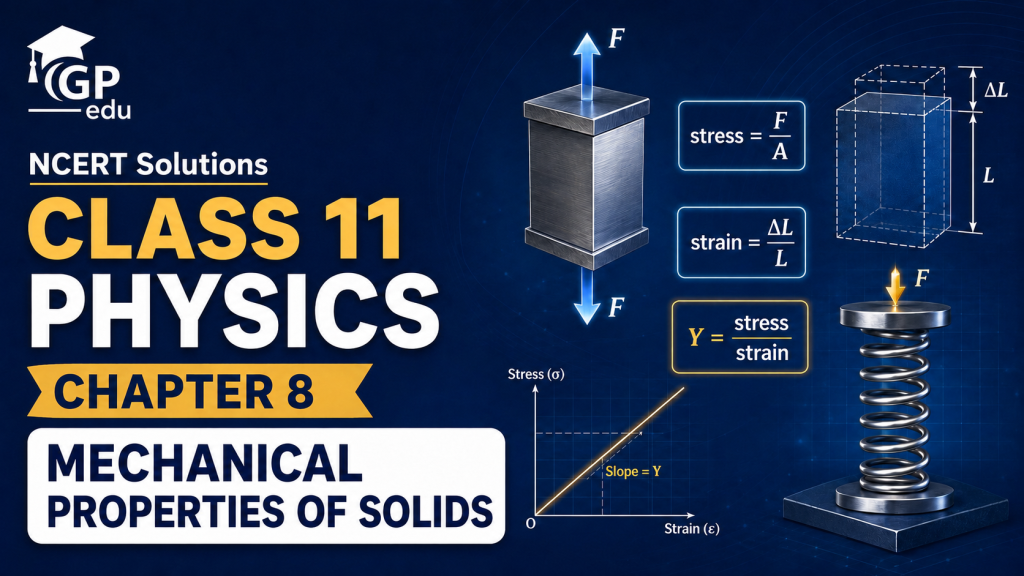
NCERT Solutions for Class 11 Physics Chapter 8, Mechanical Properties of Solids, have been carefully prepared by experienced physics teachers to help students understand every concept clearly. Before attempting the NCERT questions, students should study the chapter theory thoroughly, including elasticity, stress, strain, Hooke’s law, elastic moduli and stress-strain curves. These step-by-step solutions make both conceptual and numerical problems easier to understand and are useful for school exams, NEET and JEE preparation.
Class 11 Physics Chapter 8 Overview
The Mechanical Properties of Solids chapter explains how solid materials respond to external forces. Students learn about elasticity, stress, strain, Hooke’s law and the elastic behaviour of materials. The chapter covers Young’s modulus, bulk modulus, shear modulus and Poisson’s ratio. It also discusses the stress-strain curve, elastic potential energy and the practical applications of elasticity in buildings, bridges and engineering structures.
NCERT Solutions for Class 11 Physics
Chapter 8 – Mechanical Properties of Solids
Question 8.1.
A steel wire of length $4.7\text{ m}$ and cross-sectional area $3.0 \times 10^{-5}\text{ m}^2$ stretches by the same amount as a copper wire of length $3.5\text{ m}$ and cross-sectional area of $4.0 \times 10^{-5}\text{ m}^2$ under a given load. What is the ratio of the Young’s modulus of steel to that of copper?
Solution :
$$\text{Length of the steel wire, } L_1 = 4.7\text{ m}$$
$$\text{Area of cross-section of the steel wire, } A_1 = 3.0 \times 10^{-5}\text{ m}^2$$
$$\text{Length of the copper wire, } L_2 = 3.5\text{ m}$$
$$\text{Area of cross-section of the copper wire, } A_2 = 4.0 \times 10^{-5}\text{ m}^2$$
$$\text{Change in length} = \Delta L_1 = \Delta L_2 = \Delta L$$
$$\text{Force applied in both the cases} = F$$
Young’s modulus of the steel wire:
$$Y_1 = \left(\frac{F_1}{A_1}\right)\left(\frac{L_1}{\Delta L_1}\right) = \left(\frac{F}{3 \times 10^{-5}}\right)\left(\frac{4.7}{\Delta L}\right) \quad \dots\text{(i)}$$
Young’s modulus of the copper wire:
$$Y_2 = \left(\frac{F_2}{A_2}\right)\left(\frac{L_2}{\Delta L_2}\right) = \left(\frac{F}{4 \times 10^{-5}}\right)\left(\frac{3.5}{\Delta L}\right) \quad \dots\text{(ii)}$$
Dividing (i) by (ii), we get:
$$\frac{Y_1}{Y_2} = \frac{4.7 \times 4 \times 10^{-5}}{3 \times 10^{-5} \times 3.5} = 1.79 : 1$$
The ratio of Young’s modulus of steel to that of copper is $1.79 : 1$.
Question 8.2.
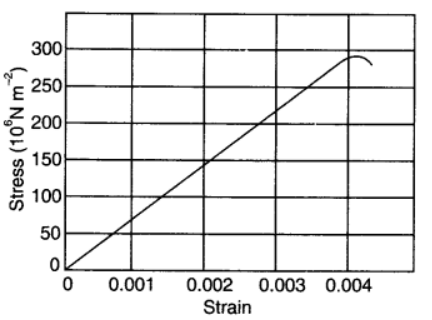
Figure 8.11 shows the strain-stress curve for a given material. What are
a. Young’s modulus and
b. approximate yield strength for this material?
Solution :
(a) It is clear from the given graph that for stress $150 \times 10^6\text{ N/m}^2$, strain is $0.002$.
$$\therefore \text{Young’s modulus, } Y = \frac{\text{Stress}}{\text{Strain}} = \frac{150 \times 10^6}{0.002} = 7.5 \times 10^{10}\text{ N m}^{-2}$$
Hence, Young’s modulus for the given material is $7.5 \times 10^{10}\text{ N/m}^2$.
(b) The yield strength of a material is the maximum stress that the material can sustain without crossing the elastic limit.
It is clear from the given graph that the approximate yield strength of this material is $300 \times 10^6\text{ N/m}^2$ or $3 \times 10^8\text{ N/m}^2$.
Question 8.3.
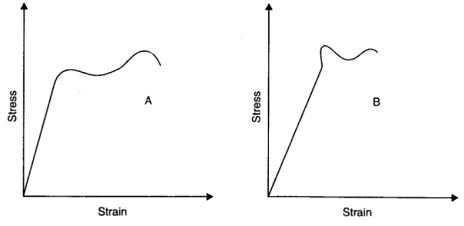
The stress-strain graphs for materials A and B are shown in Fig. 8.12. The graphs are drawn to the same scale.
(a) Which of the materials has the greater Young’s modulus?
(b) Which of the two is the stronger material?
Solution :
(a) From the two graphs we note that for a given strain, stress for A is more than that of B. Hence, Young’s modulus $\left(=\frac{\text{stress}}{\text{strain}}\right)$ is greater for A than that of B.
(b) A is stronger than B. Strength of a material is measured by the amount of stress required to cause fracture, corresponding to the point of fracture.
Question 8.4.
Read the following two statements below carefully and state, with reasons, if it is true or false.
(a) The Young’s modulus of rubber is greater than that of steel;
(b) The stretching of a coil is determined by its shear modulus.
Solution :
(a) False, because for given stress there is more strain in rubber than steel and modulus of elasticity is inversely proportional to strain.
(b) True, because the stretching of coil simply changes its shape without any change in the length of the wire used in the coil due to which shear modulus of elasticity is involved.
Question 8.5.
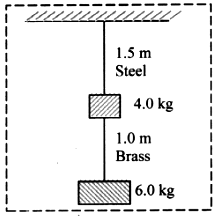
Two wires of diameter $0.25\text{ cm}$, one made of steel and the other made of brass are loaded as shown in Fig. 9.13. The unloaded length of steel wire is $1.5\text{ m}$ and that of brass wire is $1.0\text{ m}$. Compute the elongations of the steel and the brass wires.
Solution :
$$\text{Elongation of the steel wire} = 1.49 \times 10^{-4}\text{ m}$$
$$\text{Elongation of the brass wire} = 1.3 \times 10^{-4}\text{ m}$$
$$\text{Diameter of the wires, } d = 0.25\text{ cm}$$
$$\text{Hence, the radius of the wires, } r = \frac{d}{2} = 0.125\text{ cm}$$
$$\text{Length of the steel wire, } L_1 = 1.5\text{ m}$$
$$\text{Length of the brass wire, } L_2 = 1.0\text{ m}$$
Total force exerted on the steel wire:
$$F_1 = (4 + 6)g = 10 \times 9.8 = 98\text{ N}$$
Young’s modulus for steel:
$$Y_1 = \frac{F_1 / A_1}{\Delta L_1 / L_1}$$
Where,
$\Delta L_1 = \text{Change in the length of the steel wire}$
$A_1 = \text{Area of cross-section of the steel wire} = \pi r_1^2$
Young’s modulus of steel, $Y_1 = 2.0 \times 10^{11}\text{ Pa}$
$$\therefore \Delta L_1 = \frac{F_1 \times L_1}{A_1 \times Y_1} = \frac{98 \times 1.5}{\pi (0.125 \times 10^{-2})^2 \times 2 \times 10^{11}} = 1.49 \times 10^{-4}\text{ m}$$
Total force on the brass wire:
$$F_2 = 6 \times 9.8 = 58.8\text{ N}$$
Young’s modulus for brass:
$$Y_2 = \frac{F_2 / A_2}{\Delta L_2 / L_2}$$
Where,
$\Delta L_2 = \text{Change in the length of the brass wire}$
$A_2 = \text{Area of cross-section of the brass wire} = \pi r_2^2$
$$\therefore \Delta L_2 = \frac{F_2 \times L_2}{A_2 \times Y_2} = \frac{58.8 \times 1}{\pi \times (0.125 \times 10^{-2})^2 \times (0.91 \times 10^{11})} = 1.3 \times 10^{-4}\text{ m}$$
$$\text{Elongation of the steel wire} = 1.49 \times 10^{-4}\text{ m}$$
$$\text{Elongation of the brass wire} = 1.3 \times 10^{-4}\text{ m}.$$
Question 8.6.
The edge of an aluminium cube is $10\text{ cm}$ long. One face of the cube is firmly fixed to a vertical wall. A mass of $100\text{ kg}$ is then attached to the opposite face of the cube. The shear modulus of aluminium is $25\text{ GPa}$. What is the vertical deflection of this face?
Solution :
$$\text{Edge of the aluminium cube, } L = 10\text{ cm} = 0.1\text{ m}$$
$$\text{The mass attached to the cube, } m = 100\text{ kg}$$
$$\text{Shear modulus } (\eta) \text{ of aluminium} = 25\text{ GPa} = 25 \times 10^9\text{ Pa}$$
$$\text{Shear modulus, } \eta = \frac{\text{Shear stress}}{\text{Shear strain}} = \frac{F / A}{L / \Delta L}$$
Where,
$F = \text{Applied force} = mg = 100 \times 9.8 = 980\text{ N}$
$A = \text{Area of one of the faces of the cube} = 0.1 \times 0.1 = 0.01\text{ m}^2$
$\Delta L = \text{Vertical deflection of the cube}$
$$\therefore \Delta L = \frac{FL}{A\eta} = \frac{980 \times 0.1}{10^{-2} \times (25 \times 10^9)} = 3.92 \times 10^{-7}\text{ m}$$
The vertical deflection of this face of the cube is $3.92 \times 10^{-7}\text{ m}$.
Question 8.7.
Four identical hollow cylindrical columns of mild steel support a big structure of mass $50,000\text{ kg}$. The inner and outer radii of each column are $30\text{ cm}$ and $60\text{ cm}$ respectively. Assuming the load distribution to be uniform, calculate the compressional strain of each column.
Solution :
$$\text{Mass of the big structure, } M = 50,000\text{ kg}$$
$$\text{Inner radius of the column, } r = 30\text{ cm} = 0.3\text{ m}$$
$$\text{Outer radius of the column, } R = 60\text{ cm} = 0.6\text{ m}$$
$$\text{Young’s modulus of steel, } Y = 2 \times 10^{11}\text{ Pa}$$
$$\text{Total force exerted, } F = Mg = 50000 \times 9.8\text{ N}$$
$$\text{Force exerted on a single column} = \frac{50000 \times 9.8}{4} = 122500\text{ N}$$
$$\text{Young’s modulus, } Y = \frac{\text{Stress}}{\text{Strain}} \implies \text{Strain} = \frac{F / A}{Y}$$
Where,
$$\text{Area, } A = \pi(R^2 – r^2) = \pi((0.6)^2 – (0.3)^2)$$
$$\text{Strain} = \frac{122500}{\pi ((0.6)^2 – (0.3)^2) \times 2 \times 10^{11}} = 7.22 \times 10^{-7}$$
Hence, the compressional strain of each column is $7.22 \times 10^{-7}$.
Question 8.8.
A piece of copper having a rectangular cross-section of $15.2\text{ mm} \times 19.1\text{ mm}$ is pulled in tension with $44,500\text{ N}$ force, producing only elastic deformation. Calculate the resulting strain?
Solution :
$$\text{Length of the piece of copper, } l = 19.1\text{ mm} = 19.1 \times 10^{-3}\text{ m}$$
$$\text{Breadth of the piece of copper, } b = 15.2\text{ mm} = 15.2 \times 10^{-3}\text{ m}$$
Area of the copper piece:
$$A = l \times b = 19.1 \times 10^{-3} \times 15.2 \times 10^{-3} = 2.9 \times 10^{-4}\text{ m}^2$$
$$\text{Tension force applied on the piece of copper, } F = 44500\text{ N}$$
$$\text{Modulus of elasticity of copper, } \eta = 42 \times 10^9\text{ N/m}^2$$
$$\text{Modulus of elasticity, } \eta = \frac{\text{Stress}}{\text{Strain}} = \frac{F / A}{\text{Strain}}$$
$$\therefore \text{Strain} = \frac{F}{A\eta} = \frac{44500}{2.9 \times 10^{-4} \times 42 \times 10^9} = 3.65 \times 10^{-3}.$$
Question 8.9.
A steel cable with a radius of $1.5\text{ cm}$ supports a chairlift at a ski area. If the maximum stress is not to exceed $10^8\text{ N m}^{-2}$, what is the maximum load the cable can support?
Solution :
$$\text{Radius of the steel cable, } r = 1.5\text{ cm} = 0.015\text{ m}$$
$$\text{Maximum allowable stress} = 10^8\text{ N m}^{-2}$$
$$\text{Maximum stress} = \frac{\text{Maximum force}}{\text{Area of cross-section}}$$
$$\therefore \text{Maximum force} = \text{Maximum stress} \times \text{Area of cross-section}$$
$$= 10^8 \times \pi (0.015)^2 = 7.065 \times 10^4\text{ N}$$
Hence, the cable can support the maximum load of $7.065 \times 10^4\text{ N}$.
Question 8.10.
A rigid bar of mass $15\text{ kg}$ is supported symmetrically by three wires each $2.0\text{ m}$ long. Those at each end are of copper and the middle one is of iron. Determine the ratio of their diameters if each is to have the same tension.
Solution :
The tension force acting on each wire is the same. Thus, the extension in each case is the same. Since the wires are of the same length, the strain will also be the same.
The relation for Young’s modulus is given as:
$$Y = \frac{\text{Stress}}{\text{Strain}} = \frac{F / A}{\text{Strain}} = \frac{4F / \pi d^2}{\text{Strain}} \quad \dots\text{(i)}$$
Where,
$F = \text{Tension force}$
$A = \text{Area of cross-section}$
$d = \text{Diameter of the wire}$
It can be inferred from equation (i) that $Y \propto \frac{1}{d^2}$.
Young’s modulus for iron, $Y_1 = 190 \times 10^9\text{ Pa}$, Diameter $= d_1$
Young’s modulus for copper, $Y_2 = 120 \times 10^9\text{ Pa}$, Diameter $= d_2$
Therefore, the ratio of their diameters is given as:
$$\frac{d_1}{d_2} = \sqrt{\frac{Y_2}{Y_1}} = \sqrt{\frac{120 \times 10^9}{190 \times 10^9}} = \sqrt{\frac{12}{19}} \approx 0.795 : 1$$
Question 8.11.
A $14.5\text{ kg}$ mass, fastened to the end of a steel wire of unstretched length $1.0\text{ m}$, is whirled in a vertical circle with an angular velocity of $2\text{ rev/s}$ at the bottom of the circle. The cross-sectional area of the wire is $0.065\text{ cm}^2$. Calculate the elongation of the wire when the mass is at the lowest point of its path.
Solution :
$$\text{Mass, } m = 14.5\text{ kg}$$
$$\text{Length of the steel wire, } l = 1.0\text{ m}$$
$$\text{Angular velocity, } \omega = 2\text{ rev/s} = 2 \times 2\pi\text{ rad/s} = 12.56\text{ rad/s}$$
$$\text{Cross-sectional area of the wire, } a = 0.065\text{ cm}^2 = 0.065 \times 10^{-4}\text{ m}^2$$
Let $\Delta l$ be the elongation of the wire when the mass is at the lowest point of its path.
When the mass is placed at the position of the vertical circle, the total force on the mass is:
$$F = mg + ml\omega^2 = 14.5 \times 9.8 + 14.5 \times 1 \times (12.56)^2 = 2429.53\text{ N}$$
$$\text{Young’s modulus } Y = \frac{\text{Stress}}{\text{Strain}} = \frac{F / A}{\Delta l / l}$$
$$\therefore \Delta l = \frac{Fl}{AY} = \frac{2429.53 \times 1}{0.065 \times 10^{-4} \times 2 \times 10^{11}} = 1.87 \times 10^{-3}\text{ m}$$
Hence, the elongation of the wire is $1.87 \times 10^{-3}\text{ m}$.
Question 8.12.
Compute the bulk modulus of water from the following data: Initial volume $= 100.0\text{ litre}$, Pressure increase $= 100.0\text{ atm}$ ($1\text{ atm} = 1.013 \times 10^5\text{ Pa}$), Final volume $= 100.5\text{ litre}$. Compare the bulk modulus of water with that of air (at constant temperature). Explain in simple terms why the ratio is so large.
Solution :
$$\text{Initial volume, } V_1 = 100.0\text{ L} = 100.0 \times 10^{-3}\text{ m}^3$$
$$\text{Final volume, } V_2 = 100.5\text{ L} = 100.5 \times 10^{-3}\text{ m}^3$$
$$\text{Increase in volume, } \Delta V = V_2 – V_1 = 0.5 \times 10^{-3}\text{ m}^3$$
$$\text{Increase in pressure, } \Delta p = 100.0\text{ atm} = 100 \times 1.013 \times 10^5\text{ Pa}$$
$$\text{Bulk modulus} = \frac{\Delta p}{\Delta V / V_1} = \frac{\Delta p \times V_1}{\Delta V}$$
$$= \frac{100 \times 1.013 \times 10^5 \times 100 \times 10^{-3}}{0.5 \times 10^{-3}} = 2.026 \times 10^9\text{ Pa}$$
$$\text{Bulk modulus of air} = 1 \times 10^5\text{ Pa}$$
$$\therefore \frac{\text{Bulk modulus of water}}{\text{Bulk modulus of air}} = \frac{2.026 \times 10^9}{1 \times 10^5} = 2.026 \times 10^4$$
This ratio is very high because air is much more compressible than water.
Question 8.13.
What is the density of water at a depth where pressure is $80.0\text{ atm}$, given that its density at the surface is $1.03 \times 10^3\text{ kg m}^{-3}$?
Solution :
$$\text{Pressure at the given depth, } p = 80.0\text{ atm} = 80 \times 1.013 \times 10^5\text{ Pa}$$
$$\text{Density of water at the surface, } \rho_1 = 1.03 \times 10^3\text{ kg m}^{-3}$$
Let $\rho_2$ be the density of water at depth $h$.
$$\text{Volumetric strain} = \frac{\Delta V}{V_1} = 1 – \frac{\rho_1}{\rho_2} \quad \dots\text{(i)}$$
$$\text{Bulk modulus, } B = \frac{p}{\Delta V / V_1} \implies \frac{\Delta V}{V_1} = \frac{p}{B}$$
Compressibility of water $=\frac{1}{B} = 45.8 \times 10^{-11}\text{ Pa}^{-1}$
$$\therefore \frac{\Delta V}{V_1} = 80 \times 1.013 \times 10^5 \times 45.8 \times 10^{-11} = 3.71 \times 10^{-3} \quad \dots\text{(ii)}$$
From equations (i) and (ii):
$$1 – \frac{\rho_1}{\rho_2} = 3.71 \times 10^{-3} \implies \rho_2 = \frac{1.03 \times 10^3}{1 – 3.71 \times 10^{-3}} = 1.034 \times 10^3\text{ kg m}^{-3}$$
Therefore, the density of water at the given depth is $1.034 \times 10^3\text{ kg m}^{-3}$.
Question 8.14.
Compute the fractional change in volume of a glass slab, when subjected to a hydraulic pressure of $10\text{ atm}$.
Solution :
$$\text{Hydraulic pressure, } p = 10\text{ atm} = 10 \times 1.013 \times 10^5\text{ Pa}$$
$$\text{Bulk modulus of glass, } B = 37 \times 10^9\text{ N m}^{-2}$$
$$\text{Bulk modulus, } B = \frac{p}{\Delta V / V}$$
$$\therefore \frac{\Delta V}{V} = \frac{p}{B} = \frac{10 \times 1.013 \times 10^5}{37 \times 10^9} = 2.73 \times 10^{-5}$$
Hence, the fractional change in the volume of the glass slab is $2.73 \times 10^{-5}$.
Question 8.15.
Determine the volume contraction of a solid copper cube, $10\text{ cm}$ on an edge, when subjected to a hydraulic pressure of $7.0 \times 10^6\text{ Pa}$.
Solution :
$$\text{Length of an edge of the cube, } l = 10\text{ cm} = 0.1\text{ m}$$
$$\text{Hydraulic pressure, } p = 7.0 \times 10^6\text{ Pa}$$
$$\text{Bulk modulus of copper, } B = 140 \times 10^9\text{ Pa}$$
$$\text{Original volume } V = l^3 = (0.1)^3 = 10^{-3}\text{ m}^3$$
$$\Delta V = \frac{pV}{B} = \frac{7.0 \times 10^6 \times 10^{-3}}{140 \times 10^9} = 5 \times 10^{-8}\text{ m}^3 = 5 \times 10^{-2}\text{ cm}^{-3}$$
Therefore, the volume contraction of the solid copper cube is $5 \times 10^{-2}\text{ cm}^{-3}$.
Question 8.16.
How much should the pressure on a litre of water be changed to compress it by $0.10\%$?
Solution :
$$\text{Fractional change, } \frac{\Delta V}{V} = \frac{0.1}{100} = 10^{-3}$$
$$\text{Bulk modulus of water, } B = 2.2 \times 10^9\text{ N m}^{-2}$$
$$\Delta p = B \times \left(\frac{\Delta V}{V}\right) = 2.2 \times 10^9 \times 10^{-3} = 2.2 \times 10^6\text{ N m}^{-2}$$
Therefore, the pressure on water should be $2.2 \times 10^6\text{ N m}^{-2}$.
Additional Question 1
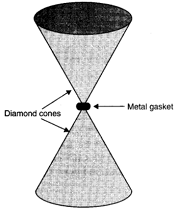
Anvils made of single crystals of diamond, with the shape as shown in Fig. 9.14, are used to investigate behaviour of materials under very high pressures. Flat faces at the narrow end of the anvil have a diameter of $0.50\text{ mm}$, and the wide ends are subjected to a compressional force of $50,000\text{ N}$. What is the pressure at the tip of the anvil?
Solution :
$$\text{Diameter of the cones at the narrow ends, } d = 0.50\text{ mm} = 0.5 \times 10^{-3}\text{ m}$$
$$\text{Radius, } r = \frac{d}{2} = 0.25 \times 10^{-3}\text{ m}$$
$$\text{Compressional force, } F = 50000\text{ N}$$
$$\text{Pressure at the tip of the anvil:} = \frac{\text{Force}}{\text{Area}} = \frac{50000}{\pi(0.25 \times 10^{-3})^2} = 2.55 \times 10^{11}\text{ Pa}$$
Therefore, the pressure at the tip of the anvil is $2.55 \times 10^{11}\text{ Pa}$.
Additional Question 2
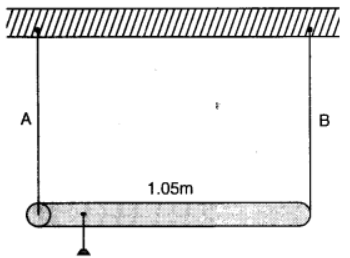
A rod of length $1.05\text{ m}$ having negligible mass is supported at its ends by two wires of steel (wire A) and aluminium (wire B) of equal lengths as shown in Fig. 9.15. The cross-sectional areas of wires A and B are $1.0\text{ mm}^2$ and $2.0\text{ mm}^2$, respectively. At what point along the rod should a mass $m$ be suspended in order to produce (a) equal stresses and (b) equal strains in both steel and aluminium wires.
Solution :
$$\text{Cross-sectional area of wire A, } a_1 = 1.0\text{ mm}^2 = 1.0 \times 10^{-6}\text{ m}^2$$
$$\text{Cross-sectional area of wire B, } a_2 = 2.0\text{ mm}^2 = 2.0 \times 10^{-6}\text{ m}^2$$
$$\text{Young’s modulus for steel, } Y_1 = 2 \times 10^{11}\text{ N m}^{-2}$$
$$\text{Young’s modulus for aluminium, } Y_2 = 7.0 \times 10^{10}\text{ N m}^{-2}$$
(a) If the two wires have equal stresses, then:
$$\frac{F_1}{a_1} = \frac{F_2}{a_2} \implies \frac{F_1}{F_2} = \frac{a_1}{a_2} = \frac{1}{2}$$
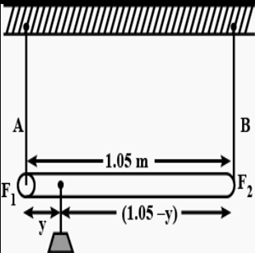
Taking torque about the point of suspension at distance $y$ from wire A:
$$F_1 y = F_2 (1.05 – y) \implies \frac{F_1}{F_2} = \frac{1.05 – y}{y}$$
$$\frac{1.05 – y}{y} = \frac{1}{2} \implies y = 0.7\text{ m}$$
(b) If the strain in the two wires is equal, then:
$$\frac{F_1 / a_1}{Y_1} = \frac{F_2 / a_2}{Y_2} \implies \frac{F_1}{F_2} = \frac{a_1 Y_1}{a_2 Y_2} = \left(\frac{1}{2}\right) \left(\frac{2 \times 10^{11}}{7 \times 10^{10}}\right) = \frac{10}{7}$$
$$\frac{1.05 – y_1}{y_1} = \frac{10}{7} \implies y_1 = 0.432\text{ m}$$
Additional Question 3
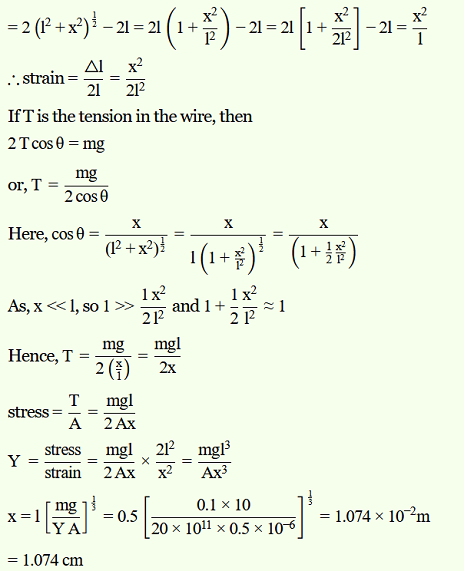
A mild steel wire of length $1.0\text{ m}$ and cross-sectional area $0.50 \times 10^{-2}\text{ cm}^2$ is stretched, well within its elastic limit, horizontally between two pillars. A mass of $100\text{ g}$ is suspended from the mid-point of the wire. Calculate the depression at the midpoint.
Solution :
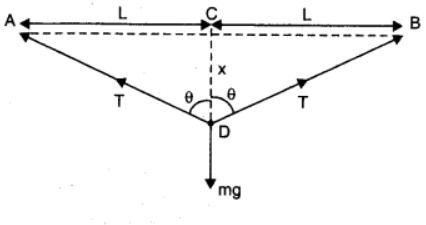
From the figure, let $x$ be the depression at the mid point ($\text{CD} = x$).
$\text{AC} = \text{CB} = l = 0.5\text{ m}$, $m = 100\text{ g} = 0.100\text{ kg}$
$$\text{Increase in length, } \Delta l = \text{AD} + \text{DB} – \text{AB} = 2\text{AD} – \text{AB} \approx \frac{x^2}{l}$$
Using force equilibrium ($2T \sin\theta = mg$) and stress-strain relations, the calculated depression $x \approx 1.07 \times 10^{-2}\text{ m}$.
Additional Question 4
Two strips of metal are riveted together at their ends by four rivets, each of diameter $6.0\text{ mm}$. What is the maximum tension that can be exerted by the riveted strip if the shearing stress on the rivet is not to exceed $6.9 \times 10^7\text{ Pa}$? Assume that each rivet is to carry one quarter of the load.
Solution :
$$\text{Diameter of the metal strip, } d = 6.0\text{ mm} = 6.0 \times 10^{-3}\text{ m}$$
$$\text{Radius, } r = \frac{d}{2} = 3 \times 10^{-3}\text{ m}$$
$$\text{Maximum shearing stress} = 6.9 \times 10^7\text{ Pa}$$
$$\text{Maximum force} = \text{Maximum stress} \times \text{Area} = 6.9 \times 10^7 \times \pi \times r^2$$
$$= 6.9 \times 10^7 \times \pi \times (3 \times 10^{-3})^2 \approx 1949.94\text{ N}$$
Each rivet carries one quarter of the load.
$$\therefore \text{Maximum tension on each rivet} = 4 \times 1949.94 = 7799.76\text{ N}.$$
Additional Question 5
The Marina trench is located in the Pacific Ocean, and at one place it is nearly eleven km beneath the surface of water. The water pressure at the bottom of the trench is about $1.1 \times 10^8\text{ Pa}$. A steel ball of initial volume $0.32\text{ m}^3$ is dropped into the ocean and falls to the bottom of the trench. What is the change in the volume of the ball when it reaches to the bottom?
Solution :
$$\text{Water pressure at the bottom, } p = 1.1 \times 10^8\text{ Pa}$$
$$\text{Initial volume of the steel ball, } V = 0.32\text{ m}^3$$
$$\text{Bulk modulus of steel, } B = 1.6 \times 10^{11}\text{ N m}^{-2}$$
Let the change in the volume of the ball on reaching the bottom of the trench be $\Delta V$.
$$\text{Bulk modulus, } B = \frac{p}{\Delta V / V} \implies \Delta V = \frac{pV}{B}$$
$$\Delta V = \frac{1.1 \times 10^8 \times 0.32}{1.6 \times 10^{11}} = 2.2 \times 10^{-4}\text{ m}^3$$
Therefore, the change in volume of the ball on reaching the bottom of the trench is $2.2 \times 10^{-4}\text{ m}^3$.
Why Class 11 Physics Chapter 8 Matters in NEET and JEE
Class 11 Physics Chapter 8, Mechanical Properties of Solids, is important for NEET and JEE because it explains how solid materials deform when external forces are applied. Students learn about elasticity, stress, strain, Hooke’s law and the elastic properties of different materials. These concepts are useful for understanding the strength, stability and behaviour of wires, rods, bridges, buildings and other structures.
NEET commonly includes direct conceptual and formula-based questions involving stress, strain, Young’s modulus, bulk modulus, shear modulus and elastic energy. JEE frequently asks numerical and graphical questions based on the stress-strain curve, extension of wires, combinations of wires and energy stored in stretched materials. Students must clearly understand the different types of stress and strain and the conditions under which Hooke’s law is valid. Strong knowledge of formulas, units and graphical interpretation helps students solve examination questions accurately.
Preparation Tips for Class 11 Physics Chapter 8
Begin by understanding elasticity and plasticity and how solids respond to deforming forces. Study the different types of stress, including longitudinal stress, volume stress and shearing stress. Similarly, learn longitudinal strain, volume strain and shearing strain.
Revise the basic relations:
$$\text{Stress} = \frac{\text{Force}}{\text{Area}}$$
$$\text{Longitudinal strain} = \frac{\text{Change in length}}{\text{Original length}}$$
$$\text{Volume strain} = \frac{\text{Change in volume}}{\text{Original volume}}$$
Study Hooke’s law carefully. Within the elastic limit, stress is directly proportional to strain:
$$\text{Stress} \propto \text{Strain}$$
Learn the important elastic moduli:
$$\text{Young’s modulus: } Y = \frac{\text{Longitudinal stress}}{\text{Longitudinal strain}}$$
$$\text{Bulk modulus: } K = \frac{\text{Volume stress}}{\text{Volume strain}}$$
$$\text{Shear modulus: } G = \frac{\text{Shearing stress}}{\text{Shearing strain}}$$
Practise numerical questions involving the extension of a wire:
$$\Delta L = \frac{FL}{AY}$$
Here, $F$ is the applied force, $L$ is the original length, $A$ is the cross-sectional area and $Y$ is Young’s modulus.
Study the stress-strain curve carefully and understand proportional limit, elastic limit, yield point, ultimate tensile strength and fracture point. Learn the difference between ductile and brittle materials. Also revise the expression for elastic potential energy stored per unit volume:
$$\text{Elastic energy density} = \frac{1}{2} \times \text{Stress} \times \text{Strain}$$
Complete all NCERT examples, diagrams and exercises before attempting NEET and JEE previous-year questions. Regularly revise SI units, dimensions and important graphs.
FAQs
1. What are the most important topics in Class 11 Physics Chapter 8?
The most important topics include elasticity, stress, strain, Hooke’s law, Young’s modulus, bulk modulus, shear modulus, stress-strain curves and elastic potential energy.
2. What is elasticity?
Elasticity is the property of a material by which it regains its original shape and size after the deforming force is removed, provided the elastic limit is not exceeded.
3. What is stress?
Stress is the restoring force developed per unit area inside a material when an external deforming force is applied:
$$\text{Stress} = \frac{\text{Force}}{\text{Area}}$$
Its SI unit is pascal.
4. What is strain?
Strain is the ratio of the change in dimension of a material to its original dimension. It is a dimensionless quantity because it is the ratio of two similar physical quantities.
5. What is Hooke’s law?
Hooke’s law states that, within the elastic limit of a material, stress is directly proportional to strain:
$$\text{Stress} \propto \text{Strain}$$
6. What is Young’s modulus?
Young’s modulus is the ratio of longitudinal stress to longitudinal strain:
$$Y = \frac{\text{Longitudinal stress}}{\text{Longitudinal strain}}$$
It measures the resistance of a material to a change in length.
7. What is bulk modulus?
Bulk modulus is the ratio of volume stress to volume strain. It measures the resistance of a material to a change in volume:
$$K = \frac{\text{Volume stress}}{\text{Volume strain}}$$
8. What is shear modulus?
Shear modulus is the ratio of shearing stress to shearing strain. It measures the resistance of a material to a change in shape.
9. What does a stress-strain curve represent?
A stress-strain curve shows how a material behaves when stress is gradually increased. It helps identify the proportional limit, elastic limit, yield point, ultimate strength and fracture point of the material.
10. Is Class 11 Physics Chapter 8 important for NEET and JEE?
Yes. Mechanical Properties of Solids is important for NEET and JEE. Questions are commonly based on elastic moduli, extension of wires, stress-strain curves, Hooke’s law and elastic energy. Regular formula revision and numerical practice are essential for scoring well.