
NCERT Solutions for Class 11 Physics Chapter 12, Kinetic Theory, have been carefully prepared by experienced physics teachers to help students understand every concept clearly. Before attempting the NCERT questions, students should study the chapter theory thoroughly, including the kinetic theory of gases, ideal gas equation, RMS speed, degrees of freedom, and specific heat capacities. These step-by-step solutions simplify both conceptual and numerical problems and are useful for school exams, NEET and JEE preparation.
Class 11 Physics Chapter 12 Overview
The Kinetic Theory chapter explains the behaviour of gases by considering them as a collection of tiny particles in continuous random motion. Students learn about the basic postulates of the kinetic theory of gases, the ideal gas model, and how molecular motion gives rise to macroscopic properties such as pressure, temperature, and volume. The chapter covers the ideal gas equation, kinetic interpretation of pressure, root mean square (RMS) speed of gas molecules, and the relationship between temperature and the average kinetic energy of molecules. It also discusses the degrees of freedom, the law of equipartition of energy, and specific heat capacities of gases, providing a strong foundation for understanding thermodynamics and the behaviour of gases.
NCERT Solutions for Class 11 Physics Chapter 12: Kinetic Theory
Question 12.1.
Estimate the fraction of molecular volume to the actual volume occupied by oxygen gas at STP. Take the diameter of an oxygen molecule to be $3\text{ \AA}$.
Solution :
$$\text{Diameter of an oxygen molecule, } d = 3\text{ \AA}$$
$$\text{Radius, } r = \frac{d}{2} = \frac{3}{2} = 1.5\text{ \AA} = 1.5 \times 10^{-8}\text{ cm}$$
$$\text{Actual volume occupied by } 1\text{ mole of oxygen gas at STP} = 22400\text{ cm}^3$$
$$\text{Molecular volume of oxygen gas, } V = \left(\frac{4}{3}\right)\pi r^3 N$$
Where $N$ is Avogadro’s number $= 6.023 \times 10^{23}\text{ molecules/mole}$
$$\therefore V = \left(\frac{4}{3}\right) \times 3.14 \times (1.5 \times 10^{-8})^3 \times 6.023 \times 10^{23} = 8.51\text{ cm}^3$$
$$\text{Ratio of the molecular volume to the actual volume of oxygen} = \frac{8.51}{22400} = 3.8 \times 10^{-4}.$$
Question 12.2.
Molar volume is the volume occupied by $1\text{ mol}$ of any (ideal) gas at standard temperature and pressure (STP: $1\text{ atmospheric pressure}$, $0^\circ\text{C}$). Show that it is $22.4\text{ litres}$.
Solution :
The ideal gas equation relating pressure ($P$), volume ($V$), and absolute temperature ($T$) is given as:
$$PV = nRT$$
Where,
$R$ is the universal gas constant $= 8.314\text{ J mol}^{-1}\text{ K}^{-1}$
$n = \text{Number of moles} = 1$
$T = \text{Standard temperature} = 273\text{ K}$
$P = \text{Standard pressure} = 1\text{ atm} = 1.013 \times 10^5\text{ N m}^{-2}$
$$\therefore V = \frac{nRT}{P} = \frac{1 \times 8.314 \times 273}{1.013 \times 10^5} = 0.0224\text{ m}^3 = 22.4\text{ litres}$$
Hence, the molar volume of a gas at STP is $22.4\text{ litres}$.
Question 12.3.
Figure 12.8 shows plot of $PV/T$ versus $P$ for $1.00 \times 10^{-3}\text{ kg}$ of oxygen gas at two different temperatures.
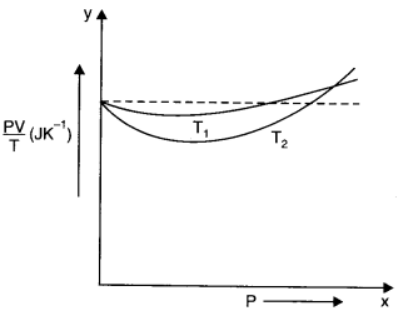
a. What does the dotted plot signify?
b. Which is true: $T_1 > T_2$ or $T_1 < T_2$?
c. What is the value of $PV/T$ where the curves meet on the y-axis?
d. If we obtained similar plots for $1.00 \times 10^{-3}\text{ kg}$ of hydrogen, would we get the same value of $PV/T$ at the point where the curves meet on the y-axis? If not, what mass of hydrogen yields the same value of $PV/T$ (for low pressure high temperature region of the plot)? (Molecular mass of $\text{H}_2 = 2.02\text{ u}$, of $\text{O}_2 = 32.0\text{ u}$, $R = 8.31\text{ J mol}^{-1}\text{ K}^{-1}$.)
Solution :
a. The dotted plot in the graph signifies the ideal behaviour of the gas, i.e., the ratio $PV/T$ is equal to $\mu R$ ($\mu$ is the number of moles and $R$ is the universal gas constant) which is a constant quantity and is not dependent on the pressure of the gas.
b. The dotted plot in the given graph represents an ideal gas. The curve of the gas at temperature $T_1$ is closer to the dotted plot than the curve of the gas at temperature $T_2$. A real gas approaches the behaviour of an ideal gas when its temperature increases. Therefore, $T_1 > T_2$ is true for the given plot.
c. The value of the ratio $PV/T$, where the two curves meet, is $\mu R$. This is because the ideal gas equation is given as:
$$PV = \mu RT \implies \frac{PV}{T} = \mu R$$
$$\text{Molecular mass of oxygen} = 32.0\text{ g}$$
$$\text{Mass of oxygen} = 1 \times 10^{-3}\text{ kg} = 1\text{ g}$$
$$\mu = \frac{1}{32}\text{ mol}$$
$$\therefore \frac{PV}{T} = \left(\frac{1}{32}\right) \times 8.314 \approx 0.26\text{ J K}^{-1}$$
Therefore, the value of the ratio $PV/T$, where the curves meet on the y-axis, is $0.26\text{ J K}^{-1}$.
d. If we obtain similar plots for $1.00 \times 10^{-3}\text{ kg}$ of hydrogen, then we will not get the same value of $PV/T$ at the point where the curves meet the y-axis. This is because the molecular mass of hydrogen ($2.02\text{ u}$) is different from that of oxygen ($32.0\text{ u}$).
Using $\frac{PV}{T} = \mu R = \left(\frac{m}{M}\right)R$:
$$m = \left(\frac{PV}{T}\right) \times \left(\frac{M}{R}\right) = \frac{0.26 \times 2.02}{8.314} \approx 6.3 \times 10^{-5}\text{ kg}$$
Hence, $6.3 \times 10^{-5}\text{ kg}$ of $\text{H}_2$ will yield the same value of $PV/T$.
Question 12.4.
An oxygen cylinder of volume $30\text{ litres}$ has an initial gauge pressure of $15\text{ atm}$ and a temperature of $27^\circ\text{C}$. After some oxygen is withdrawn from the cylinder, the gauge pressure drops to $11\text{ atm}$ and its temperature drops to $17^\circ\text{C}$. Estimate the mass of oxygen taken out of the cylinder ($R = 8.31\text{ J mol}^{-1}\text{ K}^{-1}$, molecular mass of $\text{O}_2 = 32\text{ u}$).
Solution :
$$\text{Volume, } V_1 = 30\text{ litres} = 30 \times 10^{-3}\text{ m}^3$$
$$\text{Pressure, } P_1 = 15\text{ atm} = 15 \times 1.013 \times 10^5\text{ Pa} = 15.195 \times 10^5\text{ Pa}$$
$$\text{Temperature, } T_1 = 27^\circ\text{C} = 300\text{ K}$$
Initial number of moles $n_1 = \frac{P_1 V_1}{R T_1} = \frac{15.195 \times 10^5 \times 30 \times 10^{-3}}{8.314 \times 300} \approx 18.276$
$$\text{Initial mass } m_1 = n_1 \times M = 18.276 \times 32 = 584.84\text{ g}$$
After withdrawal:
$$\text{Pressure, } P_2 = 11\text{ atm} = 11 \times 1.013 \times 10^5\text{ Pa} = 11.143 \times 10^5\text{ Pa}$$
$$\text{Temperature, } T_2 = 17^\circ\text{C} = 290\text{ K}$$
Final number of moles $n_2 = \frac{P_2 V_2}{R T_2} = \frac{11.143 \times 10^5 \times 30 \times 10^{-3}}{8.314 \times 290} \approx 13.86$
$$\text{Final mass } m_2 = n_2 \times M = 13.86 \times 32 = 453.1\text{ g}$$
$$\text{Mass taken out} = m_1 – m_2 = 584.84\text{ g} – 453.1\text{ g} = 131.74\text{ g} = 0.131\text{ kg}.$$
Question 12.5.
An air bubble of volume $1.0\text{ cm}^3$ rises from the bottom of a lake $40\text{ m}$ deep at a temperature of $12^\circ\text{C}$. To what volume does it grow when it reaches the surface, which is at a temperature of $35^\circ\text{C}$?
Solution :
$$\text{Initial volume, } V_1 = 1.0\text{ cm}^3 = 1.0 \times 10^{-6}\text{ m}^3$$
$$\text{Depth, } d = 40\text{ m}, \quad T_1 = 12^\circ\text{C} = 285\text{ K}, \quad T_2 = 35^\circ\text{C} = 308\text{ K}$$
$$\text{Surface pressure, } P_2 = 1\text{ atm} = 1.013 \times 10^5\text{ Pa}$$
$$\text{Pressure at depth } d: P_1 = P_2 + \rho dg = 1.013 \times 10^5 + (40 \times 10^3 \times 9.8) = 493300\text{ Pa}$$
Using gas equation $\frac{P_1 V_1}{T_1} = \frac{P_2 V_2}{T_2}$:
$$V_2 = \frac{P_1 V_1 T_2}{T_1 P_2} = \frac{493300 \times (1.0 \times 10^{-6}) \times 308}{285 \times 1.013 \times 10^5} \approx 5.263 \times 10^{-6}\text{ m}^3 = 5.263\text{ cm}^3.$$
Question 12.6.
Estimate the total number of air molecules (inclusive of oxygen, nitrogen, water vapour and other constituents) in a room of capacity $25.0\text{ m}^3$ at a temperature of $27^\circ\text{C}$ and $1\text{ atm}$ pressure.
Solution :
$$\text{Volume, } V = 25.0\text{ m}^3, \quad T = 27^\circ\text{C} = 300\text{ K}, \quad P = 1.013 \times 10^5\text{ Pa}$$
Using $PV = N k_B T$:
$$N = \frac{PV}{k_B T} = \frac{1.013 \times 10^5 \times 25.0}{1.38 \times 10^{-23} \times 300} \approx 6.11 \times 10^{26}\text{ molecules}.$$
Question 12.7.
Estimate the average thermal energy of a helium atom at
1. room temperature ($27^\circ\text{C}$),
2. the temperature on the surface of the Sun ($6000\text{ K}$),
3. the temperature of $10\text{ million Kelvin}$ (the typical core temperature in the case of a star).
Solution :
1. At $T = 300\text{ K}$:
$$\text{Average thermal energy} = \frac{3}{2}k_B T = \frac{3}{2} \times 1.38 \times 10^{-23} \times 300 = 6.21 \times 10^{-21}\text{ J}$$
2. At $T = 6000\text{ K}$:
$$\text{Average thermal energy} = \frac{3}{2} \times 1.38 \times 10^{-23} \times 6000 = 1.241 \times 10^{-19}\text{ J}$$
3. At $T = 10^7\text{ K}$:
$$\text{Average thermal energy} = \frac{3}{2} \times 1.38 \times 10^{-23} \times 10^7 = 2.07 \times 10^{-16}\text{ J}.$$
Question 12.8.
Three vessels of equal capacity have gases at the same temperature and pressure. The first vessel contains neon (monatomic), the second contains chlorine (diatomic), and the third contains uranium hexafluoride (polyatomic). Do the vessels contain equal number of respective molecules? Is the root mean square speed of molecules the same in the three cases? If not, in which case is $v_{\text{rms}}$ the largest?
Solution :
– **Yes**, according to Avogadro’s law, all three vessels contain an equal number of molecules since they have identical volume, temperature, and pressure.
– **No**, root mean square speed ($v_{\text{rms}} = \sqrt{\frac{3kT}{m}}$) depends inversely on molecular mass ($m$). Since neon has the smallest mass among the three gases, **neon has the largest $v_{\text{rms}}$**.
Question 12.9.
At what temperature is the root mean square speed of an atom in an argon gas cylinder equal to the rms speed of a helium gas atom at $-20^\circ\text{C}$? (atomic mass of $\text{Ar} = 39.9\text{ u}$, of $\text{He} = 4.0\text{ u}$).
Solution :
Temperature of helium $T_{\text{He}} = -20^\circ\text{C} = 253\text{ K}$, $M_{\text{He}} = 4.0\text{ u}$, $M_{\text{Ar}} = 39.9\text{ u}$
Since $v_{\text{rms}} = \sqrt{\frac{3RT}{M}}$, equating $v_{\text{rms}}$ for Ar and He:
$$\frac{T_{\text{Ar}}}{M_{\text{Ar}}} = \frac{T_{\text{He}}}{M_{\text{He}}} \implies T_{\text{Ar}} = T_{\text{He}} \times \left(\frac{M_{\text{Ar}}}{M_{\text{He}}}\right) = 253 \times \left(\frac{39.9}{4.0}\right) \approx 2523.6\text{ K} = 2.52 \times 10^3\text{ K}.$$
Question 12.10.
Estimate the mean free path and collision frequency of a nitrogen molecule in a cylinder containing nitrogen at $2.0\text{ atm}$ and temperature $17^\circ\text{C}$. Take the radius of a nitrogen molecule to be roughly $1.0\text{ \AA}$. Compare the collision time with the time the molecule moves freely between two successive collisions (Molecular mass of $\text{N}_2 = 28.0\text{ u}$).
Solution :
$$\text{Mean free path } l \approx 1.11 \times 10^{-7}\text{ m}$$
$$\text{Collision frequency} \approx 4.58 \times 10^9\text{ s}^{-1}$$
$$\text{Successive collision time} \approx 500 \times (\text{Collision time})$$
Calculations involve finding number density $n = \frac{P}{k_B T}$, mean free path $l = \frac{1}{\sqrt{2}\pi d^2 n}$, and comparing collision time $T = \frac{d}{v_{\text{rms}}}$ with free flight time $T’ = \frac{l}{v_{\text{rms}}}$.
Additional Question 1
A metre long narrow bore held horizontally (and closed at one end) contains a $76\text{ cm}$ long mercury thread, which traps a $15\text{ cm}$ column of air. What happens if the tube is held vertically with the open end at the bottom?
Solution :
Using Boyle’s law ($P_1 V_1 = P_2 V_2$) under isothermal conditions, let $h\text{ cm}$ of mercury flow out. Solving the quadratic equation yields $h = 23.8\text{ cm}$ of mercury flowing out, leaving $52.2\text{ cm}$ in the tube with an air column length of $47.8\text{ cm}$.
Additional Question 2
From a certain apparatus, the diffusion rate of hydrogen has an average value of $28.7\text{ cm}^3\text{ s}^{-1}$. The diffusion of another gas under the same conditions is measured to have an average rate of $7.2\text{ cm}^3\text{ s}^{-1}$. Identify the gas.
[Hint: Use Graham’s law of diffusion: $\frac{R_1}{R_2} = \sqrt{\frac{M_2}{M_1}}$]
Solution :
$$\frac{R_1}{R_2} = \sqrt{\frac{M_2}{M_1}} \implies \frac{28.7}{7.2} = \sqrt{\frac{M_2}{2}} \implies M_2 \approx 32\text{ g/mol}$$
$32\text{ g/mol}$ is the molecular mass of oxygen ($\text{O}_2$). Hence, the unknown gas is **oxygen**.
Additional Question 3
A gas in equilibrium has uniform density and pressure throughout its volume. This is strictly true only if there are no external influences. A gas column under gravity, for example, does not have uniform density (and pressure). As you might expect, its density decreases with height. The precise dependence is given by the so-called law of atmospheres
$$n_2 = n_1 \exp\left[-\frac{mg(h_2 – h_1)}{k_B T}\right]$
Use this relation to derive the equation for sedimentation equilibrium of a suspension in a liquid column:
$$n_2 = n_1 \exp\left[-\frac{mg N_A (\rho – \rho’)(h_2 – h_1)}{\rho RT}\right]$$
Solution :
Using Archimedes’ principle, the apparent/effective weight of a suspended particle in a liquid of density $\rho’$ is $mg\left(1 – \frac{\rho’}{\rho}\right)$. Substituting this effective weight into the law of atmospheres along with $k_B = \frac{R}{N_A}$ yields the required sedimentation equilibrium equation.
Additional Question 4
Given below are densities of some solids and liquids. Give rough estimates of the size of their atoms:
Substance: Carbon (diamond), Gold, Nitrogen, Lithium, Fluorine (liquid).
Solution :
Assuming atoms to be tightly packed in a solid or liquid phase, radius $r$ is estimated using:
$$r = \left(\frac{3M}{4\pi\rho N_A}\right)^{1/3}$$
Estimated atomic radii fall in the range of a few angstroms ($\text{\AA}$), e.g., Carbon $\approx 1.29\text{ \AA}$, Gold $\approx 1.59\text{ \AA}$, Liquid Nitrogen $\approx 1.77\text{ \AA}$.
Why Class 11 Physics Chapter 12 Matters in NEET and JEE
Class 11 Physics Chapter 12, Kinetic Theory, is important for NEET and JEE because it explains the microscopic behavior of gases and connects it with macroscopic properties such as pressure, temperature, and volume. Students learn key concepts like the kinetic theory of gases, ideal gas equation, RMS speed, and the relationship between temperature and the average kinetic energy of molecules.
NEET often includes direct conceptual and formula-based questions on the ideal gas equation, RMS speed, and kinetic energy of gas molecules. JEE frequently tests numerical and conceptual understanding of gas laws, degrees of freedom, and the law of equipartition of energy. A clear understanding of these concepts helps students solve thermodynamics and gas-related problems accurately.
Preparation Tips for Class 11 Physics Chapter 12
Start by understanding the basic assumptions of the Kinetic Theory of Gases and how the motion of gas molecules explains pressure, temperature, and volume. Learn the ideal gas equation, RMS speed, and the relationship between temperature and the average kinetic energy of gas molecules.
Memorize the important formulas:
$$PV = nRT = Nk_B T$$
$$v_{\text{rms}} = \sqrt{\frac{3RT}{M}} = \sqrt{\frac{3k_B T}{m}}$$
$$\text{Average Kinetic Energy} = \frac{3}{2}k_B T$$
Focus on concepts such as degrees of freedom, the law of equipartition of energy, and specific heat capacities. Solve all NCERT examples and exercises first, then practice NEET and JEE previous-year questions.
FAQs
1. What are the most important topics in Class 11 Physics Chapter 12?
The most important topics include the kinetic theory of gases, ideal gas equation, kinetic interpretation of pressure, RMS speed, degrees of freedom, law of equipartition of energy, and specific heat capacities.
2. What is the kinetic theory of gases?
The kinetic theory of gases explains that gases consist of a large number of tiny molecules in continuous random motion. Their collisions with the walls of the container produce gas pressure.
3. What is the ideal gas equation?
The ideal gas equation relates pressure, volume, temperature, and the amount of gas:
$$PV = nRT$$
It is used to describe the behavior of an ideal gas under different conditions.
4. What is RMS speed?
Root Mean Square (RMS) speed is the square root of the average of the squares of the speeds of gas molecules. It represents the effective speed of gas molecules:
$$v_{\text{rms}} = \sqrt{\frac{3RT}{M}}$$
5. How is temperature related to the kinetic energy of gas molecules?
The average kinetic energy of gas molecules is directly proportional to the absolute temperature. As temperature increases, the average kinetic energy also increases.
6. What are the assumptions of the kinetic theory of gases?
The theory assumes that gas molecules are in constant random motion, occupy negligible volume, experience perfectly elastic collisions, and exert no intermolecular forces except during collisions.
7. What are degrees of freedom?
Degrees of freedom refer to the number of independent ways in which a gas molecule can store energy, such as translational, rotational, and vibrational motion.