
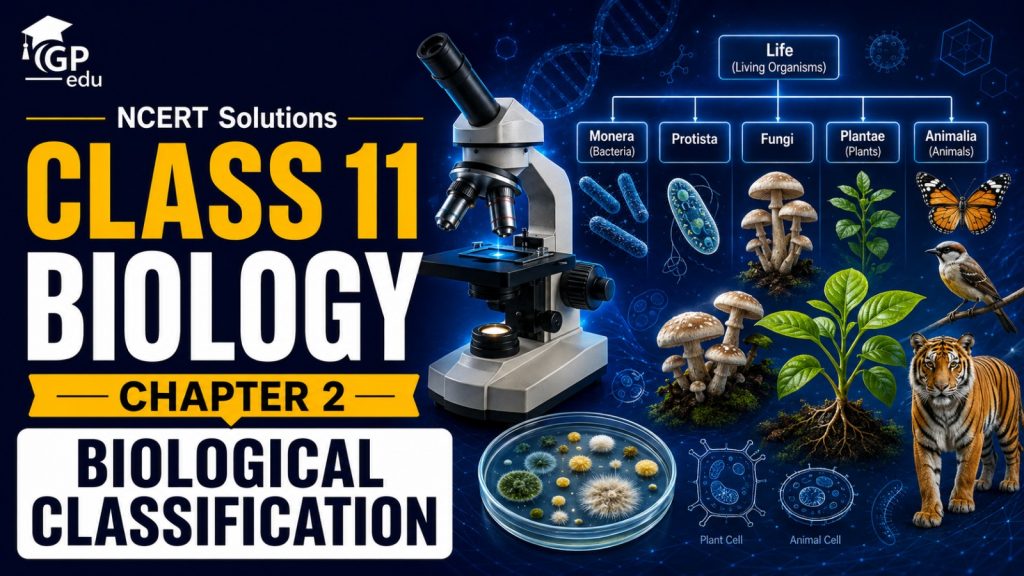
The chapter Biological Classification introduces students to the five-kingdom system proposed by R.H. Whittaker, which classifies organisms into Monera, Protista, Fungi, Plantae, and Animalia. It explores the characteristics, structure, and modes of nutrition of each kingdom. Students learn about the evolution and interrelationship of various organisms, enabling a deeper understanding of biodiversity. This chapter lays the foundation for further studies in microbiology and ecology, emphasizing the importance of systematic classification in biology.
Class 11 Biology Chapter 2 Overview
Introduces students to the scientific classification of living organisms based on their characteristics, cell structure, mode of nutrition, reproduction, and evolutionary relationships. The chapter explains the limitations of the traditional two-kingdom classification system and describes the five-kingdom classification proposed by R.H. Whittaker.
Students learn about the distinctive features of the Kingdom Monera, Protista, Fungi, Plantae, and Animalia, along with the characteristics of bacteria, cyanobacteria, archaebacteria, mycoplasma, protozoans, algae, fungi, viruses, and lichens. The chapter also highlights the importance of biological classification in understanding the diversity of life and the evolutionary relationships among organisms, providing a strong foundation for advanced biology concepts and NEET preparation.
NCERT Solutions for Class 11 Biology Chapter 2- Biological Classification
Question 2.1. Discuss how classification systems have undergone several changes over a period of time.
Answer:
Classification systems have evolved significantly over time. Aristotle first introduced a basic classification system using observable morphological traits, grouping plants into trees, shrubs, and herbs, and animals based on the presence or absence of red blood.
Later, Linnaeus proposed a two-kingdom classification, dividing organisms into Plantae and Animalia, but this system lacked the ability to differentiate between eukaryotes and prokaryotes, unicellular and multicellular organisms, and photosynthetic and non-photosynthetic organisms. Over time, R.H. Whittaker introduced a more comprehensive five-kingdom classification system (Monera, Protista, Fungi, Plantae, and Animalia) based on cellular structure, body organization, nutrition, reproduction, and phylogeny. Subsequently, a three-domain system emerged, dividing Monera into two domains (Archaea and Bacteria), highlighting evolutionary relationships more effectively.
Quick Read: Biotechnology and Its Application Topics and Solutions
Question 2.2. State two economically important uses of:
(a) heterotrophic bacteria
(b) archaebacteria
Answer:
(a) Heterotrophic bacteria
– Used in the production of antibiotics, vitamins, and dairy products like cheese and curd.
– Aid in nitrogen fixation and the formation of humus, enriching soil fertility.
(b) Archaebacteria
– Play a role in biogas production, especially methane.
– Useful in bioleaching processes in mining to extract metals.
Question 2.3. What is the nature of cell walls in diatoms?
Answer:
Diatoms have silica-embedded cell walls, giving them unique patterns and making them indestructible. These cell wall deposits accumulate over time to form diatomaceous earth.
Question 2.4. Find out what the terms ‘algal bloom’ and ‘red tides’ signify.
Answer:
Algal bloom: An overgrowth of algae, especially blue-green algae, in contaminated water. It leads to oxygen depletion and water pollution.
Red tides: Caused by rapid multiplication of red-pigmented dinoflagellates (e.g., Gonyaulax), giving the water a red appearance. These algae produce toxins harmful to aquatic life.
Check This Out: Body Fluids and Circulation Topics and Solutions
Question 2.5. How are viroids different from viruses?
Answer:
Viroids consist of single-stranded RNA without a protein coat, while viruses have genetic material (RNA or DNA) encased in a protein coat.
Viroids are much smaller in size compared to viruses.
Viroids infect only plants, whereas viruses infect plants, animals, and microorganisms.
Question 2.6. Describe the four major groups of Protozoa briefly.
Answer:
Amoeboid Protozoans: Use pseudopodia for movement and capturing prey; found in aquatic environments.
Flagellated Protozoans: Use flagella for movement; can be free-living or parasitic.
Ciliated Protozoans: Possess cilia for locomotion and feeding; thrive in aquatic habitats.
Sporozoans: Produce spores during their life cycle; often parasitic and spread through hosts.
Question 2.7. Plants are autotrophic. Can you think of some plants that are partially heterotrophic?
Answer:
Some plants, such as Utricularia (bladderwort), Drosera (sundew), and Nepenthes (pitcher plant), are partially heterotrophic. They trap and digest insects to supplement their nitrogen needs.
Question 2.8. What do the terms phycobiont and mycobiont signify?
Answer:
In lichens, the phycobiont refers to the algal partner that performs photosynthesis to produce food, while the mycobiont is the fungal partner that provides protection and structure.
Also Check: Human Reproduction Topics and Solutions
Question 2.9. Give a comparative account of the classes of Kingdom Fungi under the following:
Answer:
| Feature | Phycomycetes | Ascomycetes | Basidiomycetes | Deuteromycetes |
|---|---|---|---|---|
| Mode of Nutrition | Saprophytic or parasitic | Decomposers, saprophytic | Saprophytic | Decomposers, saprophytic |
| Mode of Reproduction | Asexual (zoospores, aplanospores); sexual (zygotes) | Asexual (conidia); sexual (ascospores) | Sexual (basidiospores) | Asexual (conidia) |
Question 2.10. What are the characteristic features of Euglenoids?
Answer:
– Lack a cell wall; have a flexible protein layer called pellicle.
– Possess two flagella of unequal lengths.
– Autotrophic in sunlight but heterotrophic in its absence.
Question 2.11. Give a brief account of viruses with respect to their structure and genetic material. Name four common viral diseases.
Answer:
Viruses are non-cellular entities with genetic material (RNA or DNA) encased in a protein coat (capsid). Capsids are made of subunits called capsomers. They infect plants, animals, and microorganisms. Common viral diseases include Influenza, AIDS, Herpes, and Rabies.
Question 2.12. Organise a discussion in your class on the topic ‘Are viruses living or nonliving’?
Answer:
Non-living Characters: (i) No cellular structure (ii) They can be stored in bottles like crystals (iii) There will be no energy storage or energy liberation systems (iv) They cannot grow or multiply outside the host
Living Characters: (i) They are host-specific (ii) The presence of genetic material (iii) The ability to multiply (iv) They have antigenic properties (v) They are obligate parasites (vi) Mutations occur
Read Next: Biotechnology Principles and Processes Topics and Solutions
Why Class 11 Biology Chapter 2 Matters in NEET
Class 11 Biology Chapter 2: Biological Classification is highly important for NEET because it explains the scientific basis of classifying living organisms and introduces the five-kingdom classification system proposed by R.H. Whittaker. Students learn important concepts such as the characteristics of Monera, Protista, Fungi, Plantae, and Animalia, along with the unique features of bacteria, cyanobacteria, archaebacteria, mycoplasma, algae, protozoans, viruses, and lichens. NEET frequently includes direct NCERT-based questions on kingdom characteristics, differences among organisms, modes of nutrition, reproduction, and examples of different groups. A thorough understanding of this chapter helps students build a strong foundation for microbiology, plant biology, and animal biology while improving their performance in the examination.
Preparation Tips for Class 11 Biology Chapter 2
Begin by understanding the five-kingdom classification system and the criteria used for classification, such as cell structure, body organization, mode of nutrition, reproduction, and phylogenetic relationships. Study the characteristics of each kingdom—Monera, Protista, Fungi, Plantae, and Animalia—and learn important examples of organisms belonging to each group.
Pay special attention to the differences between archaebacteria and eubacteria, the types of bacteria, cyanobacteria, mycoplasma, protozoans, algae, and the various classes of fungi. Revise the features of viruses, viroids, and lichens, as these topics are commonly tested in NEET. Prepare comparison tables to differentiate the kingdoms and major groups of organisms. Complete all NCERT diagrams, tables, examples, and exercise questions, as NEET asks many direct questions from the NCERT textbook. Finally, solve NEET previous-year questions and practice regularly to strengthen conceptual understanding and improve accuracy in the examination.
FAQs
What are the most important topics in Class 11 Biology Chapter 2?
The most important topics include the five-kingdom classification, characteristics of Monera, Protista, Fungi, Plantae, and Animalia, bacteria, cyanobacteria, archaebacteria, mycoplasma, viruses, viroids, lichens, algae, protozoans, and fungal classification. These topics are frequently asked in NEET.
What is the five-kingdom classification?
The five-kingdom classification is a system proposed by R.H. Whittaker in 1969. It classifies all living organisms into Monera, Protista, Fungi, Plantae, and Animalia based on cell structure, body organization, mode of nutrition, reproduction, and evolutionary relationships.
What is the difference between Monera and Protista?
Monera consists of prokaryotic organisms that lack a true nucleus and membrane-bound organelles, whereas Protista consists of eukaryotic organisms that possess a true nucleus and membrane-bound organelles. Protists are generally more complex than monerans.
Why are viruses not placed in any kingdom?
Viruses are not included in any of the five kingdoms because they are acellular and exhibit characteristics of both living and non-living organisms. They can reproduce only inside the living cells of a host organism.
What are lichens?
Lichens are a symbiotic association between an alga (or cyanobacterium) and a fungus. The alga prepares food through photosynthesis, while the fungus provides water, minerals, and protection.
Who proposed the five-kingdom classification?
The five-kingdom classification was proposed by R.H. Whittaker in 1969. It is one of the most important biological classification systems and forms the basis of many NEET questions.
Is Class 11 Biology Chapter 2 important for NEET?
Yes. Class 11 Biology Chapter 2: Biological Classification is highly important for NEET because it contains many direct NCERT-based questions on the five kingdoms, bacteria, fungi, protists, viruses, lichens, and classification criteria. Regular revision of NCERT concepts, diagrams, comparison tables, and previous-year questions is essential for scoring well.