
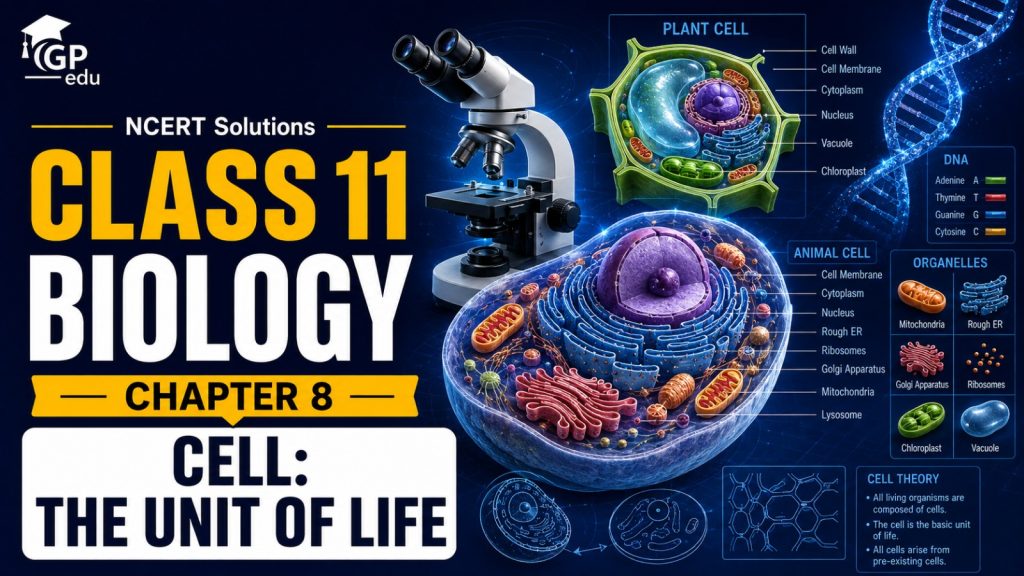
The chapter Cell: The Unit of Life introduces students to the cell as the fundamental structural and functional unit of all living organisms and explains its organisation, structure, and functions. It covers cell theory, prokaryotic and eukaryotic cells, plasma membrane, cell wall, cytoplasm, nucleus, and major cell organelles, along with their important characteristics and functions.
Students learn about the structure and functions of mitochondria, chloroplasts, endoplasmic reticulum, Golgi apparatus, lysosomes, ribosomes, vacuoles, centrosomes, peroxisomes, cilia, and flagella. The chapter also explains the differences between plant and animal cells and prokaryotic and eukaryotic cells, along with the structure of the nucleus and chromosomes. A clear understanding of Cell: The Unit of Life provides a strong foundation for studying cell biology, genetics, molecular biology, and physiology, making it an important topic for NEET preparation.
Class 11 Biology Chapter 8 Overview
Students learn about cell theory, prokaryotic and eukaryotic cell organisation, plasma membrane, cell wall, cytoplasm, nucleus, and different cell organelles, along with their structural features and functions. The chapter also covers mitochondria, plastids, endoplasmic reticulum, Golgi apparatus, lysosomes, ribosomes, vacuoles, centrosomes, and other specialised cellular structures. Students are introduced to the differences between plant and animal cells and understand how different organelles work together to maintain cellular activities. A clear understanding of Cell: The Unit of Life helps students develop a strong foundation in cell structure, cellular functions, genetics, molecular biology, and physiological processes, making it an important chapter for NEET preparation.
NCERT Solutions for Class 11 Biology Chapter 8 – Cell: The Unit Of Life
Question 8.1. Which of the following is not correct?
(a) Robert Brown discovered the cell.
(b) Schleiden and Schwann formulated the cell theory.
(c) Virchow explained that cells are formed from pre-existing cells.
(d) A unicellular organism carries out its life activities within a single cell.
Solution:
The answer is (a) Robert Brown discovered the cell. It is incorrect because Robert Brown discovered the nucleus in the cell.
Question 8.2. New cells generate from
(a) bacterial fermentation
(b) regeneration of old cells
(c) pre-existing cells
(d) abiotic materials
Solution:
The answer is (c) pre-existing cells.
Question 8.3. Match the following
| Column I | Column II |
|---|---|
| (a) Cristae | (i) Flat membranous sacs in stroma |
| (b) Cisternae | (ii) Infoldings in mitochondria |
| (c) Thylakoids | (iii) Disc-shaped sacs in Golgi apparatus |
Solution:
| Column I | Column II |
|---|---|
| (a) Cristae | (ii) Infoldings in mitochondria |
| (b) Cisternae | (iii) Disc-shaped sacs in Golgi apparatus |
| (c) Thylakoids | (i) Flat membranous sacs in stroma |
Question 8.4. Which of the following is correct?
(a) Cells of all living organisms have a nucleus.
(b) Both animal and plant cells have a well-defined cell wall.
(c) In prokaryotes, there are no membrane-bound organelles.
(d) Cells are formed de novo from abiotic materials
Solution:
The answer is (c) In prokaryotes, there are no membrane-bound organelles.
Question 8.5. What is a mesosome in a prokaryotic cell? Mention the functions that it performs.
Solution:
A mesosome in a prokaryotic cell is a folded, membranous structure formed by the invagination of the plasma membrane. It increases the surface area for enzymatic activities. Functions include aiding in cell wall formation, DNA replication, distribution to daughter cells, and facilitating respiration and secretion processes in prokaryotic cells.
Question 8.6. How do neutral solutes move across the plasma membrane? Can the polar molecules also move across it in the same way? If not, how are these transported across the membrane?
Solution:
Because they are lipid-soluble, the neutral solutes are able to penetrate the lipid bilayer. No, polar molecules need specific hydrophilic regions to get through the plasma membrane; they cannot do so in the same manner as neutral solutes. Ions, channels, permeases, and active transport that uses $\text{ATP}$ are the different ways that they are carried.
Question 8.7. Name two cell organelles that are double membrane-bound. What are the characteristics of these two organelles? State their functions and draw labelled diagrams of both.
Solution:
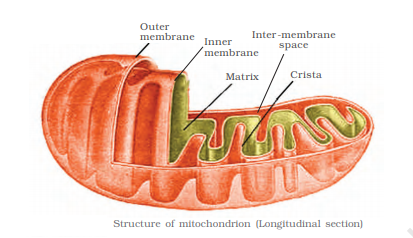
Two organelles that are double membrane-bound are i) Mitochondria ii) Chloroplasts
Characteristics of mitochondria:
– The outer and inner membranes of the mitochondrion, which is a double membrane-bound structure, clearly separate its lumen into two watery compartments: the outer compartment and the inner compartment.
– Mitochondria are semi-autonomous as they possess their own DNA.
– Mitochondria are the place of aerobic respiration.
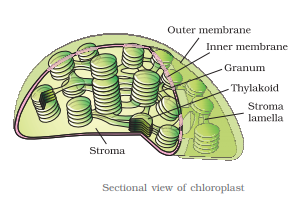
Characteristics of Chloroplasts:
– Variously shaped in lower plants and disc-shaped in higher plants, they are present in euglenoids and plants.
– They contain particular pigments that give the plants’ leaves colour.
– Each chloroplast has its own DNA.
– Pigments aid in photosynthesis by capturing sunlight.
– It is made up of thylakoids, which are membrane-flattened sacs found in their matrix. Thylakoids, often referred to as Grana, are stacked at specific places.
Question 8.8. What are the characteristics of prokaryotic cells?
Solution:
The characteristics of prokaryotic cells are listed below:
– The nuclear membrane is absent, and the genetic material is not enclosed by an envelope. The naked DNA is found to be coiled in the cytoplasm and is referred to as a genophore or nucleoid.
– They lack membrane-bound organelles and membrane-bound nucleus.
– The cell lumen is filled with a fluid known as cytoplasm.
– Prokaryotic DNA is situated in the nucleoid of the cell.
– The prokaryotic cell wall acts as a layer of protection and helps in maintaining cell shape.
– The ribosome is the only cytoplasmic organelle that is found in prokaryotic cells.
Question 8.9. Multicellular organisms have a division of labour. Explain.
Solution:
Organs and organ systems are formed by the arrangement of cells to produce tissues. A cell is a self-sufficient structure that can perform tasks alone. Therefore, in order to perform various tasks with greater efficiency and survivability, the division of labour is necessary.
Question 8.10. The cell is the basic unit of life. Discuss in brief.
Solution:
Organ systems are the building blocks of all plant and animal cells, and organ systems are composed of organs. Tissues, which are composed of a collection of cells, build organs. The cell is referred to as the fundamental unit of life since it is an autonomous structure that can perform tasks on its own.
Question 8.11. What are nuclear pores? State their function.
Solution:
At several places, the nuclear membrane is surrounded by minute pores formed by the fusion of two membranes called nuclear pores. They are simple perforations on the nuclear envelope.
Functions:
– Maintains the nucleus’s shape.
– Known to protect the genetic material from cytoplasmic respiratory breakdown, maintaining its stability.
– Accountable for the bidirectional flow of protein and RNA molecules between the cytoplasm and the nucleus.
Question 8.12. Both lysosomes and vacuoles are endomembrane structures, yet they differ in terms of their functions. Comment.
Solution:
Materials move via vesicles from one section of the cell to another thanks to the endomembrane system, an intercellular mechanism. Vacuoles, plasma membranes, endoplasmic reticulum, lysosomes, and the Golgi apparatus are a few of its constituents. Lysosomes, also referred to as suicide sacs, are membrane-bound organelles that release lytic enzymes to break down exhausted cells. Conversely, vacuoles aid in the shape-maintenance of cells. Food, water, and waste materials are also stored in vacuoles.
Question 8.13. Describe the structure of the following with the help of labelled diagrams.
(i) Nucleus (ii) Centrosome
Solution:
(i) Nucleus: The nucleus is an oval-shaped or round structure having a double membrane containing the genetic material. It consists of five parts, namely – the nuclear envelope, nuclear matrix, nucleoplasm, nucleolus and chromatin.
– Nuclear envelope: The nucleus is constrained by the nuclear envelope, a double-membrane having tiny pores which serve as a channel for substances to pass in and out. The endoplasmic reticulum is connected to the outer membrane.
– Nucleoplasm: The fluid that fills the nucleus and contains proteins, nucleosides, enzymes, and other elements necessary for the genetic material to function.
– Chromatin: A delicate network of thread-like structures that include DNA and histone proteins. Condenses into chromosomes during cell division.
– Nucleolus: A circular, slightly asymmetrical, naked structure where ribosome subunits are produced.
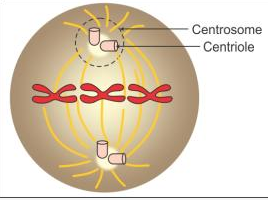
(ii) Centrosome:
– It consists of two cylindrical structures known as centrioles which lie perpendicular to one another, organised as a cartwheel.
– Engirdled by amorphous pericentriolar materials.
– Consists of 9 evenly spaced peripheral fibrils of the tubulin protein, wherein each is a triplet and adjacent triplets are linked to each other.
– The centre of the centriole is a proteinaceous hub attached to the triplets through radial spokes.
– It is critical during cell division as it organises the spindle fibres and astral rays.
Question 8.14. What is a centromere? How does the position of the centromere form the basis of the classification of chromosomes? Support your answer with a diagram showing the position of the centromere on different types of chromosomes.
Solution:
The primary constriction present in a chromosome is called the centromere. The centromere holds two chromatids of a chromosome. Based on the position of the centromere, the chromosomes can be classified into four types:
1. Metacentric: Central centromere forming two equal chromosomal arms.
2. Submetacentric: Centromere is positioned slightly distant from the centre, forming one shorter and one longer arm.
3. Acrocentric: Centromere is located near the end, forming one very long arm and one very short arm.
4. Telocentric: Terminal centromere.
Why Class 11 Biology Chapter 8 Matters in NEET
Class 11 Biology Chapter 8: Cell: The Unit of Life is highly important for NEET because it explains the basic structural and functional unit of all living organisms—the cell. Students learn important concepts such as cell theory, prokaryotic and eukaryotic cells, cell membrane, cell wall, nucleus, cytoplasm, cell organelles, and their functions. NEET frequently includes direct NCERT-based questions on the structure and functions of mitochondria, chloroplasts, endoplasmic reticulum, Golgi apparatus, lysosomes, ribosomes, vacuoles, centrosomes, and cilia and flagella. A thorough understanding of this chapter helps students build a strong foundation in cell biology, molecular biology, genetics, and physiology while improving their performance in the examination.
Preparation Tips for Class 11 Biology Chapter 8
Begin by understanding the cell theory and the basic differences between prokaryotic and eukaryotic cells. Study the structure and functions of the plasma membrane, cell wall, cytoplasm, and nucleus carefully. Pay special attention to the fluid mosaic model of the plasma membrane and the structural differences between plant and animal cells.
Study each cell organelle individually, including mitochondria, chloroplasts, endoplasmic reticulum, Golgi apparatus, lysosomes, ribosomes, vacuoles, centrosomes, peroxisomes, cilia, and flagella. Focus on their structure, functions, and distinguishing features, as NEET often asks direct questions from NCERT descriptions.
Learn the structure of the nucleus, chromosomes, and nucleolus, and understand the organisation of genetic material inside the cell. Prepare comparison tables for prokaryotic vs eukaryotic cells and plant vs animal cells for quick revision. Practise identifying organelles from NCERT diagrams and complete all NCERT diagrams, tables, examples, and exercise questions. Finally, practise NEET previous-year questions regularly and revise important structures, functions, and differences to improve accuracy, speed, and confidence.
FAQs
1. What are the most important topics in Class 11 Biology Chapter 8?
The most important topics include cell theory, prokaryotic and eukaryotic cells, plasma membrane, cell wall, nucleus, chromosomes, and cell organelles such as mitochondria, chloroplasts, ER, Golgi apparatus, lysosomes, ribosomes, vacuoles, and centrosomes. These topics are frequently tested in NEET.
2. What is the cell theory?
The cell theory states that all living organisms are composed of cells and cell products, and the cell is the basic structural and functional unit of life. It also states that all cells arise from pre-existing cells.
3. What is the difference between prokaryotic and eukaryotic cells?
Prokaryotic cells do not possess a true membrane-bound nucleus or membrane-bound organelles, whereas eukaryotic cells have a well-defined nucleus and membrane-bound organelles. Bacteria are examples of prokaryotic organisms, while plants, animals, fungi, and protists are eukaryotic.
4. What is the function of the plasma membrane?
The plasma membrane forms the outer boundary of the cell and regulates the movement of substances into and out of the cell. It is selectively permeable and plays an important role in maintaining the internal environment of the cell.
5. What are the main functions of mitochondria?
Mitochondria are known as the powerhouses of the cell because they are the major sites of aerobic respiration and ATP production. They possess their own DNA and ribosomes and are therefore considered semi-autonomous organelles.
6. What is the function of the Golgi apparatus?
The Golgi apparatus is involved in the modification, packaging, and transport of proteins and lipids. It also plays an important role in the formation of lysosomes and secretion of cellular products.
7. What are the main differences between plant and animal cells?
Plant cells generally possess a cell wall, plastids, and a large central vacuole, while animal cells lack a cell wall and plastids and generally have smaller vacuoles. Animal cells commonly possess centrosomes with centrioles, which are generally absent in higher plant cells.
8. Is Class 11 Biology Chapter 8 important for NEET?
Yes. Class 11 Biology Chapter 8: Cell: The Unit of Life is highly important for NEET because it contains many direct NCERT-based questions on cell structure, cell organelles, their functions, prokaryotic and eukaryotic cells, and differences between plant and animal cells. Regular revision of NCERT diagrams, tables, concepts, and previous-year questions is essential for scoring well in the examination.