
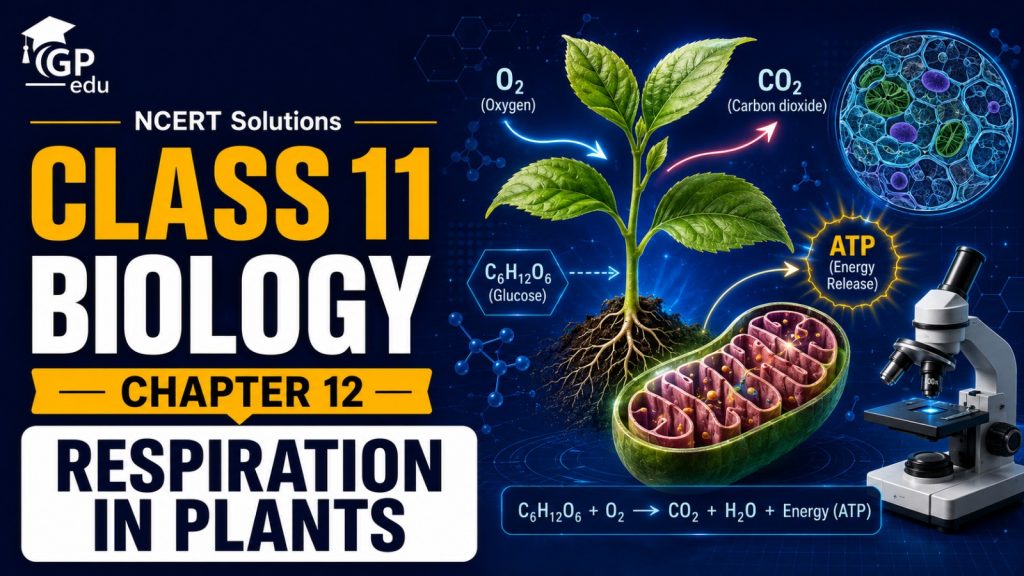
The chapter Respiration in Plants introduces students to the process by which plants break down organic substances to release energy in the form of $\text{ATP}$. It explains the role of cellular respiration, glycolysis, fermentation, the Krebs cycle, electron transport system, and oxidative phosphorylation in energy production.
Students learn about aerobic and anaerobic respiration, glycolysis, the formation of pyruvate, fermentation pathways, and the complete oxidation of glucose through the Krebs cycle and electron transport system. The chapter also covers chemiosmosis, respiratory balance sheet, respiratory quotient ($\text{RQ}$), and the significance of respiration in plants. A clear understanding of Respiration in Plants provides a strong foundation for studying plant physiology, metabolism, energy production, and biochemical processes, making it an important chapter for NEET preparation.
Class 11 Biology Chapter 12 Overview
Students learn about the mechanism of cellular respiration and how carbohydrates and other respiratory substrates are broken down to release energy. The chapter covers glycolysis, including the conversion of glucose into pyruvate, followed by fermentation under anaerobic conditions and the formation of ethanol or lactic acid.
Students are introduced to aerobic respiration, including the Krebs cycle, electron transport system ($\text{ETS}$), oxidative phosphorylation, and chemiosmosis. The chapter also explains the respiratory balance sheet, respiratory quotient ($\text{RQ}$), and the role of carbohydrates, fats, and proteins as respiratory substrates. A clear understanding of Respiration in Plants helps students develop a strong foundation in plant physiology, cellular metabolism, $\text{ATP}$ production, and energy transformation, making it an important chapter for NEET preparation.
NCERT Solutions for Class 11 Biology Chapter 12 – Respiration in Plants
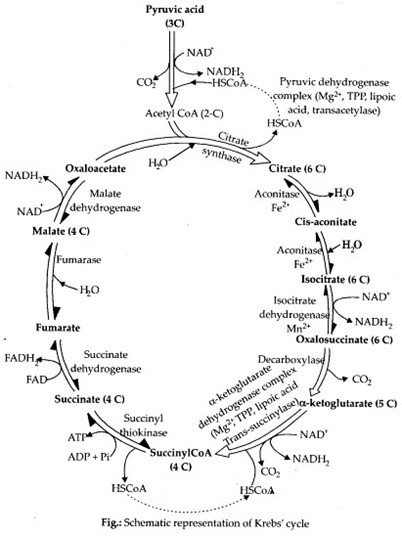
Question 12.1. Give the schematic representation of an overall view of Krebs’ cycle.
Solution:
Question 12.2. Differentiate between
(a) Respiration and Combustion
(b) Glycolysis and Krebs’ cycle
(c) Aerobic respiration and Fermentation
Solution:
(a) Differences between respiration and combustion:
| Respiration | Combustion |
|---|---|
| It is a biochemical process occurring in living cells. | It is a non-living physico-chemical process. |
| Energy is released in steps and trapped as $\text{ATP}$. | Energy is released rapidly in a single step as heat and light. |
| It requires enzymes. | It does not require enzymes. |
(b) Differences between glycolysis and Krebs’ cycle:
| Glycolysis | Krebs’ cycle |
|---|---|
| Occurs in the cytoplasm. | Occurs in the mitochondrial matrix. |
| Does not require oxygen directly. | Requires oxygen indirectly/aerobic conditions. |
| Converts glucose into pyruvate. | Oxidises acetyl-$\text{CoA}$ completely into $\text{CO}_2$ and $\text{H}_2\text{O}$. |
(c) Differences between aerobic respiration and fermentation:
| Aerobic respiration | Fermentation |
|---|---|
| Requires oxygen. | Does not require oxygen. |
| Complete oxidation of glucose yielding $\text{CO}_2$, $\text{H}_2\text{O}$, and large amount of $\text{ATP}$. | Incomplete breakdown yielding alcohol/lactic acid and minimal $\text{ATP}$. |
| Occurs in cytoplasm and mitochondria. | Occurs entirely in the cytoplasm. |
Question 12.3. What are respiratory substrates? Name the most common respiratory substrate.
Solution:
Respiratory substrates are those organic substances which are oxidised during respiration to liberate energy inside the living cells. The common respiratory substrates are carbohydrates, proteins, fats and organic acids. The most common respiratory substrate is glucose. It is a hexose monosaccharide.
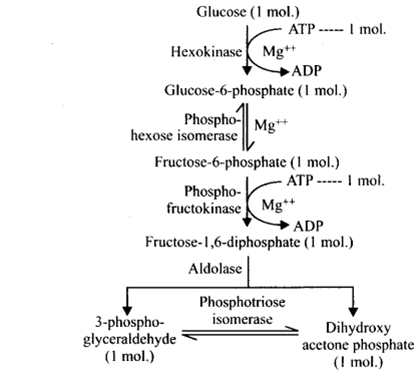
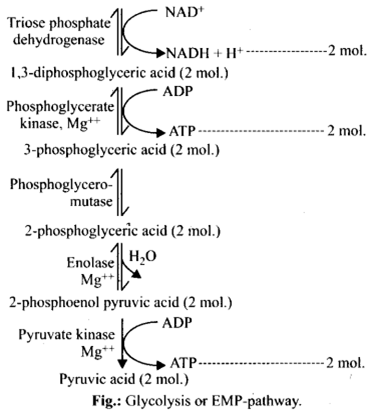
Question 12.4. Give the schematic representation of glycolysis.
Solution:
Question 12.5. Explain ETS.
Solution:
An electron transport chain or system ($\text{ETS}$) is a series of coenzymes and cytochromes that take part in the passage of electrons from a chemical to its ultimate acceptor. Reduced coenzymes participate in electron transport chain. Electron transport takes place on cristae of mitochondria [oxysomes ($F_0\text{-}F_1$ particles) found on the inner surface of the membrane of mitochondria]. $\text{NADH}$ formed in glycolysis and citric acid cycle are oxidised by $\text{NADH}$ dehydrogenase (complex I) and the electrons are transferred to ubiquinone. Ubiquinone also receives reducing equivalents via $\text{FADH}_2$ through the activity of succinate dehydrogenase (complex II). The reduced ubiquinone is then oxidised by transfer of electrons of cytochrome $c$ via cytochrome $bc_1$ complex (complex III). Cytochrome $c$ acts as a mobile carrier between complex III and complex IV. Complex IV refers to cytochrome $c$ oxidase complex containing cytochromes $a$ and $a_3$ and two copper centres. When the electrons are shunted over the carriers via complex I to IV in the electron transport chain, they are coupled to $\text{ATP}$ synthetase (complex V) for the formation of $\text{ATP}$ from $\text{ADP}$ and $P_i$. Oxygen functions as the terminal acceptor of electrons and is reduced to water along with the hydrogen atoms. Reduced coenzymes do not combine directly with molecular $\text{O}_2$. Only their hydrogen or electrons are transferred through various substances and finally reach $\text{O}_2$. Both cytochrome $a$ and $a_3$ form a system called cytochrome oxidase. Copper is also present in cyt $a_3$ in addition to iron. The molecular oxygen that has accepted electrons now receives the protons that were liberated into the surrounding medium to give rise to a molecule of water. The liberated energy is utilised for the synthesis of $\text{ATP}$ from $\text{ADP}$ and $P_i$.
Question 12.6. What are the main steps in aerobic respiration? Where does it take place?
Solution:
Aerobic respiration is an enzymatically controlled release of energy in a stepwise catabolic process of complete oxidation of organic food into carbon dioxide and water with oxygen acting as terminal oxidant. The common pathway of aerobic respiration consists of three steps – glycolysis, Krebs’ cycle and terminal oxidation ($\text{ETS}$). Aerobic respiration takes place within mitochondria (though glycolysis occurs in the cytoplasm). The final product of glycolysis, pyruvate is transported from the cytoplasm into the mitochondria.
Question 12.7. What are the assumptions made during the calculation of net gain of $\text{ATP}$?
Solution:
It is possible to make calculations of the net gain of $\text{ATP}$ for every glucose molecule oxidised; but in reality this can remain only a theoretical exercise. These calculations can be made only on certain assumptions that:
– There is a sequential, orderly pathway functioning, with one substrate forming the next and with glycolysis, TCA cycle and ETS pathway following one after another.
– $\text{NADH}$ synthesised in glycolysis is transferred into the mitochondria and undergoes oxidative phosphorylation.
– None of the intermediates in the pathway are utilised to synthesise any other compound.
– Only glucose is being respired – no other alternative substrates are entering in the pathway at any of the intermediary stages.
These kinds of assumptions are not really valid in a living system; all pathways work simultaneously and do not take place one after another; substrates enter the pathways and are withdrawn from it as and when necessary; $\text{ATP}$ is utilised as and when needed; enzymatic rates are controlled by multiple means. Hence, there can be a net gain of 36 or $38\text{ ATP}$ molecules during aerobic respiration of one molecule of glucose.
Question 12.8. Distinguish between the following:
(a) Aerobic respiration and Anaerobic respiration.
(b) Glycolysis and Fermentation.
(c) Glycolysis and Citric acid cycle.
Solution:
(a) Differences between aerobic and anaerobic respiration:
| Aerobic respiration | Anaerobic respiration |
|---|---|
| Takes place in presence of oxygen. | Takes place in absence of oxygen. |
| End products are $\text{CO}_2$ and $\text{H}_2\text{O}$. | End products are alcohol/lactic acid and $\text{CO}_2$. |
| Yields a large amount of energy ($36\text{–}38\text{ ATP}$). | Yields very little energy ($2\text{ ATP}$). |
(b) Differences between glycolysis and fermentation:
| Glycolysis | Fermentation |
|---|---|
| Common pathway for both aerobic and anaerobic respiration. | Anaerobic pathway following glycolysis. |
| Converts glucose to pyruvate with net gain of $2\text{ ATP}$ and $2\text{ NADH}$. | Converts pyruvate to ethanol/lactic acid without further $\text{ATP}$ net gain. |
(c) Differences between glycolysis and citric acid cycle:
| Glycolysis | Citric acid cycle |
|---|---|
| Takes place in cytoplasm. | Takes place in mitochondrial matrix. |
| Does not involve $\text{CO}_2$ release. | Involves release of $\text{CO}_2$. |
Question 12.9. Discuss “The respiratory pathway is an amphibolic pathway”.
Solution:
Amphibolic pathway is the one which is used for both breakdown (catabolism) and build-up (anabolism) reactions. Respiratory pathway is mainly a catabolic process which serves to run the living system by providing energy. The pathway produces a number of intermediates. Many of them are raw materials for building up both primary and secondary metabolites. Acetyl $\text{CoA}$ is helpful not only in Krebs’ cycle but is also a raw material for synthesis of fatty acids, steroids, terpenes, aromatic compounds and carotenoids. $\alpha$-ketoglutarate is an organic acid which forms glutamate (an important amino acid) on amination. $\text{OAA}$ (Oxaloacetic acid) on amination produces aspartate. Both aspartate and glutamate are components of proteins. Succinyl $\text{CoA}$ forms cytochromes and chlorophyll.
Hence, fatty acids would be broken down to acetyl $\text{CoA}$ before entering the respiratory pathway when it is used as a substrate. But when the organism needs to synthesise fatty acids, acetyl $\text{CoA}$ would be withdrawn from the respiratory pathway for it. Hence, the respiratory pathway comes into the picture both during breakdown and synthesis of fatty acids. Similarly, during breakdown and synthesis of proteins too, respiratory intermediates form the link. Breaking down processes within the living organism are catabolism, and synthesis is anabolism. Because the respiratory pathway is involved in both anabolism and catabolism, it is better to consider the respiratory pathway as an amphibolic pathway rather than strictly as a catabolic one.
Question 12.10. Define $\text{RQ}$. What is its value for fats?
Solution:
Respiratory quotient ($\text{RQ}$) is the ratio of the volume of carbon dioxide produced to the volume of oxygen consumed in respiration over a period of time.
$$\text{RQ} = \frac{\text{Volume of }\text{CO}_2\text{ evolved}}{\text{Volume of }\text{O}_2\text{ consumed}}$$
$\text{RQ}$ is less than one when the respiratory substrate is either fat or protein. For example, for tripalmitin (a fat):
$$\text{C}_{51}\text{H}_{98}\text{O}_6 + 145\text{O}_2 \rightarrow 102\text{CO}_2 + 98\text{H}_2\text{O}$$
$$\text{RQ} = \frac{102\text{CO}_2}{145\text{O}_2} \approx 0.7$$
$\text{RQ}$ is about $0.7$ for most of the common fats.
Question 12.11. What is oxidative phosphorylation?
Solution:
Oxidative phosphorylation is the synthesis of energy-rich $\text{ATP}$ molecules with the help of energy liberated during oxidation of reduced co-enzymes ($\text{NADH}, \text{FADH}_2$) produced in respiration. The enzyme required for this synthesis is called $\text{ATP}$ synthase (complex V). $\text{ATP}$ synthase is located in $F_1$ head piece of $F_0\text{-}F_1$ particles present in the inner mitochondrial membrane. $\text{ATP}$ synthase becomes active in $\text{ATP}$ formation only when there is a proton gradient having higher concentration of $\text{H}^+$ protons on the $F_0$ side as compared to the matrix side (chemiosmotic hypothesis).
Increased proton concentration is produced in the intermembrane space by the pumping of protons with the help of energy liberated by passage of electrons through the $\text{ETS}$. The flow of protons through the $F_0$ channel induces the $F_1$ particle to function as $\text{ATP}$ synthase, attaching a phosphate radical to $\text{ADP}$ to produce $\text{ATP}$. Oxidation of one molecule of $\text{NADH}$ produces $3\text{ ATP}$ molecules (or $2.5\text{ ATP}$ depending on shuttle), while oxidation of $\text{FADH}_2$ forms $2\text{ ATP}$ molecules ($1.5\text{ ATP}$).
Question 12.12. What is the significance of step-wise release of energy in respiration?
Solution:
The utility of step-wise release of energy in respiration are given as follows:
(i) There is a step-wise release of chemical bond energy which is very easily trapped in forming $\text{ATP}$ molecules.
(ii) Cellular temperature is not allowed to rise destructively.
(iii) Wastage of energy is reduced.
(iv) There are several intermediates which can be used in production of a number of biochemicals.
(v) Through their metabolic intermediates different substances can undergo respiratory catabolism.
(vi) Each step of respiration is controlled by its own enzyme, helping in controlling the rate of respiration and the amount of energy liberated.
Why Class 11 Biology Chapter 12 Matters in NEET
Class 11 Biology Chapter 12: Respiration in Plants is highly important for NEET because it explains how plants break down organic substances to release energy in the form of $\text{ATP}$. Students learn important concepts such as glycolysis, fermentation, aerobic respiration, the Krebs cycle, electron transport system, oxidative phosphorylation, chemiosmosis, respiratory balance sheet, and respiratory quotient ($\text{RQ}$). NEET frequently includes direct NCERT-based questions on glycolysis, pyruvate oxidation, fermentation, Krebs cycle, $\text{ATP}$ production, electron transport, oxidative phosphorylation, and factors related to respiration. A thorough understanding of this chapter helps students build a strong foundation in plant physiology, cellular metabolism, energy production, and biochemical processes while improving their performance in the examination.
Preparation Tips for Class 11 Biology Chapter 12
Begin by understanding the basic concept of respiration in plants and the difference between aerobic and anaerobic respiration. Study glycolysis carefully, including the major steps involved in the conversion of glucose into pyruvate and the production and utilisation of $\text{ATP}$ and $\text{NADH}$.
Study fermentation and understand the formation of ethanol and carbon dioxide during alcoholic fermentation. Then learn aerobic respiration, including pyruvate oxidation, the Krebs cycle, and the production of $\text{ATP}$, $\text{NADH}$, and $\text{FADH}_2$. Pay special attention to the location of each process within the cell.
Study the electron transport system and oxidative phosphorylation carefully and understand the role of chemiosmosis and the proton gradient in $\text{ATP}$ synthesis. Revise the respiratory balance sheet and understand the concept of Respiratory Quotient ($\text{RQ}$) for different respiratory substrates.
FAQs
1. What are the most important topics in Class 11 Biology Chapter 12?
The most important topics include glycolysis, fermentation, aerobic respiration, pyruvate oxidation, Krebs cycle, electron transport system, oxidative phosphorylation, chemiosmosis, respiratory balance sheet, and respiratory quotient ($\text{RQ}$). These topics are frequently tested in NEET.
2. What is respiration in plants?
Respiration is the process by which organic substances such as glucose are broken down to release energy, which is captured mainly in the form of $\text{ATP}$ and used for various cellular activities.
3. What is glycolysis?
Glycolysis is the process in which one molecule of glucose is converted into two molecules of pyruvate through a series of enzymatic reactions. It occurs in the cytoplasm and does not directly require oxygen.
4. What is fermentation?
Fermentation is an anaerobic process in which pyruvate is converted into products such as ethanol and carbon dioxide in alcoholic fermentation or other products depending on the organism. It occurs in the absence of sufficient oxygen.
5. What is the Krebs cycle?
The Krebs cycle, also called the citric acid cycle or TCA cycle, is a series of reactions that occurs in the mitochondrial matrix in eukaryotic cells. It involves the oxidation of acetyl-$\text{CoA}$ and produces $\text{NADH}$, $\text{FADH}_2$, $\text{ATP}/\text{GTP}$, and $\text{CO}_2$.
6. What is the electron transport system?
The electron transport system ($\text{ETS}$) is a series of electron carriers located in the inner mitochondrial membrane. Electrons from $\text{NADH}$ and $\text{FADH}_2$ pass through these carriers, creating a proton gradient that helps drive $\text{ATP}$ synthesis.
7. What is oxidative phosphorylation?
Oxidative phosphorylation is the process of $\text{ATP}$ synthesis associated with the oxidation of reduced electron carriers through the electron transport system. The energy released during electron transfer is used to establish a proton gradient that drives $\text{ATP}$ synthesis through $\text{ATP}$ synthase.
8. What is Respiratory Quotient ($\text{RQ}$)?
Respiratory Quotient ($\text{RQ}$) is the ratio of the volume of $\text{CO}_2$ evolved to the volume of $\text{O}_2$ consumed during respiration.
$$\text{RQ} = \frac{\text{CO}_2\text{ evolved}}{\text{O}_2\text{ consumed}}$$
The $\text{RQ}$ varies depending on the respiratory substrate being oxidised.
9. What is the difference between aerobic and anaerobic respiration?
Aerobic respiration generally involves oxygen and results in more complete oxidation of respiratory substrates with a higher energy yield. Anaerobic respiration or fermentation occurs without sufficient oxygen and produces partially oxidised products with a much lower energy yield.