
The chapter Photosynthesis in Higher Plants introduces students to the process by which green plants capture light energy and convert it into chemical energy to synthesise food. It explains the role of chloroplasts, photosynthetic pigments, light reactions, electron transport, photophosphorylation, and carbon fixation in photosynthesis.
Students learn about light harvesting complexes, Photosystem I and Photosystem II, photolysis of water, cyclic and non-cyclic photophosphorylation, and chemiosmosis. The chapter also covers the Calvin cycle, $C_3$ and $C_4$ pathways, photorespiration, and factors affecting photosynthesis. A clear understanding of Photosynthesis in Higher Plants provides a strong foundation for studying plant physiology, metabolism, energy conversion, and biochemical processes, making it an important chapter for NEET preparation.
Class 11 Biology Chapter 11 Overview
Students learn about the mechanism of photosynthesis and the role of different photosynthetic pigments, including chlorophyll and carotenoids. The chapter covers the light-dependent reactions, including Photosystem I, Photosystem II, electron transport, photolysis of water, ATP formation, and NADPH production.
Students are introduced to the Calvin cycle and its major stages—carbon fixation, reduction, and regeneration. The chapter also explains the $C_3$ and $C_4$ pathways, Kranz anatomy, photorespiration, and the major factors affecting the rate of photosynthesis, such as light intensity, $\text{CO}_2$ concentration, temperature, and water availability. A clear understanding of Photosynthesis in Higher Plants helps students develop a strong foundation in plant physiology, energy metabolism, carbon fixation, and biochemical processes, making it an important chapter for NEET preparation.
NCERT Solutions for Class 11 Biology
Chapter 11 – Photosynthesis in Higher Plants
Question 11.1. By looking at a plant externally can you tell whether a plant is $C_3$ or $C_4$? Why and how?
Solution:
It is not possible to distinguish externally between a $C_3$ and $C_4$ plant, but generally tropical plants are adapted for the $C_4$ cycle.
Question 11.2. By looking at which internal structure of a plant can you tell whether a plant is $C_3$ or $C_4$? Explain.
Solution:
$C_4$ plants live in hot moist or arid and nonsaline or saline habitats. Internally the leaves show Kranz anatomy. In Kranz anatomy, the mesophyll is undifferentiated and its cells occur in concentric layers around vascular bundles. Vascular bundles are surrounded by large-sized bundle sheath cells which are arranged in a wreath-like manner (Kranz – wreath). The mesophyll and bundle sheath cells are connected by plasmodesmata or cytoplasmic bridges. The chloroplasts of the mesophyll cells are smaller. They have well-developed grana and a peripheral reticulum but no starch. Mesophyll cells are specialised to perform light reaction, evolve $\text{O}_2$ and produce assimilatory power ($\text{ATP}$ and $\text{NADPH}$). They also possess enzyme PEPcase for initial fixation of $\text{CO}_2$. The chloroplasts of the bundle sheath cells are agranal.
Question 11.3. Even though very few cells in a $C_4$ plant carry out the biosynthetic – Calvin pathway, yet they are highly productive. Can you discuss why?
Solution:
Since, through the $C_4$ cycle, a plant can photosynthesise even in the presence of very low concentration of $\text{CO}_2$ (up to $10\text{ parts per million}$), the partial closure of stomata due to xeric conditions would not bring much effect. Therefore, the plants can adapt to grow at low water content, high temperature and bright light intensities. This cycle is specially suited to such plants which grow in dry climates of tropics and subtropics. Besides, the photosynthetic rate remains higher due to the absence of photorespiration in these plants. It can be visualised that both the $C_4$ cycle and photorespiration are the result of evolution or might have been one of the reasons of evolution for the adaptation of plants to different environments. $C_4$ plants are about twice as efficient as $C_3$ plants in converting solar energy into the production of dry matter.
Question 11.4. RuBisCO is an enzyme that acts both as a carboxylase and oxygenase. Why do you think RuBisCO carries out more carboxylation in $C_4$ plants?
Solution:
RuBisCO is an enzyme which acts both as carboxylase (carboxylation during photosynthesis) and oxygenase (during photorespiration). But RuBisCO carries out more carboxylation in $C_4$ plants. In $C_4$ plants, initial fixation of carbon dioxide occurs in mesophyll cells. The primary acceptor of $\text{CO}_2$ is phosphoenol pyruvate or PEP. It combines with carbon dioxide in the presence of PEP carboxylase or PEPcase to form oxaloacetic acid or oxaloacetate. Malic acid or aspartic acid is translocated to bundle sheath cells through plasmodesmata. Inside the bundle sheath cells they are decarboxylated (and deaminated in case of aspartic acid) to form pyruvate and $\text{CO}_2$. $\text{CO}_2$ is again fixed inside the bundle sheath cells through the Calvin cycle. RuBP of the Calvin cycle is called secondary or final acceptor of $\text{CO}_2$ in $C_4$ plants. Pyruvate is sent back to mesophyll cells.
Question 11.5. Suppose there were plants that had a high concentration of chlorophyll b, but lacked chlorophyll a, would it carry out photosynthesis? Then why do plants have chlorophyll b and other accessory pigments?
Solution:
Plants that do not possess chlorophyll a will not carry out photosynthesis because it is the primary pigment and acts as the reaction centre. It performs the primary reactions of photosynthesis or conversion of light into chemical or electrical energy. Other photosynthetic pigments are called accessory pigments. They absorb light energy of different wavelengths and hence broaden the spectrum of light absorbed by photosynthetic pigments. These pigments hand over the absorbed energy to chlorophyll a.
Question 11.6. Give comparison between the following:
(a) $C_3$ and $C_4$ pathways
(b) Cyclic and non-cyclic photophosphorylation
(c) Anatomy of leaf in $C_3$ and $C_4$ plants.
Solution:
(a) The differences between $C_3$ and $C_4$ pathways:
– In $C_3$ pathways, the first stable product is a 3-carbon compound ($3\text{-PGA}$), whereas in $C_4$ pathways, it is a 4-carbon compound ($\text{OAA}$).
– $C_3$ plants lack Kranz anatomy, whereas $C_4$ plants exhibit Kranz anatomy.
(b) The differences between cyclic and non-cyclic photophosphorylation:
– Cyclic photophosphorylation involves only Photosystem I, produces only $\text{ATP}$, and does not involve photolysis of water or $\text{NADPH}$ formation.
– Non-cyclic photophosphorylation involves both Photosystem I and II, produces $\text{ATP}$ and $\text{NADPH}$, and involves photolysis of water with evolution of $\text{O}_2$.
(c) Differences between the leaf anatomy of $C_3$ and $C_4$ plants:
– $C_3$ leaves do not have bundle sheath chloroplast dimorphism.
– $C_4$ leaves possess Kranz anatomy with distinct bundle sheath cells surrounding vascular bundles containing large chloroplasts.
Question 11.7. Look at leaves of the same plant on the shady side and compare it with the leaves on the sunny side. Or compare the potted plants kept in the sunlight with those in the shade. Which of them has leaves that are darker green? Why?
Solution:
The leaves of the shaded side are darker green than those kept in sunlight due to two reasons:
(i) The chloroplasts occur mostly in the mesophyll cells along their walls for receiving optimum quantity of incident light.
(ii) The chloroplasts align themselves in vertical position along the lateral walls in high light intensity and along tangential walls in moderate light.
Question 11.8. The given figure shows the effect of light on the rate of photosynthesis. Based on the graph, answer the following questions.
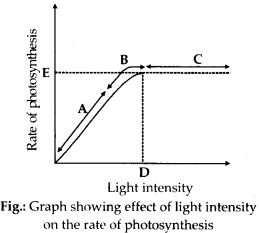
(a) At which point/s (A, B or C) in the curve is light a limiting factor?
(b) What could be the limiting factor/s in region A?
(c) What do C and D represent on the curve?
Solution:
(a) At regions A and B light is the limiting factor.
(b) In the region A, light can be a limiting factor.
(c) C is the region where the rate of photosynthesis is not increased when light intensity is increased. D is the point where some other factors become limiting.
Question 11.9. Why does the colour of a leaf kept in the dark frequently become yellow, or pale green? Which pigment do you think is more stable?
Solution:
Carotenoid pigments are found in all photosynthetic cells. They are accessory pigments also found in roots, petals etc. These pigments do not breakdown easily thus temporarily reveal their colour due to unmasking, following breakdown of chlorophylls. Thus the colour of leaf kept in dark is yellow or pale green.
Why Class 11 Biology Chapter 11 Matters in NEET
Class 11 Biology Chapter 11: Photosynthesis in Higher Plants is highly important for NEET because it explains the process by which green plants convert light energy into chemical energy and prepare food. Students learn important concepts such as photosynthetic pigments, light reaction, photophosphorylation, electron transport, chemiosmosis, Calvin cycle, $C_3$ and $C_4$ pathways, photorespiration, and factors affecting photosynthesis. NEET frequently includes direct NCERT-based questions on chlorophyll, photosystems, cyclic and non-cyclic photophosphorylation, $\text{ATP}$ and $\text{NADPH}$ formation, Calvin cycle, RuBisCO, $C_3$ and $C_4$ plants, and the role of light, $\text{CO}_2$, temperature, and water. A thorough understanding of this chapter helps students build a strong foundation in plant physiology, metabolism, energy conversion, and cellular processes while improving their performance in the examination.
Preparation Tips for Class 11 Biology Chapter 11
Begin by understanding the basic concept of photosynthesis and the role of chloroplasts and photosynthetic pigments. Study the structure and functions of chlorophyll a, chlorophyll b, carotenoids, and xanthophylls, along with their role in absorbing light energy. Pay special attention to the light reaction, including Photosystem I, Photosystem II, electron transport, photolysis of water, $\text{ATP}$ formation, and $\text{NADPH}$ production.
Study cyclic and non-cyclic photophosphorylation carefully and understand the role of chemiosmosis in $\text{ATP}$ synthesis. Then learn the Calvin cycle, including carbon fixation, reduction, and regeneration phases, along with the role of RuBisCO. Pay special attention to the differences between $C_3$ and $C_4$ pathways, including the anatomy and functions of Kranz anatomy, and understand the significance of photorespiration.
Revise the factors affecting photosynthesis, including light intensity, $\text{CO}_2$ concentration, temperature, and water availability. Prepare comparison tables for cyclic vs non-cyclic photophosphorylation, $C_3$ vs $C_4$ plants, and light reaction vs dark reaction for quick revision. Practise identifying pathways and structures from NCERT diagrams, complete all NCERT diagrams, tables, examples, and exercise questions, and finally practise NEET previous-year questions regularly to improve accuracy, speed, and confidence.
FAQs
1. What are the most important topics in Class 11 Biology Chapter 11?
The most important topics include photosynthetic pigments, light reaction, Photosystem I, Photosystem II, photophosphorylation, electron transport, chemiosmosis, Calvin cycle, $C_3$ and $C_4$ pathways, photorespiration, and factors affecting photosynthesis. These topics are frequently tested in NEET.
2. What is photosynthesis?
Photosynthesis is the process by which green plants use light energy to synthesise organic compounds, mainly carbohydrates, from carbon dioxide and water, with the release of oxygen as a by-product.
3. What are the main photosynthetic pigments?
The main photosynthetic pigments include chlorophyll a, chlorophyll b, carotenoids, and xanthophylls. Chlorophyll a is the chief pigment associated with photosynthesis, while other pigments help absorb light and transfer energy to chlorophyll a.
4. What is photophosphorylation?
Photophosphorylation is the process of formation of $\text{ATP}$ from $\text{ADP}$ and inorganic phosphate using light energy during photosynthesis. It may be cyclic or non-cyclic depending on the pathway followed by electrons.
5. What is the Calvin cycle?
The Calvin cycle is the series of light-independent reactions in which carbon dioxide is fixed and converted into carbohydrates. It involves three major stages: carboxylation, reduction, and regeneration of the $\text{CO}_2$ acceptor.
6. What is the difference between $C_3$ and $C_4$ plants?
In $C_3$ plants, the first stable product of carbon fixation is a three-carbon compound, 3-phosphoglyceric acid ($3\text{-PGA}$). In $C_4$ plants, the first stable product is a four-carbon compound, oxaloacetic acid ($\text{OAA}$). $C_4$ plants also show Kranz anatomy and have an efficient mechanism for reducing photorespiration.
7. What is photorespiration?
Photorespiration is a process associated mainly with $C_3$ plants in which RuBisCO acts as an oxygenase and leads to the uptake of oxygen and release of carbon dioxide. It reduces the efficiency of photosynthesis under certain conditions.
8. What factors affect photosynthesis?
The major factors affecting photosynthesis include light intensity, light quality, carbon dioxide concentration, temperature, and water availability. The rate of photosynthesis changes according to the availability of these factors.
9. Is Class 11 Biology Chapter 11 important for NEET?
Yes. Class 11 Biology Chapter 11: Photosynthesis in Higher Plants is highly important for NEET because it contains many direct NCERT-based questions on photosynthetic pigments, light reactions, photophosphorylation, Calvin cycle, $C_3$ and $C_4$ pathways, photorespiration, and factors affecting photosynthesis. Regular revision of NCERT diagrams, pathways, tables, concepts, and previous-year questions is essential for scoring well in the examination.