
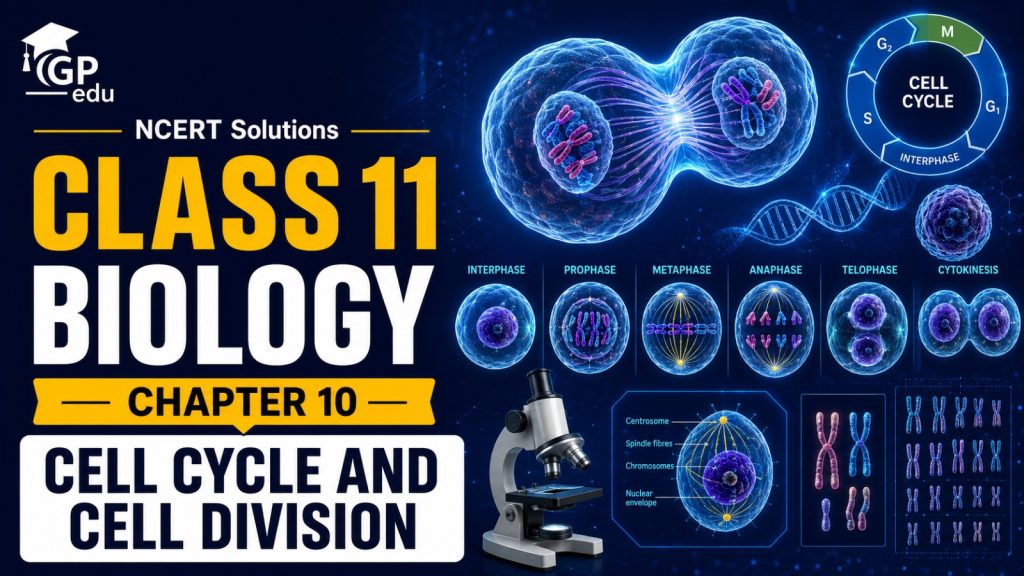
The chapter Cell Cycle and Cell Division introduces students to the process by which cells grow, replicate their genetic material, and divide to produce new cells. It explains the different stages of the cell cycle, including interphase and the M phase, along with the important events that occur during each stage.
Students learn about $G_1$, $S$, and $G_2$ phases of interphase, followed by mitosis and cytokinesis. The chapter also covers the different stages of mitosis and meiosis, including prophase, metaphase, anaphase, and telophase, along with important events such as synapsis, crossing over, chiasmata formation, and reduction in chromosome number. A clear understanding of Cell Cycle and Cell Division provides a strong foundation for studying growth, reproduction, genetics, heredity, and molecular biology, making it an important topic for NEET preparation.
Class 11 Biology Chapter 10 Overview
Students learn about the cell cycle and its major phases, including $G_1$, $S$, $G_2$, and $M$ phases, along with the important events associated with cell growth and DNA replication. The chapter also covers mitosis, meiosis, and cytokinesis, explaining the sequence of stages and chromosome behaviour during cell division.
Students are introduced to the significance of mitosis in growth and repair and meiosis in sexual reproduction and genetic variation. Important concepts such as synapsis, crossing over, chiasmata, homologous chromosome separation, and reduction division are also covered. A clear understanding of Cell Cycle and Cell Division helps students develop a strong foundation in cell biology, genetics, reproduction, growth, and heredity, making it an important chapter for NEET preparation.
NCERT Solutions for Class 11 Biology Chapter 10 – Cell Cycle Cell Division
Question 10.1. What is the average cell cycle span for a mammalian cell?
Answer:
The average cell cycle span for a mammalian cell is approximately $24\text{ hours}$. This cycle includes various stages such as interphase (which consists of $G_1$, $S$, and $G_2$ phases) and the mitotic phase ($M$ phase), during which cell division takes place.
Question 10.2. Distinguish cytokinesis from karyokinesis.
Answer:
Cytokinesis is the division of the cytoplasm that occurs at the end of the cell cycle, resulting in two separate daughter cells. It begins during the late stages of the mitotic phase.
Karyokinesis refers to the division of the cell’s nucleus during mitosis or meiosis, resulting in the separation of the genetic material into two sets, one for each daughter cell.
Question 10.3. Describe the events taking place during interphase.
Answer:
Interphase is the phase where the cell prepares for division and is divided into three stages:
– $G_1$ phase (Gap 1): The cell is metabolically active, growing in size and synthesizing proteins for DNA replication.
– $S$ phase (Synthesis): DNA replication occurs, doubling the DNA content of the cell. The chromosome number remains the same, but each chromosome consists of two chromatids.
– $G_2$ phase (Gap 2): The cell continues to grow and synthesizes proteins needed for mitosis. It also ensures that the DNA replication is accurate before cell division begins.
Question 10.4. What is the $G_0$ (quiescent phase) of the cell cycle?
Answer:
The $G_0$ phase is a resting phase where cells are no longer dividing. It occurs when cells exit the $G_1$ phase and enter a dormant state. Cells in the $G_0$ phase can either remain inactive indefinitely or re-enter the cell cycle when needed, such as during tissue repair or cell regeneration.
Question 10.5. Why is mitosis called equational division?
Answer:
Mitosis is called equational division because it results in two daughter cells that are genetically identical to the parent cell, with the same number of chromosomes. The chromosome number does not change, and each daughter cell receives an equal and identical set of chromosomes.
Question 10.6. Name the stage of cell cycle at which one of the following events occur:
(i) Chromosomes are moved to spindle equator.
(ii) Centromere splits and chromatids separate.
(iii) Pairing between homologous chromosomes takes place.
(iv) Crossing over between homologous chromosomes takes place.
Answer:
(i) Chromosomes are moved to the spindle equator in Metaphase. During this stage, chromosomes align along the metaphase plate, positioned equidistantly from the two poles of the spindle.
(ii) Centromere splits and chromatids separate in Anaphase. Here, the centromeres divide, and the sister chromatids are pulled toward opposite poles of the cell.
(iii) Pairing between homologous chromosomes takes place in the Zygotene stage of Prophase I in meiosis. During zygotene, homologous chromosomes pair up closely in a process known as synapsis.
(iv) Crossing over between homologous chromosomes takes place during the Pachytene stage of Prophase I in meiosis. In this stage, homologous chromosomes exchange segments of genetic material, contributing to genetic diversity.
Question 10.7. Describe the following:
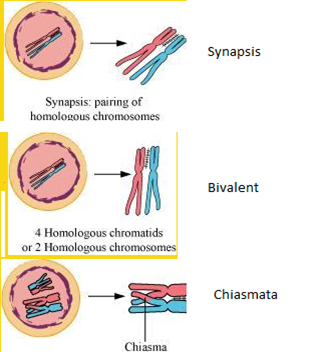
(a) synapsis (b) bivalent (c) chiasmata
Draw a diagram to illustrate your answer.
Answer:
(a) Synapsis: Synapsis is the pairing of homologous chromosomes during Zygotene in Prophase I of meiosis, where they align closely and exchange genetic material.
(b) Bivalent: A bivalent or tetrad refers to a pair of homologous chromosomes, each made up of two sister chromatids, that are synapsed during Zygotene.
(c) Chiasmata: Chiasmata are X-shaped structures formed during Diplotene of meiosis, where crossing over occurs between homologous chromosomes, exchanging genetic material.
Question 10.8. How does cytokinesis in plant cells differ from that in animal cells?
Answer:
In plant cells, cytokinesis occurs by the formation of a cell plate, which eventually forms the new cell wall.
In animal cells, cytokinesis occurs by cleavage, where the cell membrane pinches inwards to divide the cell into two. The process begins at the periphery and moves inward, forming a midbody at the center of the cell.
Question 10.9. Find examples where the four daughter cells from meiosis are equal in size and where they are unequal in size.
Answer:
In the formation of male gametes (sperms) in humans, the four daughter cells formed during meiosis are equal in size. In the formation of female gametes (ova), three smaller polar bodies are produced, leaving one large ovum, resulting in unequal daughter cells.
Question 10.10. Distinguish anaphase of mitosis from anaphase I of meiosis.
Answer:
In Anaphase of mitosis, the centromere splits, and sister chromatids separate, moving toward opposite poles. In Anaphase I of meiosis, the centromere does not split. Instead, homologous chromosomes are pulled apart, and sister chromatids remain connected at their centromere.
Question 10.11. List the main differences between mitosis and meiosis.
Answer:
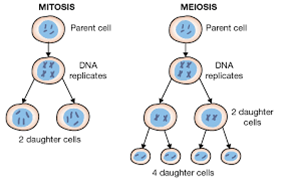
Mitosis: Occurs in somatic cells, results in two identical daughter cells, and maintains the same chromosome number.
Meiosis: Occurs in germ cells, results in four non-identical daughter cells, and halves the chromosome number to create gametes for sexual reproduction.
Question 10.12. What is the significance of meiosis?
Answer:
Meiosis is essential for sexual reproduction as it reduces the chromosome number by half, ensuring that offspring inherit the correct number of chromosomes. It promotes genetic diversity through crossing over and independent assortment, which is important for evolution.
Question 10.13. Discuss haploid insects and lower plants where cell division occurs.
Answer:
Haploid insects like drones of honeybees undergo cell division by mitosis.
Lower plants like Spirogyra, Chlamydomonas, and certain pteridophytes also undergo mitosis for reproduction and growth.
Question 10.14. Can there be mitosis without DNA replication in the S phase?
Answer:
No, DNA replication is essential for mitosis. Without replication during the $S$ phase, the cell would not have enough genetic material to divide properly.
Question 10.15. Can there be DNA replication without cell division?
Answer:
Yes, DNA replication can occur without cell division. For example, during the preparation for meiosis, DNA replication takes place without immediate cell division, allowing the chromosomes to duplicate.
Question 10.16. Analyse the events during every stage of the cell cycle and notice how the following two parameters change:
(i) the number of chromosomes ($N$) per cell
(ii) the amount of DNA content ($C$) per cell
Answer:
(i) The number of chromosomes ($N$) per cell:
– $G_1$ phase: The number of chromosomes remains the same as the parent cell (diploid in somatic cells). Each chromosome consists of a single chromatid.
– $S$ phase: DNA replication occurs, but the number of chromosomes does not change. Each chromosome now consists of two sister chromatids, but the chromosome count ($N$) stays the same.
– $G_2$ phase: The number of chromosomes remains the same, as the cell continues to grow and prepare for mitosis.
– $M$ phase (mitosis): The chromosome number stays the same as the chromatids separate during anaphase, ensuring that the two daughter cells receive an identical set of chromosomes ($N$).
Thus, throughout the cell cycle, the number of chromosomes ($N$) does not change, but the structure of the chromosomes changes from a single chromatid in $G_1$ to two sister chromatids in $S$ and $G_2$, before separating during mitosis.
(ii) The amount of DNA content ($C$) per cell:
– $G_1$ phase: The DNA content is at its baseline ($C$), representing one copy of the DNA per chromosome.
– $S$ phase: DNA replication takes place, and the DNA content doubles. Each chromosome now consists of two sister chromatids, effectively doubling the DNA content ($2C$).
– $G_2$ phase: The DNA content remains doubled ($2C$) as the cell prepares for division, and no further DNA replication occurs.
– $M$ phase: As the chromatids are separated into two daughter cells, the DNA content is halved back to the baseline ($C$) in each daughter cell.
Thus, the DNA content doubles during $S$ phase ($2C$) and then is halved in the $M$ phase ($C$) as the cell divides into two.
Why Class 11 Biology Chapter 10 Matters in NEET
Class 11 Biology Chapter 10: Cell Cycle and Cell Division is highly important for NEET because it explains the process by which cells grow, duplicate their genetic material, and divide to produce new cells. Students learn important concepts such as the cell cycle, interphase, mitosis, meiosis, chromosome behaviour, cytokinesis, and the significance of cell division. NEET frequently includes direct NCERT-based questions on the different phases of the cell cycle, stages of mitosis and meiosis, chromosome number, crossing over, synapsis, and differences between mitosis and meiosis. A thorough understanding of this chapter helps students build a strong foundation in genetics, reproduction, growth, development, and molecular biology while improving their performance in the examination.
Preparation Tips for Class 11 Biology Chapter 10
Begin by understanding the cell cycle and its major phases, including $G_1$, $S$, $G_2$, and $M$ phases. Study the important events occurring during each phase, especially DNA replication during the $S$ phase. Understand the importance of cell-cycle regulation and how cells progress from one phase to another.
Study mitosis carefully, including prophase, metaphase, anaphase, telophase, and cytokinesis. Focus on chromosome behaviour and the changes that occur during each stage. Then study meiosis I and meiosis II in detail, paying special attention to synapsis, crossing over, chiasmata, homologous chromosome separation, and reduction in chromosome number.
Prepare comparison tables for mitosis vs meiosis and revise the chromosome number and major events at each stage. Practise identifying different stages of cell division from NCERT diagrams and learn the sequence of events accurately. Complete all NCERT diagrams, tables, examples, and exercise questions. Finally, practise NEET previous-year questions regularly and revise important stages, terminology, chromosome behaviour, and differences between mitosis and meiosis to improve accuracy, speed, and confidence.
FAQs
1. What are the most important topics in Class 11 Biology Chapter 10?
The most important topics include cell cycle, interphase, $G_1$ phase, $S$ phase, $G_2$ phase, mitosis, meiosis, cytokinesis, chromosome behaviour, crossing over, synapsis, and differences between mitosis and meiosis. These topics are frequently tested in NEET.
2. What is the cell cycle?
The cell cycle is the sequence of events through which a cell grows, duplicates its genetic material, and divides into daughter cells. It consists mainly of interphase and the $M$ phase.
3. What are the phases of interphase?
Interphase consists of three major phases: $G_1$, $S$, and $G_2$. During $G_1$, the cell grows and performs normal activities; during $S$ phase, DNA replication occurs; and during $G_2$, the cell prepares for division.
4. What is mitosis?
Mitosis is a type of cell division in which one parent cell produces two genetically similar daughter cells, generally maintaining the same chromosome number as the parent cell. It is important for growth, repair, and asexual reproduction in some organisms.
5. What is meiosis?
Meiosis is a specialised type of cell division that involves two successive divisions and produces cells with half the chromosome number of the parent cell. It is important for the formation of gametes in sexually reproducing organisms.
6. What is crossing over?
Crossing over is the exchange of genetic material between non-sister chromatids of homologous chromosomes during pachytene of prophase I of meiosis. It contributes to genetic variation.
7. What is the difference between mitosis and meiosis?
Mitosis involves one division and generally produces two genetically similar daughter cells with the same chromosome number. Meiosis involves two successive divisions and produces four genetically different haploid cells, with chromosome number reduced by half.
8. What is the significance of meiosis?
Meiosis maintains the chromosome number of a species across generations by producing haploid gametes. It also generates genetic variation through processes such as crossing over and independent assortment, which are important for evolution and adaptation.
9. Is Class 11 Biology Chapter 10 important for NEET?
Yes. Class 11 Biology Chapter 10: Cell Cycle and Cell Division is highly important for NEET because it contains many direct NCERT-based questions on cell-cycle phases, mitosis, meiosis, chromosome behaviour, crossing over, and cytokinesis. Regular revision of NCERT diagrams, stages, tables, concepts, and previous-year questions is essential for scoring well in the examination.