
Waves are a fundamental concept in physics that describe the propagation of a disturbance through a medium or space, transferring energy from one point to another without the transfer of matter. In Class 11 Physics Chapter 14, “Waves,” students learn about the nature and types of waves, transverse and longitudinal waves, wave motion, displacement relation in a progressive wave, wave parameters such as amplitude, wavelength, frequency, time period, and wave velocity, as well as the principle of superposition, reflection of waves, and standing waves.
Class 11 Physics Chapter 14 Overview
The Waves chapter explains how disturbances travel through a medium or space by transferring energy without transferring matter. Students learn about transverse and longitudinal waves, wave motion, wavelength, frequency, time period, amplitude, and wave velocity. The chapter also covers progressive waves, standing waves, and the principle of superposition, providing a strong foundation for understanding sound, light, and other wave phenomena.
NCERT Solutions for Class 11 Physics Chapter 14: Waves
Question 14.1. A string of mass $2.50\text{ kg}$ is under a tension of $200\text{ N}$. The length of the stretched string is $20.0\text{ m}$. If the transverse jerk is struck at one end of the string, how long does the disturbance take to reach the other end?
Solution :
Mass of the string, $M = 2.50\text{ kg}$
Tension in the string, $T = 200\text{ N}$
Length of the string, $l = 20.0\text{ m}$
Mass per unit length, $\mu = \frac{M}{l} = \frac{2.50}{20} = 0.125\text{ kg m}^{-1}$
The velocity ($v$) of the transverse wave in the string is given by the relation:
$$v = \sqrt{\frac{T}{\mu}}$$
$$v = \sqrt{\frac{200}{0.125}} = \sqrt{1600} = 40\text{ m/s}$$
$\therefore$ Time taken by the disturbance to reach the other end, $t = \frac{l}{v} = \frac{20}{40} = 0.5\text{ s}$.
Question 14.2. A stone dropped from the top of a tower of height $300\text{ m}$ high splashes into the water of a pond near the base of the tower. When is the splash heard at the top given that the speed of sound in air is $340\text{ m s}^{-1}$? ($g = 9.8\text{ m s}^{-2}$)
Solution :
Height of the tower, $s = 300\text{ m}$
Initial velocity of the stone, $u = 0$
Acceleration, $a = g = 9.8\text{ m/s}^2$
Speed of sound in air = $340\text{ m/s}$
The time ($t_1$) taken by the stone to strike the water in the pond can be calculated using the second equation of motion, as:
$$s = ut_1 + \frac{1}{2}gt_1^2$$
$$300 = 0 + \frac{1}{2} \times 9.8 \times t_1^2$$
$$\therefore t_1 = \sqrt{\frac{300 \times 2}{9.8}} = 7.82\text{ s}$$
Time taken by the sound to reach the top of the tower, $t_2 = \frac{300}{340} = 0.88\text{ s}$
Therefore, the time after which splash is heard, $t = t_1 + t_2$
$t = 7.82 + 0.88 = 8.7\text{ s}$.
Question 14.3. A steel wire has a length of $12.0\text{ m}$ and a mass of $2.10\text{ kg}$. What should be the tension in the wire so that speed of a transverse wave on the wire equals the speed of sound in dry air at $20\text{ }^\circ\text{C} = 343\text{ m s}^{-1}$.
Solution :
Length of the steel wire, $l = 12\text{ m}$
Mass of the steel wire, $m = 2.10\text{ kg}$
Velocity of the transverse wave, $v = 343\text{ m/s}$
Mass per unit length, $\mu = \frac{m}{l} = \frac{2.10}{12} = 0.175\text{ kg m}^{-1}$
For Tension $T$, velocity of the transverse wave can be obtained using the relation:
$$v = \sqrt{\frac{T}{\mu}}$$
$$\therefore T = v^2 \mu$$
$$T = (343)^2 \times 0.175 = 20588.575 \approx 2.06 \times 10^4\text{ N}.$$
Question 14.4 Use the formula $v = \sqrt{\frac{\gamma P}{\rho}}$ to explain why the speed of sound in air
a. is independent of pressure,
b. increases with temperature,
c. increases with humidity.
Solution :
a. Take the relation:
$$v = \sqrt{\frac{\gamma P}{\rho}} \quad \text{….(i)}$$
where,
Density, $\rho = \frac{\text{Mass}}{\text{Volume}} = \frac{M}{V}$
$M = \text{Molecular weight of the gas}$
$V = \text{Volume of the gas}$
Hence, equation (i) reduces to:
$$v = \sqrt{\frac{\gamma PV}{M}} \quad \text{….(ii)}$$
Now from the ideal gas equation for $n = 1$:
$$PV = RT$$
For constant $T$, $PV = \text{Constant}$
Since both $M$ and $\gamma$ are constants, $v = \text{Constant}$
Hence, at a constant temperature, the speed of sound in a gaseous medium is independent of the change in the pressure of the gas.
b. Take the relation:
$$v = \sqrt{\frac{\gamma P}{\rho}} \quad \text{….(i)}$$
For one mole of any ideal gas, the equation can be written as:
$$PV = RT$$
$$P = \frac{RT}{V} \quad \text{….(ii)}$$
Substituting equation (ii) in equation (i), we get:
$$v = \sqrt{\frac{\gamma RT}{V\rho}} = \sqrt{\frac{\gamma RT}{M}} \quad \text{….(iii)}$$
where,
$\text{mass } M = \rho V \text{ is a constant}$
$\gamma \text{ and } R \text{ are also constants}$
We conclude from equation (iii) that $v \propto \sqrt{T}$
Hence, the speed of sound in a gas is directly proportional to the square root of the temperature of the gaseous medium, i.e., the speed of the sound increases with an increase in the temperature of the gaseous medium and vice versa.
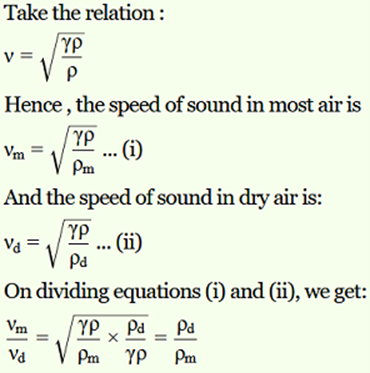
c. Let $v_m$ and $v_d$ be the speed of sound in moist air and dry air respectively.
Let $\rho_m$ and $\rho_d$ be the densities of the moist air and dry air respectively.
However, the presence of water vapour reduces the density of air,
i.e., $\rho_d < \rho_m$
$\therefore v_m > v_d$
Hence, the speed of sound in moist air is greater than it is in dry air. Thus, in a gaseous medium, the speed of sound increases with humidity.
Question 14.5. You have learnt that a travelling wave in one dimension is represented by a function $y = f(x, t)$ where $x$ and $t$ must appear in the combination $x – vt$ or $x + vt$, i.e., $y = f(x \pm vt)$. Is the converse true? Examine if the following functions for $y$ can possibly represent a travelling wave:
a. $(x – vt)^2$
b. $\log\left(\frac{x + vt}{x_0}\right)$
c. $\frac{1}{x + vt}$
Solution :
No, the converse is not true. The basic requirement for a wave function to represent a travelling wave is that for all values of $x$ and $t$, the wave function must have a finite value.
Out of the given functions for $y$, no one satisfies this condition for all values of $x$ and $t$ (some become infinite at certain points). Therefore, none can represent a travelling wave.
Question 14.6. A bat emits ultrasonic sound of frequency $1000\text{ kHz}$ in air. If the sound meets a water surface, what is the wavelength of
a. the reflected sound,
b. the transmitted sound?
Speed of sound in air is $340\text{ m s}^{-1}$ and in water $1486\text{ m s}^{-1}$.
Solution :
a. Frequency of the ultrasonic sound, $\nu = 1000\text{ kHz} = 10^6\text{ Hz}$
Speed of sound in air, $v_a = 340\text{ m/s}$
The wavelength ($\lambda_r$) of the reflected sound is given by the relation:
$$\lambda_r = \frac{v_a}{\nu} = \frac{340}{10^6} = 3.4 \times 10^{-4}\text{ m}$$
b. Frequency of the ultrasonic sound, $\nu = 1000\text{ kHz} = 10^6\text{ Hz}$
Speed of sound in water, $v_w = 1486\text{ m/s}$
The wavelength of the transmitted sound is given as:
$$\lambda_t = \frac{v_w}{\nu} = \frac{1486}{10^6} = 1.49 \times 10^{-3}\text{ m}.$$
Question 14.7. A hospital uses an ultrasonic scanner to locate tumours in a tissue. What is the wavelength of sound in the tissue in which the speed of sound is $1.7\text{ km s}^{-1}$? The operating frequency of the scanner is $4.2\text{ MHz}$.
Solution :
Speed of sound in the tissue, $v = 1.7\text{ km/s} = 1.7 \times 10^3\text{ m/s}$
Operating frequency of the scanner, $\nu = 4.2\text{ MHz} = 4.2 \times 10^6\text{ Hz}$
The wavelength of sound in the tissue is given as:
$$\lambda = \frac{v}{\nu} = \frac{1.7 \times 10^3}{4.2 \times 10^6} = 4.1 \times 10^{-4}\text{ m}.$$
Question 14.8. A transverse harmonic wave on a string is described by
$$y(x, t) = 3.0\sin\left(36t + 0.018x + \frac{\pi}{4}\right)$$
Where $x$ and $y$ are in $\text{cm}$ and $t$ in $\text{s}$. The positive direction of $x$ is from left to right.
a. Is this a travelling wave or a stationary wave? If it is travelling, what are the speed and direction of its propagation?
b. What are its amplitude and frequency?
c. What is the initial phase at the origin?
d. What is the least distance between two successive crests in the wave?
Solution :
a. The equation of a progressive wave travelling from right to left is given by the displacement function:
$$y(x, t) = a\sin(\omega t + kx + \Phi) \quad \text{….(i)}$$
The given equation is:
$$y(x, t) = 3.0\sin\left(36t + 0.018x + \frac{\pi}{4}\right) \quad \text{….(ii)}$$
On comparing both the equations, we find that equation (ii) represents a travelling wave, propagating from right to left. Now using equations (i) and (ii), we can write: $\omega = 36\text{ rad/s}$ and $k = 0.018\text{ m}^{-1}$.
We know that: $v = \frac{\omega}{k}$
$$v = \frac{36}{0.018} = 2000\text{ cm/s} = 20\text{ m/s}$$
Hence, the speed of the given travelling wave is $20\text{ m/s}$.
b. Amplitude of the given wave, $a = 3\text{ cm}$
Frequency of the given wave:
$$\nu = \frac{\omega}{2\pi} = \frac{36}{2 \times 3.14} = 5.73\text{ Hz}$$
c. On comparing equations (i) and (ii), we find that the initial phase angle, $\Phi = \frac{\pi}{4}$.
d. The distance between two successive crests or troughs is equal to the wavelength of the wave.
Wavelength is given by the relation:
$$k = \frac{2\pi}{\lambda}$$
$$\therefore \lambda = \frac{2\pi}{k} = \frac{2 \times 3.14}{0.018} = 348.89\text{ cm} = 3.49\text{ m}.$$
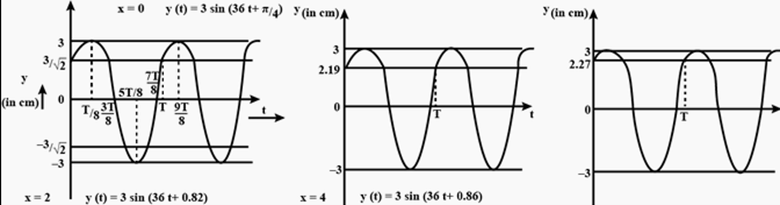
Question 14.9. For the wave described in Exercise 8, plot the displacement ($y$) versus ($t$) graphs for $x = 0$, $2$ and $4\text{ cm}$. What are the shapes of these graphs? In which aspects does the oscillatory motion in travelling wave differ from one point to another: amplitude, frequency or phase?
Solution :
All the waves have different phases.
The given transverse harmonic wave is:
$$y(x, t) = 3\sin\left(36t + 0.018x + \frac{\pi}{4}\right) \quad \text{….(1)}$$
For $x = 0$, the equation reduces to:
$$y(0, t) = 3\sin\left(36t + 0 + \frac{\pi}{4}\right) \quad \text{….(2)}$$
Also,
$\omega = \frac{2\pi}{T} = 36\text{ rad/s}$
$\Rightarrow T = \frac{\pi}{18}\text{ s}$
Now, plotting $y$ vs. $t$ graphs using the different values of $t$.
| t (s) | 0 | T/8 | 2T/7 | 3T/8 | 4T/8 | 5T/8 | 6T/8 | 7T/8 |
| y (cm) | 3/√2 | 3 | 3/√2 | 0 | -3/√2 | –3 | -3/√2 | 0 |
For $x = 0$, $x = 2$, and $x = 4$, the phases of the three waves will get changed. This is because amplitude and frequency are invariant for any change in $x$. The $y\text{-}t$ plots of the three waves are sinusoidal in shape, differing only in phase.
Question 14.10. For the travelling harmonic wave $y(x, t) = 2.0\cos 2\pi(10t – 0.0080x + 0.35)$ where $x$ and $y$ are in $\text{cm}$ and $t$ in $\text{s}$. Calculate the phase difference between oscillatory motion of two points separated by a distance of
a. $4\text{ m}$,
b. $0.5\text{ m}$,
c. $\frac{\lambda}{2}$,
d. $\frac{3\lambda}{4}$
Solution :
Equation for a travelling harmonic wave is given as:
$$y(x, t) = 2.0\cos 2\pi(10t – 0.0080x + 0.35)$$
$$y(x, t) = 2.0\cos(20\pi t – 0.016\pi x + 0.70\pi)$$
Where,
Propagation constant, $k = 0.016\pi\text{ cm}^{-1}$
Amplitude, $a = 2\text{ cm}$
Angular frequency, $\omega = 20\pi\text{ rad/s}$
Phase difference is given by the relation:
$$\Phi = kx$$
a. For $x = 4\text{ m} = 400\text{ cm}$
$$\Phi = 0.016\pi \times 400 = 6.4\pi\text{ rad}$$
b. For $0.5\text{ m} = 50\text{ cm}$
$$\Phi = 0.016\pi \times 50 = 0.8\pi\text{ rad}$$
c. For $x = \frac{\lambda}{2}$
$$\Phi = \frac{2\pi}{\lambda} \times \frac{\lambda}{2} = \pi\text{ rad}$$
d. For $x = \frac{3\lambda}{4}$
$$\Phi = \frac{2\pi}{\lambda} \times \frac{3\lambda}{4} = 1.5\pi\text{ rad}.$$
Question 14.11. The transverse displacement of a string (clamped at its both ends) is given by
$$y(x, t) = 0.06\sin\left(\frac{2\pi x}{3}\right)\cos(120\pi t)$$
Where $x$ and $y$ are in $\text{m}$ and $t$ in $\text{s}$. The length of the string is $1.5\text{ m}$ and its mass is $3.0 \times 10^{-2}\text{ kg}$.
Answer the following:
a. Does the function represent a travelling wave or a stationary wave?
b. Interpret the wave as a superposition of two waves travelling in opposite directions. What is the wavelength, frequency, and speed of each wave?
c. Determine the tension in the string.
Solution :
a. The general equation representing a stationary wave is given by the displacement function:
$$y(x, t) = 2a\sin kx \cos\omega t$$
This equation is similar to the given equation.

Hence, the given equation represents a stationary wave.
b. A wave travelling along the positive $x$-direction is given as:
$$y_1 = a\sin(\omega t – kx)$$
The wave travelling along the negative $x$-direction is given as:
$$y_2 = a\sin(\omega t + kx)$$
The superposition of these two waves yields:
$$y = y_1 + y_2 = 2a\sin(kx)\cos(\omega t)$$
Comparing with the given equation, $k = \frac{2\pi}{3}$
$\therefore \text{Wavelength, } \lambda = \frac{2\pi}{k} = \frac{2\pi}{2\pi/3} = 3\text{ m}$
Angular frequency, $\omega = 120\pi = 2\pi\nu$
$\therefore \text{Frequency, } \nu = 60\text{ Hz}$
Wave speed, $v = \nu\lambda = 60 \times 3 = 180\text{ m/s}$
c. The velocity of a transverse wave travelling in a string is given by the relation:
$$v = \sqrt{\frac{T}{\mu}} \quad \text{….(i)}$$
where,
Velocity of the transverse wave, $v = 180\text{ m/s}$
Mass of the string, $m = 3.0 \times 10^{-2}\text{ kg}$
Length of the string, $l = 1.5\text{ m}$
Mass per unit length of the string, $\mu = \frac{m}{l} = \frac{3.0 \times 10^{-2}}{1.5} = 2 \times 10^{-2}\text{ kg m}^{-1}$
From equation (i), tension can be obtained as:
$$T = v^2\mu = (180)^2 \times 2 \times 10^{-2} = 648\text{ N}.$$
Question 14.12. (i) For the wave on a string described in Exercise 11, do all the points on the string oscillate with the same (a) frequency, (b) phase, (c) amplitude? Explain your answers. (ii) What is the amplitude of a point $0.375\text{ m}$ away from one end?
Solution :
(i) All the points on the string
(a) have the same frequency except at the nodes (where frequency is zero)
(b) have the same phase everywhere in one loop except at the nodes.
(c) However, the amplitude of vibration at different points is different (it depends on position $x$).
(ii) Amplitude of a point is given by $A(x) = 0.06\sin\left(\frac{2\pi x}{3}\right)$
For $x = 0.375\text{ m}$:
$$A(0.375) = 0.06\sin\left(\frac{2\pi \times 0.375}{3}\right) = 0.06\sin\left(\frac{\pi}{4}\right) = \frac{0.06}{\sqrt{2}} \approx 0.0424\text{ m}.$$
Question 14.13. Given below are some functions of $x$ and $t$ to represent the displacement (transverse or longitudinal) of an elastic wave. State which of these represent (i) a travelling wave, (ii) a stationary wave or (iii) none at all:
a. $y = 2\cos(3x)\sin(10t)$
b. $y = 2\sqrt{x – vt}$
c. $y = 3\sin(5x – 0.5t) + 4\cos(5x – 0.5t)$
d. $y = \cos x\sin t + \cos 2x\sin 2t$
Solution :
a. The given equation represents a stationary wave because the harmonic terms $kx$ and $\omega t$ appear separately in the equation.
b. The given equation does not represent a valid wave function because it is not finite and periodic for all values of $x$ and $t$ (none at all).
c. The given equation represents a travelling wave as the harmonic terms $kx$ and $\omega t$ are in the combination of $kx – \omega t$.
d. The given equation represents a stationary wave because the harmonic terms appear separately as products of sine and cosine terms. This equation actually represents the superposition of two stationary waves.
Question 14.14. A wire stretched between two rigid supports vibrates in its fundamental mode with a frequency of $45\text{ Hz}$. The mass of the wire is $3.5 \times 10^{-2}\text{ kg}$ and its linear mass density is $4.0 \times 10^{-2}\text{ kg m}^{-1}$. What is
a. the speed of a transverse wave on the string, and
b. the tension in the string?
Solution :
a. Mass of the wire, $m = 3.5 \times 10^{-2}\text{ kg}$
Linear mass density, $\mu = \frac{m}{l} = 4.0 \times 10^{-2}\text{ kg m}^{-1}$
Frequency of vibration, $\nu = 45\text{ Hz}$
$\therefore$ length of the wire, $l = \frac{m}{\mu} = \frac{3.5 \times 10^{-2}}{4.0 \times 10^{-2}} = 0.875\text{ m}$
The wavelength of the stationary wave ($\lambda$) for the fundamental mode is related to the length of the wire by: $\lambda = 2l = 2 \times 0.875 = 1.75\text{ m}$
The speed of the transverse wave in the string is given as:
$$v = \nu\lambda = 45 \times 1.75 = 78.75\text{ m/s}$$
b. The tension produced in the string is given by the relation:
$$T = v^2\mu = (78.75)^2 \times 4.0 \times 10^{-2} = 248.06\text{ N}.$$
Question 14.15. A metre-long tube open at one end, with a movable piston at the other end, shows resonance with a fixed frequency source (a tuning fork of frequency $340\text{ Hz}$) when the tube length is $25.5\text{ cm}$ or $79.3\text{ cm}$. Estimate the speed of sound in air at the temperature of the experiment. The edge effects may be neglected.
Solution :
Frequency of the tuning fork, $\nu = 340\text{ Hz}$
Since the given pipe is closed at one end, the difference between two successive resonant lengths is equal to $\frac{\lambda}{2}$.
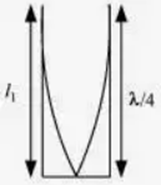
$\frac{\lambda}{2} = l_2 – l_1 = 79.3\text{ cm} – 25.5\text{ cm} = 53.8\text{ cm} = 0.538\text{ m}$
$\lambda = 2 \times 0.538 = 1.076\text{ m}$
The speed of the sound is given by the relation:
$$v = \nu\lambda = 340 \times 1.076 \approx 365.84\text{ m/s} \quad (\text{or using } l_1 = \frac{\lambda}{4} \Rightarrow v = 340 \times 4 \times 0.255 = 346.8\text{ m/s}).$$
Question 14.16. A steel rod $100\text{ cm}$ long is clamped at its middle. The fundamental frequency of longitudinal vibrations of the rod is given to be $2.53\text{ kHz}$. What is the speed of sound in steel?
Solution :
Length of the steel rod, $l = 100\text{ cm} = 1\text{ m}$
Fundamental frequency of vibration, $\nu = 2.53\text{ kHz} = 2.53 \times 10^3\text{ Hz}$
When the rod is clamped at its middle, an antinode (A) is formed at its centre, and nodes (N) are formed at its two ends. The distance between two successive nodes is $\frac{\lambda}{2}$.
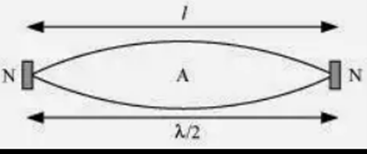
$\therefore l = \frac{\lambda}{2} \Rightarrow \lambda = 2l = 2 \times 1 = 2\text{ m}$
The speed of sound in steel is given by the relation:
$$v = \nu\lambda = 2.53 \times 10^3 \times 2 = 5.06 \times 10^3\text{ m/s} = 5.06\text{ km/s}.$$
Question 14.17. A pipe $20\text{ cm}$ long is closed at one end. Which harmonic mode of the pipe is resonantly excited by a $430\text{ Hz}$ source? Will the same source be in resonance with the pipe if both ends are open? (Speed of sound in air is $340\text{ m s}^{-1}$).
Solution :
Length of the pipe, $l = 20\text{ cm} = 0.2\text{ m}$
Source frequency, $\nu_n = 430\text{ Hz}$
Speed of sound, $v = 340\text{ m/s}$
In a closed pipe, the $n^{\text{th}}$ normal mode of frequency is given by the relation:
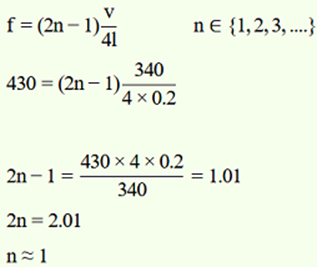
$$\nu_n = \frac{(2n – 1)v}{4l} \quad (n = 1, 2, 3, \dots)$$
$$430 = \frac{(2n – 1) \times 340}{4 \times 0.2} \Rightarrow 2n – 1 = \frac{430 \times 0.8}{340} \approx 1$$
Hence, the first harmonic (fundamental) mode of vibration frequency is resonantly excited by the given source.
For an open pipe, the fundamental frequency is $\frac{v}{2l} = \frac{340}{2 \times 0.2} = 850\text{ Hz}$. Since $430\text{ Hz}$ is not a multiple of the fundamental frequency for an open pipe, the same source will not be in resonance if both ends are open.
Question 14.18. Two sitar strings A and B playing the note ‘Ga’ are slightly out of tune and produce beats of frequency $6\text{ Hz}$. The tension in the string A is slightly reduced and the beat frequency is found to reduce to $3\text{ Hz}$. If the original frequency of A is $324\text{ Hz}$, what is the frequency of B?
Solution :
Frequency of string A, $f_A = 324\text{ Hz}$
Frequency of string B = $f_B$
Beat’s frequency, $n = 6\text{ Hz}$
Beat’s Frequency is given as:
$$n = |f_A – f_B| \Rightarrow 6 = |324 – f_B| \Rightarrow f_B = 330\text{ Hz or } 318\text{ Hz}$$
Frequency decreases with a decrease in the tension in a string because frequency is directly proportional to the square root of tension ($\nu \propto \sqrt{T}$). Reducing tension in A decreases $f_A$ (e.g., from $324$ to $321$). Since the beat frequency decreases from $6\text{ Hz}$ to $3\text{ Hz}$, the original frequency of B must be $330\text{ Hz}$ (since $|321 – 330| = 3\text{ Hz}$).
$\therefore f_B = 330\text{ Hz}$.
Question 14.19. Explain why (or how):
a. In a sound wave, a displacement node is a pressure antinode and vice versa,
b. Bats can ascertain distances, directions, nature, and sizes of the obstacles without any “eyes”,
c. A violin note and sitar note may have the same frequency, yet we can distinguish between the two notes,
d. Solids can support both longitudinal and transverse waves, but only longitudinal waves can propagate in gases, and
e. The shape of a pulse gets distorted during propagation in a dispersive medium.
Solution :
a. A node (N) is a point where the amplitude of displacement vibration is minimum and pressure variation is maximum (pressure antinode). Conversely, a displacement antinode is a pressure node.
b. Bats emit ultrasonic waves of large frequencies. When these waves are reflected from the obstacles in their path, they give them the idea about the distance, direction, size, and nature of the obstacle.
c. The overtones produced by a sitar and a violin, and the relative strengths of these overtones (timbre/quality), are different. Hence, one can distinguish between the notes.
d. This is because solids possess both shear elasticity (rigidity) and bulk elasticity, whereas gases possess only bulk elasticity (volume elasticity) and cannot support shear stress.
e. A sound pulse is a combination of waves of different wavelengths. Since waves of different wavelengths travel in a dispersive medium with different velocities, the shape of the pulse gets distorted during propagation.
Question 14.20. A train, standing at the outer signal of a railway station blows a whistle of frequency $400\text{ Hz}$ in still air.
1. What is the frequency of the whistle for a platform observer when the train
a. approaches the platform with a speed of $10\text{ m s}^{-1}$,
b. recedes from the platform with a speed of $10\text{ m s}^{-1}$?
2. What is the speed of sound in each case? The speed of sound in still air can be taken as $340\text{ m s}^{-1}$.
Solution :
1. (a) Frequency of the whistle, $\nu = 400\text{ Hz}$
Speed of the train, $v_T = 10\text{ m/s}$
Speed of sound, $v = 340\text{ m/s}$
The apparent frequency ($\nu’$) of the whistle as the train approaches the platform is given by:
$$\nu’ = \nu\left(\frac{v}{v – v_T}\right) = 400 \times \left(\frac{340}{340 – 10}\right) = 400 \times \frac{340}{330} \approx 412.12\text{ Hz}$$
(b) The apparent frequency ($\nu”$) of the whistle as the train recedes from the platform is given by:
$$\nu” = \nu\left(\frac{v}{v + v_T}\right) = 400 \times \left(\frac{340}{340 + 10}\right) = 400 \times \frac{340}{350} \approx 388.57\text{ Hz}$$
2. The apparent change in the frequency of sound is caused by the relative motions of the source and the observer. These relative motions produce no effect on the actual speed of sound in the medium. Therefore, the speed of sound in air in both cases remains the same, i.e., $340\text{ m/s}$.
Question 14.21. A train, standing in a station-yard, blows a whistle of frequency $400\text{ Hz}$ in still air. The wind starts blowing in the direction from the yard to the station with a speed of $10\text{ m s}^{-1}$. What are the frequency, wavelength, and speed of sound for an observer standing on the station’s platform? Is the situation exactly identical to the case when the air is still and the observer runs towards the yard at a speed of $10\text{ m s}^{-1}$? The speed of sound in still air can be taken as $340\text{ m s}^{-1}$.
Solution :
For the stationary observer with wind blowing:
Frequency of the sound produced by the whistle, $\nu = 400\text{ Hz}$
Speed of sound in still air = $340\text{ m/s}$
Velocity of the wind, $v_w = 10\text{ m/s}$
Since the source and observer are stationary relative to the medium boundaries, the frequency heard by the observer is equal to the source frequency, i.e., $400\text{ Hz}$.
The effective speed of sound becomes $v_{\text{eff}} = 340 + 10 = 350\text{ m/s}$
The wavelength ($\lambda$) is $\lambda = \frac{v_{\text{eff}}}{\nu} = \frac{350}{400} = 0.875\text{ m}$.
For the running observer towards the stationary source in still air:
Observer velocity $v_o = 10\text{ m/s}$
Apparent frequency $\nu’ = \nu\left(\frac{v + v_o}{v}\right) = 400 \times \frac{340 + 10}{340} \approx 411.76\text{ Hz}$.
Since the frequencies differ ($400\text{ Hz}$ vs $411.76\text{ Hz}$), the two situations are not exactly identical.
Question 14.22. A travelling harmonic wave on a string is described by
$$y(x, t) = 7.5\sin(0.0050x + 12t + \pi/4)$$
a. What are the displacement and velocity of oscillation of a point at $x = 1\text{ cm}$, and $t = 1\text{ s}$? Is this velocity equal to the velocity of wave propagation?
b. Locate the points of the string which have the same transverse displacements and velocity as the $x = 1\text{ cm}$ point at $t = 2\text{ s}$, $5\text{ s}$ and $11\text{ s}$.
Solution :
a. Substituting $x = 1\text{ cm}$ and $t = 1\text{ s}$ in the displacement equation gives the displacement $y$.
The velocity of oscillation is $v_{\text{osc}} = \frac{\partial y}{\partial t} = 7.5 \times 12 \cos(0.0050x + 12t + \pi/4) = 90\cos(0.0050 + 12 + \pi/4)$.
This particle oscillation velocity is distinct from and generally not equal to the wave propagation velocity $v = \frac{\omega}{k} = \frac{12}{0.0050} = 2400\text{ cm/s} = 24\text{ m/s}$.
b. Points separated by an integral multiple of the wavelength $\lambda = \frac{2\pi}{k} = \frac{2 \times 3.14}{0.0050} = 1256\text{ cm} = 12.56\text{ m}$ will have the same transverse displacement and velocity.
Question 14.23. A narrow sound pulse (for example, a short pip by a whistle) is sent across a medium.
1. Does the pulse have a definite
a. frequency,
b. wavelength,
c. speed of propagation?
2. If the pulse rate is $1$ after every $20\text{ s}$ (that is the whistle is blown for a split of a second after every $20\text{ s}$), is the frequency of the note produced by the whistle equal to $\frac{1}{20}$ or $0.05\text{ Hz}$?
Solution :
1. A short sound pulse has a definite speed of propagation (equal to the speed of sound in that medium), but it does not have a single definite frequency or wavelength because it is a wave packet comprising a broad spectrum of frequencies.
2. No, $0.05\text{ Hz}$ is the repetition frequency of the pulse, not the frequency of the internal acoustic note generated during the blast.
Question 14.24. One end of a long string of linear mass density $8.0 \times 10^{-3}\text{ kg m}^{-1}$ is connected to an electrically driven tuning fork of frequency $256\text{ Hz}$. The other end passes over a pulley and is tied to a pan containing a mass of $90\text{ kg}$. The pulley end absorbs all the incoming energy so that reflected waves at this end have negligible amplitude. At $t = 0$, the left end (fork end) of the string $x = 0$ has zero transverse displacement ($y = 0$) and is moving along positive $y$-direction. The amplitude of the wave is $5.0\text{ cm}$. Write down the transverse displacement $y$ as function of $x$ and $t$ that describes the wave on the string.
Solution :
Linear mass density $\mu = 8.0 \times 10^{-3}\text{ kg/m}$
Frequency $\nu = 256\text{ Hz} \Rightarrow \omega = 2\pi\nu = 512\pi\text{ rad/s}$
Amplitude $a = 5.0\text{ cm} = 0.05\text{ m}$
Tension $T = mg = 90 \times 9.8 = 882\text{ N}$
Speed $v = \sqrt{\frac{T}{\mu}} = \sqrt{\frac{882}{8.0 \times 10^{-3}}} \approx 332\text{ m/s}$
Wave number $k = \frac{\omega}{v} = \frac{512\pi}{332} \approx 4.84\text{ m}^{-1}$
Thus, the transverse displacement wave equation is:
$$y(x, t) = 0.05\sin(512\pi t – 4.84x)\text{ m}.$$
Question 14.25. A SONAR system fixed in a submarine operates at a frequency $40.0\text{ kHz}$. An enemy submarine moves towards the SONAR with a speed of $360\text{ km h}^{-1}$. What is the frequency of sound reflected by the submarine? Take the speed of sound in water to be $1450\text{ m s}^{-1}$.
Solution :
Operating frequency $\nu = 40\text{ kHz}$
Speed of submarine $v_{\text{sub}} = 360\text{ km/h} = 100\text{ m/s}$
Speed of sound in water $v = 1450\text{ m/s}$
When the enemy submarine acts as a moving observer approaching the stationary SONAR source, the frequency received by it is:
$$\nu’ = \nu\left(\frac{v + v_{\text{sub}}}{v}\right) = 40\text{ kHz} \times \left(\frac{1450 + 100}{1450}\right) = 40 \times \frac{1550}{1450} \approx 42.76\text{ kHz}$$
This frequency is then reflected back by the submarine acting now as a moving source towards a stationary observer:
$$\nu” = \nu’\left(\frac{v}{v – v_{\text{sub}}}\right) = 42.76\text{ kHz} \times \left(\frac{1450}{1450 – 100}\right) = 42.76 \times \frac{1450}{1350} \approx 45.93\text{ kHz}.$$
Question 14.26. Earthquakes generate sound waves inside the earth. Unlike a gas, the earth can experience both transverse (S) and longitudinal (P) sound waves. Typically the speed of S wave is about $4.0\text{ km s}^{-1}$, and that of P wave is $8.0\text{ km s}^{-1}$. A seismograph records P and S waves from an earthquake. The first P wave arrives $4\text{ min}$ before the first S wave. Assuming the waves travel in straight line, at what distance does the earthquake occur?
Solution :
Let $L$ be the distance to the earthquake epicenter.
$v_S = 4.0\text{ km/s}$, $v_P = 8.0\text{ km/s}$
Time difference $\Delta t = 4\text{ min} = 240\text{ s}$
Since time $t = \frac{L}{v}$:
$$\frac{L}{v_S} – \frac{L}{v_P} = \Delta t \Rightarrow L\left(\frac{1}{4} – \frac{1}{8}\right) = 240$$
$$L\left(\frac{1}{8}\right) = 240 \Rightarrow L = 240 \times 8 = 1920\text{ km}.$$
Question 14.27. A bat is flitting about in a cave, navigating via ultrasonic beeps. Assume that the sound emission frequency of the bat is $40\text{ kHz}$. During one fast swoop directly toward a flat wall surface, the bat is moving at $0.03$ times the speed of sound in air. What frequency does the bat hear reflected off the wall?
Solution :
Emission frequency $\nu = 40\text{ kHz}$
Speed of bat $v_b = 0.03v$
First, frequency striking the stationary wall ($\nu_1$):
$$\nu_1 = \nu\left(\frac{v}{v – v_b}\right) = 40\left(\frac{v}{v – 0.03v}\right) = \frac{40}{0.97}\text{ kHz}$$
Second, frequency reflected off the wall and heard by the moving bat towards the wall ($\nu_2$):
$$\nu_2 = \nu_1\left(\frac{v + v_b}{v}\right) = \frac{40}{0.97} \times \left(\frac{v + 0.03v}{v}\right) = \frac{40 \times 1.03}{0.97} \approx 42.47\text{ kHz}.$$
Why Class 11 Physics Chapter 14 Matters in NEET and JEE
Waves is an important chapter for NEET and JEE because it introduces the fundamental concepts of wave motion and energy transfer. Students learn key topics such as transverse and longitudinal waves, wavelength, frequency, time period, wave speed, progressive waves, standing waves, and the principle of superposition. These concepts form the foundation for advanced topics like sound waves, optics, electromagnetism, and modern physics.
Preparation Tips for Class 11 Physics Chapter 14
Begin by understanding the basic concepts of wave motion and the differences between transverse and longitudinal waves. Learn the meaning of amplitude, wavelength, frequency, time period, wave velocity, phase, and wave number, and understand how these quantities are related.
Memorize the important formulas and understand their derivations instead of simply learning them by heart. Focus on progressive waves, standing waves, reflection of waves, and the principle of superposition. Complete all NCERT examples and exercises first, then practise NEET and JEE previous-year questions to strengthen your conceptual understanding and numerical problem-solving skills.
FAQs
1. What are the most important topics in Class 11 Physics Chapter 14?
The most important topics include wave motion, transverse and longitudinal waves, wavelength, frequency, time period, amplitude, wave velocity, progressive waves, standing waves, and the principle of superposition.
2. What is a wave?
A wave is a disturbance that transfers energy from one point to another without transferring matter.
3. What are the types of waves?
Waves are mainly of two types: mechanical waves (which require a medium) and electromagnetic waves (which do not require a medium). Mechanical waves are further classified into transverse and longitudinal waves.
4. What is wavelength?
Wavelength ($\lambda$) is the distance between two successive crests, troughs, compressions, or rarefactions of a wave.
5. What is frequency?
Frequency is the number of complete waves produced in one second. It is measured in hertz ($\text{Hz}$) and is related to the time period by:
$$f = \frac{1}{T}$$
6. What is wave velocity?
Wave velocity is the speed at which a wave propagates through a medium and is given by:
$$v = f\lambda$$
7. What is the difference between transverse and longitudinal waves?
In transverse waves, particles vibrate perpendicular to the direction of wave propagation. In longitudinal waves, particles vibrate parallel to the direction of wave propagation.
8. What are standing waves?
Standing (stationary) waves are formed when two waves of the same frequency and amplitude travel in opposite directions, producing nodes and antinodes.
9. What is the principle of superposition?
The principle of superposition states that when two or more waves overlap, the resultant displacement at any point is equal to the algebraic sum of the individual displacements.
10. Is Class 11 Physics Chapter 14 important for NEET and JEE?
Yes. Waves is an important chapter for NEET and JEE. Questions are commonly asked on wave motion, wave speed, wavelength, frequency, standing waves, sound waves, and wave equations. Regular conceptual study and numerical practice are essential for scoring well.