
NCERT Solutions For Class 11 Chemistry Chapter 5 – States Of Matter
NCERT Solutions for Class 11 Chemistry Chapter 5 States of Matter is prepared by our senior and renowned teachers of Physics Wallah primary focus while solving these questions of class-11 in NCERT textbook, also do read theory of this Chapter 5 States of Matter while going before solving the NCERT questions. Our Physics Wallah team Prepared Other Subjects NCERT Solutions for class 11.
Class 11 Chemistry Chapter 5 Overview
The States of Matter chapter explains the physical behaviour of gases and liquids through intermolecular forces and the kinetic molecular theory. Students learn important gas laws, including Boyle’s Law, Charles’s Law, Gay-Lussac’s Law and Avogadro’s Law. The chapter introduces the ideal gas equation and explains how pressure, volume, temperature and the number of moles are related. It also covers Dalton’s Law of Partial Pressures, Graham’s Law of Diffusion and the behaviour of real gases using the van der Waals equation. Properties of liquids, including vapour pressure, viscosity and surface tension, are also discussed.
Class 11 Chemistry Chapter 5 States of Matter: Rectified Exercise Solutions
Question 1:
What minimum pressure is required to compress $500\text{ dm}^3$ of air at $1\text{ bar}$ to $200\text{ dm}^3$ at $30^\circ\text{C}$?
Solution:
Given,
Initial pressure, $P_1 = 1\text{ bar}$
Initial volume, $V_1 = 500\text{ dm}^3$
Final volume, $V_2 = 200\text{ dm}^3$
Since the temperature remains constant, the final pressure ($P_2$) can be calculated using Boyle’s law.
According to Boyle’s law,
$$P_1 V_1 = P_2 V_2$$
$$P_2 = \frac{P_1 V_1}{V_2} = \frac{1\text{ bar} \times 500\text{ dm}^3}{200\text{ dm}^3} = 2.5\text{ bar}$$
Minimum required pressure $= 2.5\text{ bar}$
Question 2:
A vessel of $120\text{ mL}$ capacity contains a certain amount of gas at $35^\circ\text{C}$ and $1.2\text{ bar}$ pressure. The gas is transferred to another vessel of volume $180\text{ mL}$ at $35^\circ\text{C}$. What would be its pressure?
Solution:
Initial pressure, $P_1 = 1.2\text{ bar}$
Initial volume, $V_1 = 120\text{ mL}$
Final volume, $V_2 = 180\text{ mL}$
As the temperature remains same, final pressure ($P_2$) can be calculated with the help of Boyle’s law.
According to the Boyle’s law,
$$P_1 V_1 = P_2 V_2$$
$$P_2 = \frac{1.2\text{ bar} \times 120\text{ mL}}{180\text{ mL}} = 0.80\text{ bar}$$
Final pressure $= 0.80\text{ bar}$
Question 3:
Using the equation of state $PV = nRT$, show that at a given temperature the density of a gas is proportional to its pressure.
Solution:
The equation of state is given by,
$$pV = nRT \quad \dots\text{(i)}$$
Where,
$p \rightarrow \text{Pressure of gas}$
$V \rightarrow \text{Volume of gas}$
$n \rightarrow \text{Number of moles of gas}$
$R \rightarrow \text{Gas constant}$
$T \rightarrow \text{Temperature of gas}$
From equation (i) we have,
$$p = \frac{n}{V} RT \quad \dots\text{(ii)}$$
Replacing $n$ with $\frac{m}{M}$, we have:
$$p = \frac{m}{V} \frac{RT}{M}$$
Where,
$m \rightarrow \text{Mass of gas}$
$M \rightarrow \text{Molar mass of gas}$
But, $\frac{m}{V} = d$ ($d = \text{density of gas}$)
Thus, from equation (ii), we have:
$$p = d \frac{RT}{M} \implies d = \left(\frac{M}{RT}\right)p$$
Molar mass ($M$) of a gas is always constant and therefore, at constant temperature $\frac{M}{RT} = \text{constant}$.
Hence, at a given temperature, the density ($d$) of gas is proportional to its pressure ($p$).
Question 4:
At $0^\circ\text{C}$, the density of a certain oxide of a gas at $2\text{ bar}$ is same as that of dinitrogen at $5\text{ bar}$. What is the molecular mass of the oxide?
Solution:
Density ($d$) of the substance at temperature ($T$) can be given by the expression,
$$d = \frac{pM}{RT}$$
Now, density of oxide ($d_1$) is given by,
$$d_1 = \frac{p_1 M_1}{RT}$$
Where, $M_1$ and $p_1$ are the mass and pressure of the oxide respectively.
Density of dinitrogen gas ($d_2$) is given by,
$$d_2 = \frac{p_2 M_2}{RT}$$
Where, $M_2$ and $p_2$ are the mass and pressure of dinitrogen respectively.
According to the given question, $d_1 = d_2$:
$$\frac{p_1 M_1}{RT} = \frac{p_2 M_2}{RT} \implies p_1 M_1 = p_2 M_2$$
Given, $p_1 = 2\text{ bar}$, $p_2 = 5\text{ bar}$, Molecular mass of nitrogen, $M_2 = 28\text{ g/mol}$:
$$2 \times M_1 = 5 \times 28 \implies M_1 = \frac{140}{2} = 70\text{ g/mol}$$
Hence, the molecular mass of the oxide is $70\text{ g/mol}$.
Question 5:
The pressure of $1\text{ g}$ of an ideal gas A at $27^\circ\text{C}$ is $2\text{ bar}$. When $2\text{ g}$ of another ideal gas B is introduced into the same flask at the same temperature, the total pressure becomes $3\text{ bar}$. Find the relationship between their molar masses.
Solution:
Suppose molecular masses of A and B are $M_A$ and $M_B$ respectively. Then their number of moles will be $n_A = \frac{1}{M_A}$ and $n_B = \frac{2}{M_B}$.
Using the ideal gas equation:
$$p_A V = n_A R T \implies 2 V = \left(\frac{1}{M_A}\right) R T$$
Total pressure after introducing B:
$$p_{\text{total}} V = (n_A + n_B) R T \implies 3 V = \left(\frac{1}{M_A} + \frac{2}{M_B}\right) R T$$
Dividing the equations:
$$\frac{2}{3} = \frac{1/M_A}{1/M_A + 2/M_B} \implies \frac{2}{M_A} + \frac{4}{M_B} = \frac{3}{M_A} \implies \frac{1}{M_A} = \frac{4}{M_B} \implies M_B = 4 M_A$$
Question 6:
The drain cleaner, Drainex contains small bits of aluminum which react with caustic soda to produce dihydrogen. What volume of dihydrogen at $20^\circ\text{C}$ and one bar will be released when $0.15\text{ g}$ of aluminum reacts?
Solution:
The reaction of aluminium with caustic soda can be represented as:
$$2\text{Al} + 2\text{NaOH} + 2\text{H}_2\text{O} \rightarrow 2\text{NaAlO}_2 + 3\text{H}_2$$
At STP ($273.15\text{ K}$ and $1\text{ atm}$), $54\text{ g}$ ($2 \times 27\text{ g}$) of Al gives $3 \times 22400\text{ mL}$ of $\text{H}_2$.
$0.15\text{ g}$ Al gives:
$$\frac{3 \times 22400 \times 0.15}{54} = 186.67\text{ mL of }\text{H}_2\text{ at STP}$$
At STP: $P_1 = 1\text{ atm}$, $V_1 = 186.67\text{ mL}$, $T_1 = 273.15\text{ K}$
Let the volume of dihydrogen be at $P_2 = 0.987\text{ atm}$ (since $1\text{ bar} = 0.987\text{ atm}$) and $T_2 = 20^\circ\text{C} = (273.15 + 20)\text{ K} = 293.15\text{ K}$.
Using the combined gas law:
$$V_2 = \frac{P_1 V_1 T_2}{T_1 P_2} = \frac{1 \times 186.67 \times 293.15}{273.15 \times 0.987} \approx 203\text{ mL}$$
Therefore, $203\text{ mL}$ of dihydrogen will be released.
Question 7:
What will be the pressure exerted by a mixture of $3.2\text{ g}$ of methane and $4.4\text{ g}$ of carbon dioxide contained in a $9\text{ dm}^3$ flask at $27^\circ\text{C}$?
Solution:
It is known that, $PV = nRT$
For methane ($\text{CH}_4$, molar mass $= 16\text{ g/mol}$):
$$n_{\text{CH}_4} = \frac{3.2\text{ g}}{16\text{ g/mol}} = 0.2\text{ mol}$$
For carbon dioxide ($\text{CO}_2$, molar mass $= 44\text{ g/mol}$):
$$n_{\text{CO}_2} = \frac{4.4\text{ g}}{44\text{ g/mol}} = 0.1\text{ mol}$$
Total moles $n = 0.2 + 0.1 = 0.3\text{ mol}$
Volume $V = 9\text{ dm}^3 = 9 \times 10^{-3}\text{ m}^3$, Temperature $T = 27^\circ\text{C} = 300\text{ K}$, $R = 8.314\text{ J mol}^{-1}\text{ K}^{-1}$
Total pressure exerted by the mixture can be obtained as:
$$P = \frac{nRT}{V} = \frac{0.3 \times 8.314 \times 300}{9 \times 10^{-3}} = 8.314 \times 10^4\text{ Pa}$$
Hence, the total pressure exerted by the mixture is $8.314 \times 10^4\text{ Pa}$.
Question 8:
What will be the pressure of the gaseous mixture when $0.5\text{ L}$ of $\text{H}_2$ at $0.8\text{ bar}$ and $2.0\text{ L}$ of dioxygen at $0.7\text{ bar}$ are introduced in a $1\text{ L}$ vessel at $27^\circ\text{C}$?
Solution:
Calculation of partial pressure of $\text{H}_2$ in $1\text{ L}$ vessel ($P_{\text{H}_2}$):
$P_1 = 0.8\text{ bar}, V_1 = 0.5\text{ L}, V_2 = 1.0\text{ L}$
As temperature remains constant, $P_1 V_1 = P_2 V_2$:
$$(0.8\text{ bar})(0.5\text{ L}) = P_{\text{H}_2} (1.0\text{ L}) \implies P_{\text{H}_2} = 0.40\text{ bar}$$
Calculation of partial pressure of $\text{O}_2$ in $1\text{ L}$ vessel ($P_{\text{O}_2}$):
$P_1′ = 0.7\text{ bar}, V_1′ = 2.0\text{ L}, V_2′ = 1.0\text{ L}$:
$$(0.7\text{ bar})(2.0\text{ L}) = P_{\text{O}_2} (1.0\text{ L}) \implies P_{\text{O}_2} = 1.4\text{ bar}$$
Total pressure $= P_{\text{H}_2} + P_{\text{O}_2} = 0.4\text{ bar} + 1.4\text{ bar} = 1.8\text{ bar}$.
Question 9:
Density of a gas is found to be $5.46\text{ g/dm}^3$ at $27^\circ\text{C}$ at $2\text{ bar}$ pressure. What will be its density at STP?
Solution:
Using $\frac{d_1 T_1}{P_1} = \frac{d_2 T_2}{P_2}$:
$$d_1 = 5.46\text{ g/dm}^3, T_1 = 300\text{ K}, P_1 = 2\text{ bar}$$
$$T_2 = 273.15\text{ K}, P_2 = 1.013\text{ bar}$$
$$d_2 = \frac{d_1 P_2 T_1}{P_1 T_2} = \frac{5.46 \times 1.013 \times 300}{2 \times 273.15} \approx 3.00\text{ g dm}^{-3}$$
Density at STP $\approx 3.00\text{ g dm}^{-3}$.
Question 10:
$34.05\text{ mL}$ of phosphorus vapour weighs $0.0625\text{ g}$ at $546^\circ\text{C}$ and $0.1\text{ bar}$ pressure. What is the molar mass of phosphorus?
Solution:
Given,
$p = 0.1\text{ bar}$
$V = 34.05\text{ mL} = 34.05 \times 10^{-3}\text{ L} = 34.05 \times 10^{-3}\text{ dm}^3$
$R = 0.083\text{ bar dm}^3\text{ K}^{-1}\text{ mol}^{-1}$
$T = 546^\circ\text{C} = (546 + 273)\text{ K} = 819\text{ K}$
$w = 0.0625\text{ g}$
The number of moles ($n$) can be calculated using the ideal gas equation as:
$$pV = nRT = \frac{w}{M} RT \implies M = \frac{wRT}{pV} = \frac{0.0625 \times 0.083 \times 819}{0.1 \times 34.05 \times 10^{-3}} = 1247.5\text{ g mol}^{-1}$$
Hence, the molar mass of phosphorus is $1247.5\text{ g mol}^{-1}$.
Question 11:
A student forgot to add the reaction mixture to the round bottomed flask at $27^\circ\text{C}$ but instead he/she placed the flask on the flame. After a lapse of time, he realized his mistake, and using a pyrometer he found the temperature of the flask was $477^\circ\text{C}$. What fraction of air would have been expelled out?
Solution:
Initial temperature $T_1 = 27^\circ\text{C} = 300\text{ K}$
Final temperature $T_2 = 477^\circ\text{C} = 750\text{ K}$
Since pressure and volume remain constant, $n_1 T_1 = n_2 T_2$:
$$\frac{n_2}{n_1} = \frac{T_1}{T_2} = \frac{300}{750} = \frac{2}{5} = 0.4$$
Fraction of air remaining $= 0.4$.
Fraction of air expelled out $= 1 – 0.4 = 0.6$ (or $60\%$).
Question 12:
Calculate the temperature of $4.0\text{ mol}$ of a gas occupying $5\text{ dm}^3$ at $3.32\text{ bar}$ ($R = 0.083\text{ bar dm}^3\text{ K}^{-1}\text{ mol}^{-1}$).
Solution:
Given,
$n = 4.0\text{ mol}$
$V = 5\text{ dm}^3$
$p = 3.32\text{ bar}$
$R = 0.083\text{ bar dm}^3\text{ K}^{-1}\text{ mol}^{-1}$
The temperature ($T$) can be calculated using the ideal gas equation as:
$$T = \frac{pV}{nR} = \frac{3.32 \times 5}{4.0 \times 0.083} = \frac{16.6}{0.332} = 50\text{ K}$$
Hence, the required temperature is $50\text{ K}$.
Question 13:
Calculate the total number of electrons present in $1.4\text{ g}$ of dinitrogen gas.
Solution:
Molar mass of dinitrogen ($\text{N}_2$) $= 28\text{ g mol}^{-1}$
Thus, $1.4\text{ g}$ of $\text{N}_2 = \frac{1.4}{28} = 0.05\text{ mol} = 0.05 \times 6.022 \times 10^{23} = 3.011 \times 10^{22}\text{ molecules}$.
Now, $1\text{ molecule}$ of $\text{N}_2$ contains $14\text{ electrons}$.
Therefore, $3.011 \times 10^{22}\text{ molecules}$ of $\text{N}_2$ contains:
$$3.011 \times 10^{22} \times 14 = 4.215 \times 10^{23}\text{ electrons}$$
Question 14:
How much time would it take to distribute one Avogadro number of wheat grains, if $10^{10}\text{ grains}$ are distributed each second?
Solution:
Avogadro number $= 6.022 \times 10^{23}$
Thus, time required:
$$t = \frac{6.022 \times 10^{23}}{10^{10}} = 6.022 \times 10^{13}\text{ seconds} = \frac{6.022 \times 10^{13}}{365 \times 24 \times 3600} \approx 1.9 \times 10^6\text{ years}$$
Hence, the time taken would be $1.9 \times 10^6\text{ years}$.
Question 15:
Calculate the total pressure in a mixture of $8\text{ g}$ of dioxygen and $4\text{ g}$ of dihydrogen confined in a vessel of $1\text{ dm}^3$ at $27^\circ\text{C}$. $R = 0.083\text{ bar dm}^3\text{ K}^{-1}\text{ mol}^{-1}$.
Solution:
Given,
Mass of dioxygen ($\text{O}_2$) $= 8\text{ g} \implies n_{\text{O}_2} = \frac{8}{32} = 0.25\text{ mol}$
Mass of dihydrogen ($\text{H}_2$) $= 4\text{ g} \implies n_{\text{H}_2} = \frac{4}{2} = 2.0\text{ mol}$
Therefore, total number of moles in the mixture $= 0.25 + 2.0 = 2.25\text{ mol}$
Given, $V = 1\text{ dm}^3$, $n = 2.25\text{ mol}$, $R = 0.083\text{ bar dm}^3\text{ K}^{-1}\text{ mol}^{-1}$, $T = 27^\circ\text{C} = 300\text{ K}$
Total pressure ($p$) can be calculated as:
$$pV = nRT \implies p = \frac{nRT}{V} = \frac{2.25 \times 0.083 \times 300}{1} = 56.025\text{ bar}$$
Hence, the total pressure of the mixture is $56.025\text{ bar}$.
Question 16:
Payload is the difference between the mass of displaced air and the total mass of the balloon with its gas. Calculate the payload of a spherical balloon of radius $10\text{ m}$ and mass $100\text{ kg}$, filled with helium at $1.66\text{ bar}$ and $27^\circ\text{C}$. Density of air $= 1.2\text{ kg m}^{-3}$.
Solution:
Given,
Radius of the balloon, $r = 10\text{ m}$
Volume of the balloon $V = \frac{4}{3}\pi r^3 = \frac{4}{3} \times 3.1416 \times (10)^3 = 4188.79\text{ m}^3$ (or $4190.5\text{ m}^3$ as standard approx)
Thus, the volume of the displaced air is $4190.5\text{ m}^3$.
Given, Density of air $= 1.2\text{ kg m}^{-3}$
Mass of displaced air $= 4190.5 \times 1.2 = 5028.6\text{ kg}$
Mass of helium ($m$) inside the balloon:
$$m = \frac{PVM}{RT} = \frac{1.66 \times 10^5 \times 4190.5 \times 4}{8.314 \times 300} = 1117.5\text{ kg}$$
Total mass of the balloon filled with helium $= (100 + 1117.5)\text{ kg} = 1217.5\text{ kg}$
Payload $= (5028.6 – 1217.5)\text{ kg} = 3811.1\text{ kg}$
Hence, the payload of the balloon is $3811.1\text{ kg}$.
Question 17:
Calculate the volume occupied by $8.8\text{ g }\text{CO}_2$ at $31.1^\circ\text{C}$ and $1\text{ bar}$. Use $R = 0.083\text{ bar L K}^{-1}\text{ mol}^{-1}$.
Solution:
It is known that $pV = nRT = \frac{w}{M} RT$
Here, $m = 8.8\text{ g}$, $R = 0.083\text{ bar L K}^{-1}\text{ mol}^{-1}$, $T = 31.1^\circ\text{C} = 304.1\text{ K}$, $M = 44\text{ g}$, $p = 1\text{ bar}$
$$V = \frac{wRT}{pM} = \frac{8.8 \times 0.083 \times 304.1}{1 \times 44} = 5.048\text{ L} \approx 5.05\text{ L}$$
Hence, the volume occupied is $5.05\text{ L}$.
Question 18:
A $2.9\text{ g}$ sample of a gas at $95^\circ\text{C}$ occupies the same volume as $0.184\text{ g }\text{H}_2$ at $17^\circ\text{C}$ at the same pressure. What is molar mass of the gas.
Solution:
Volume ($V$) occupied by dihydrogen is given by:
$$V = \frac{n_{\text{H}_2} R T_{\text{H}_2}}{p} = \frac{(0.184 / 2) R (273 + 17)}{p} = \frac{0.092 \times 290 R}{p}$$
Let $M$ be the molar mass of the unknown gas. Volume ($V$) occupied by the unknown gas can be calculated as:
$$V = \frac{n_{\text{gas}} R T_{\text{gas}}}{p} = \frac{(2.9 / M) R (273 + 95)}{p} = \frac{2.9 \times 368 R}{M p}$$
According to the question, volumes and pressures are identical:
$$\frac{0.092 \times 290}{1} = \frac{2.9 \times 368}{M} \implies 26.68 = \frac{1067.2}{M} \implies M = \frac{1067.2}{26.68} = 40\text{ g mol}^{-1}$$
Hence, the molar mass of the gas is $40\text{ g mol}^{-1}$.
Question 19:
A mixture of dihydrogen and dioxygen at one bar pressure contains $20\%$ by weight of dihydrogen. Calculate the partial pressure of dihydrogen.
Solution:
Let the weight of dihydrogen be $20\text{ g}$ and the weight of dioxygen be $80\text{ g}$.
Then, the number of moles of dihydrogen:
$$n_{\text{H}_2} = \frac{20\text{ g}}{2\text{ g/mol}} = 10\text{ mol}$$
and the number of moles of dioxygen:
$$n_{\text{O}_2} = \frac{80\text{ g}}{32\text{ g/mol}} = 2.5\text{ mol}$$
Total moles $= 10 + 2.5 = 12.5\text{ mol}$.
Given, Total pressure of the mixture, $p_{\text{total}} = 1\text{ bar}$.
Then, partial pressure of dihydrogen:
$$p_{\text{H}_2} = x_{\text{H}_2} \times p_{\text{total}} = \left(\frac{10}{12.5}\right) \times 1\text{ bar} = 0.8\text{ bar}$$
Hence, the partial pressure of dihydrogen is $0.8\text{ bar}$.
Question 20:
What would be the SI unit for the quantity $\frac{pV^2 T^2}{n}$?
Solution:
The SI unit for pressure, $p$ is $\text{N m}^{-2}$.
The SI unit for volume, $V$ is $\text{m}^3$.
The SI unit for temperature, $T$ is $\text{K}$.
The SI unit for the number of moles, $n$ is $\text{mol}$.
Therefore, the SI unit for quantity is given by:
$$\frac{(\text{N m}^{-2}) (\text{m}^3)^2 (\text{K})^2}{\text{mol}} = \text{N m}^4\text{ K}^2\text{ mol}^{-1} \text{ (or } \text{kg m}^5\text{ s}^{-2}\text{ K}^2\text{ mol}^{-1}\text{)}$$
Question 21:
Using Charles’ law, explain why $-273.15^\circ\text{C}$ is the lowest possible temperature.
Solution:
Charles’ law states that at constant pressure, the volume of a fixed mass of gas is directly proportional to its absolute temperature ($V \propto T$).
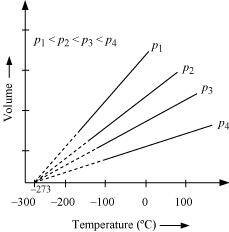
It was found that for all gases (at any given pressure), the plots of volume vs. temperature (in $^\circ\text{C}$) is a straight line. If this line is extended to zero volume, then it intersects the temperature-axis at $-273.15^\circ\text{C}$. In other words, the volume of any gas at $-273.15^\circ\text{C}$ is zero theoretically. This is because all gases get liquefied before reaching a temperature of $-273.15^\circ\text{C}$. Hence, it can be concluded that $-273.15^\circ\text{C}$ is the lowest possible temperature.
Question 22:
Critical temperature for carbon dioxide and methane are $31.1^\circ\text{C}$ and $-81.9^\circ\text{C}$ respectively. Which of these has stronger intermolecular forces and why?
Solution:
Higher is the critical temperature of a gas, easier is its liquefaction. This means that the intermolecular forces of attraction between the molecules of a gas are directly proportional to its critical temperature.
Hence, intermolecular forces of attraction are stronger in the case of $\text{CO}_2$ ($31.1^\circ\text{C} > -81.9^\circ\text{C}$).
Question 23:
Explain the physical significance of the van der Waals parameters.
Solution:
Physical significance of ‘a’:
‘a’ is a measure of the magnitude of intermolecular attractive forces within a gas.
Physical significance of ‘b’:
‘b’ is a measure of the volume of a gas molecule (excluded volume).
Why Class 11 Chemistry Chapter 5 Matters in NEET and JEE
Class 11 Chemistry Chapter 5 is important for NEET and JEE because it explains the behaviour of gases and liquids through gas laws, intermolecular forces and kinetic molecular theory. Students must understand Boyle’s Law, Charles’s Law, Avogadro’s Law, Dalton’s Law of Partial Pressures and the ideal gas equation. JEE frequently includes numerical questions involving pressure, volume, temperature, density, molar mass and gaseous mixtures. NEET commonly tests direct NCERT concepts, assumptions of kinetic theory, real-gas behaviour and critical temperature. Topics such as the van der Waals equation, liquefaction of gases, vapour pressure, surface tension and viscosity also support later chapters in physical chemistry. A strong command of formulas, unit conversions and gas-law calculations helps students solve examination questions quickly and accurately.
Preparation Tips for Class 11 Chemistry Chapter 5
Begin by understanding the basic gas laws, including Boyle’s Law, Charles’s Law, Gay-Lussac’s Law and Avogadro’s Law. Prepare a formula sheet containing the ideal gas equation, combined gas law, Dalton’s Law of Partial Pressures, density relation and Graham’s Law of Diffusion. Always convert temperature into kelvin and use compatible units for pressure, volume and the gas constant before solving numerical questions. Practise identifying which quantities remain constant in each problem so that the correct gas law can be selected.
Study the assumptions of kinetic molecular theory and understand why real gases deviate from ideal behaviour. Learn the physical significance of the van der Waals constants ($a$) and ($b$), along with critical temperature and gas liquefaction. Revise liquid-state properties such as vapour pressure, surface tension and viscosity. Complete all NCERT examples and exercise questions before attempting JEE and NEET previous-year questions. Regular practice of calculations, unit conversions and formula-based questions will improve speed and accuracy.
FAQs
What are the most important topics in Class 11 Chemistry Chapter 5?
The most important topics include intermolecular forces, Boyle’s Law, Charles’s Law, Gay-Lussac’s Law, Avogadro’s Law, the ideal gas equation, Dalton’s Law of Partial Pressures, kinetic molecular theory, real gases, the van der Waals equation, critical temperature, surface tension and viscosity.
Which formulas should students remember from the States of Matter chapter?
Students should learn the gas-law equations, the ideal gas equation ($PV = nRT$), the combined gas law, the density relation ($d = \frac{PM}{RT}$), Dalton’s Law of Partial Pressures and the van der Waals equation $\left(P + \frac{an^2}{V^2}\right)(V – nb) = nRT$. They should also remember the correct values and units of the gas constant.
Why must temperature be converted into kelvin in gas-law calculations?
Gas laws use absolute temperature because gas volume and pressure are directly related to temperature measured from absolute zero. Therefore, temperature given in degrees Celsius must be converted using $T(\text{K}) = t(^\circ\text{C}) + 273.15$.
What is the difference between ideal and real gases?
An ideal gas is assumed to have negligible molecular volume and no intermolecular forces. Real gases have finite molecular size and attractive forces between particles. Real gases show the greatest deviation from ideal behaviour at high pressure and low temperature.
What is the significance of the van der Waals constants ($a$) and ($b$)?
The constant ($a$) represents the strength of intermolecular attractive forces in a gas. The constant ($b$) represents the effective volume occupied by gas molecules. Larger values indicate stronger attractions or larger molecular size.
Is Class 11 Chemistry Chapter 5 important for NEET and JEE?
Yes. NEET and JEE frequently include numerical and conceptual questions based on gas laws, gaseous mixtures, density, molar mass, kinetic theory, real-gas behaviour and critical temperature. Regular practice of NCERT questions and previous-year problems is essential for scoring well.