Published by:
CGP EDU Academic Team
Published on: September 12, 2026
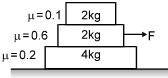
In the situation shown in figure, for what value of minimum horizontal force F (in Newton), sliding between middle and lower block will start? (Take g = 10 m/s 2 )
Text Solution
Verified by ExpertsThe correct answer is:
B
Step 1: Identify the weights of the blocks:
- Block 1 (top): 2 kg
- Block 2 (middle): 2 kg
- Block 3 (bottom): 4 kg.
Step 2: Calculate the normal forces acting on each block.
The weight of Block 1 is: \( W_1 = m_1 \cdot g = 2 \times 10 = 20 \, \text{N} \)
The weight of Block 2 is: \( W_2 = m_2 \cdot g = 2 \times 10 = 20 \, \text{N} \)
The weight of Block 3 is: \( W_3 = m_3 \cdot g = 4 \times 10 = 40 \, \text{N} \)
Step 3: Determine the friction forces:
- Top block (Block 1) on Block 2: \( F_{1} = \mu_1 \cdot W_1 = 0.1 \cdot 20 = 2 \, \text{N} \)
- Middle block (Block 2) on Block 3: \( F_{2} = \mu_2 \cdot W_2 = 0.6 \cdot 20 = 12 \, \text{N} \)
Step 4: Calculate the total friction force that must be overcome to start the sliding of Block 1 over Block 2.
When Block 1 starts sliding over Block 2, the applied force \( F \) must overcome the static friction force, which is limited to the friction force between Block 2 and Block 3:
Therefore, for Block 1 to start sliding, it must overcome the friction force \( F_{2} \): \( F = F_2 = 12 \, \text{N} \)
However, we must also overcome the friction between Block 1 and Block 2, which adds up:
Total force required to start sliding = \( F_{1} + F_{2} = 2 + 12 = 14 \, \text{N} \)
Therefore, the minimum horizontal force \( F \) must be: \( F = 14 \, \text{N} \). Thus, option B is correct.
- Block 1 (top): 2 kg
- Block 2 (middle): 2 kg
- Block 3 (bottom): 4 kg.
Step 2: Calculate the normal forces acting on each block.
The weight of Block 1 is: \( W_1 = m_1 \cdot g = 2 \times 10 = 20 \, \text{N} \)
The weight of Block 2 is: \( W_2 = m_2 \cdot g = 2 \times 10 = 20 \, \text{N} \)
The weight of Block 3 is: \( W_3 = m_3 \cdot g = 4 \times 10 = 40 \, \text{N} \)
Step 3: Determine the friction forces:
- Top block (Block 1) on Block 2: \( F_{1} = \mu_1 \cdot W_1 = 0.1 \cdot 20 = 2 \, \text{N} \)
- Middle block (Block 2) on Block 3: \( F_{2} = \mu_2 \cdot W_2 = 0.6 \cdot 20 = 12 \, \text{N} \)
Step 4: Calculate the total friction force that must be overcome to start the sliding of Block 1 over Block 2.
When Block 1 starts sliding over Block 2, the applied force \( F \) must overcome the static friction force, which is limited to the friction force between Block 2 and Block 3:
Therefore, for Block 1 to start sliding, it must overcome the friction force \( F_{2} \): \( F = F_2 = 12 \, \text{N} \)
However, we must also overcome the friction between Block 1 and Block 2, which adds up:
Total force required to start sliding = \( F_{1} + F_{2} = 2 + 12 = 14 \, \text{N} \)
Therefore, the minimum horizontal force \( F \) must be: \( F = 14 \, \text{N} \). Thus, option B is correct.
Prepare Smarter with CGP Edu
Get practice questions, solutions, and test series in one place.
Write a Review
Share your experience with this question and solution.
Commentary
Send your comment, doubt, correction, or feedback to admin.
Similar Questions
Explore conceptually related problems
A body of mass 5 kg is kept on a rough horizontal surface. It is found that the body does not slide…
In the given figures find the accelerations and the friction forces involved
(i)
(ii)
(iii)
(iv)
In the given figure find the accelerations of blocks A and B for the following cases (g = 10 m/s 2 …
Column II gives certain situations involving two blocks of mass 2 kg and 4 kg. The 4 kg block lies …
In the arrangement shown tension in the string connecting 4kg and 6kg masses is
In the given figure the coefficient of friction between 4kg and 5 kg blocks is 0.2 and between 5 kg…