Published by:
CGP EDU Academic Team
Published on: September 12, 2026
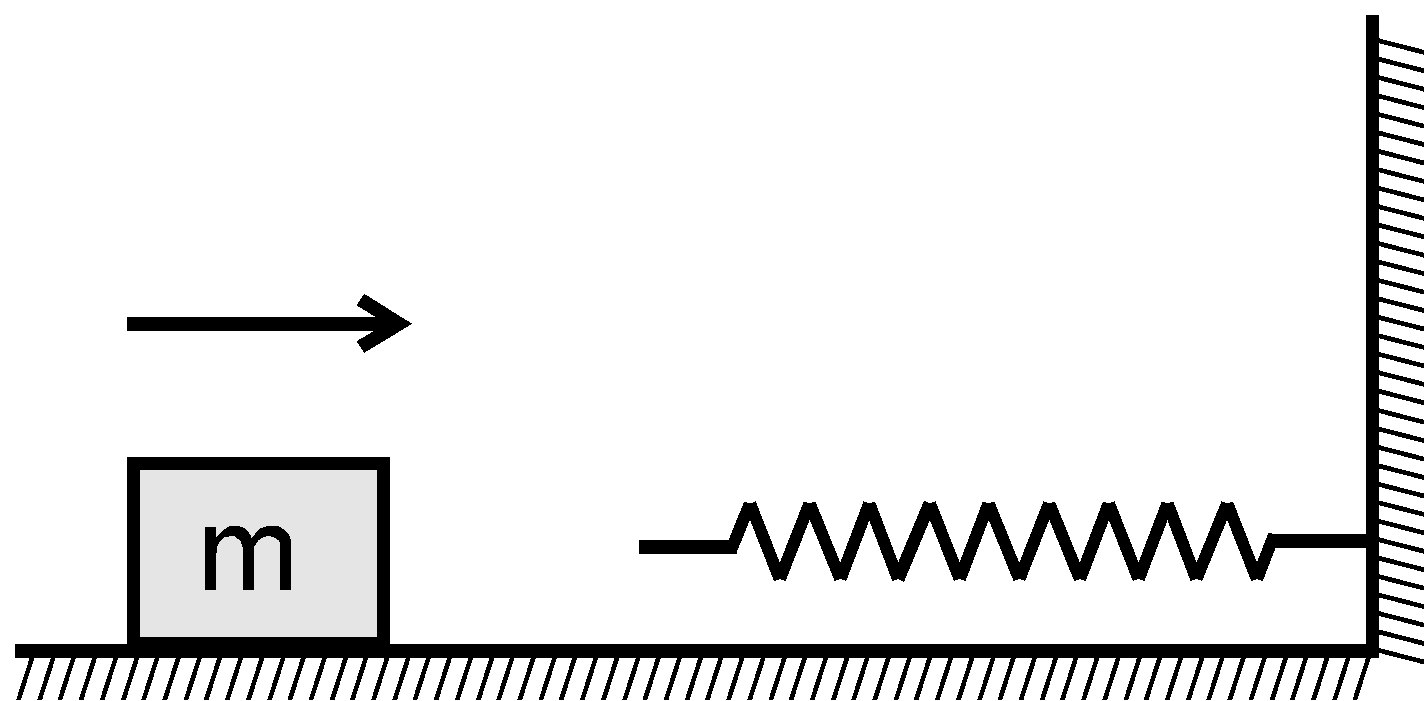
In the figure shown the change in magnitude of momentum of the block when it comes to its initial position if the maximum compression of the spring is x 0 will be :
A
2  x 0
x 0
x 0
B
 x 0
x 0
C
zero
D
none of these
Text Solution
Verified by ExpertsThe correct answer is:
A
To find the change in the momentum of the block when it comes back to its initial position after compressing the spring by an amount \(x_0\), we need to analyze the motion involved.
1. **Initial Momentum**: When the block is at rest before it is displaced by the spring, its momentum is zero: \(p_{initial} = 0\).
2. **At Maximum Compression**: At maximum compression \(x_0\), the speed of the block is momentarily zero, therefore its momentum remains zero at this point as well: \(p_{max extrm{compression}} = 0\).
3. **Block Returning to Initial Position**: As the spring pushes the block back to its position, it accelerates. The block accelerates due to the force exerted by the spring (following Hooke's Law: \(F = -kx\)).
4. **Final Momentum (Back at Initial Position)**: When the block returns to its original position, it will have a certain velocity again due to the elastic potential energy being converted to kinetic energy. The momentum of the block when it returns can be calculated as \(p_{final} = mv\), where \(v\) is the speed at return.
However, since the speed of the block coming back must equal the speed it had right before it began compressing the spring, we can state that the change in momentum equals twice the momentum at the moment of returning. Thus:
\(\Delta p = p_{final} - p_{initial} = mv - 0 = 2mv_{initial}\)
Hence the final expression for the change in the momentum will lead us back to the maximum displacement of the spring, indicating that the change is proportional to \(2kx_0\) (from spring energy considerations, where \(k\) is the spring constant). Therefore, the correct answer is Option A: 2kx_0.
1. **Initial Momentum**: When the block is at rest before it is displaced by the spring, its momentum is zero: \(p_{initial} = 0\).
2. **At Maximum Compression**: At maximum compression \(x_0\), the speed of the block is momentarily zero, therefore its momentum remains zero at this point as well: \(p_{max extrm{compression}} = 0\).
3. **Block Returning to Initial Position**: As the spring pushes the block back to its position, it accelerates. The block accelerates due to the force exerted by the spring (following Hooke's Law: \(F = -kx\)).
4. **Final Momentum (Back at Initial Position)**: When the block returns to its original position, it will have a certain velocity again due to the elastic potential energy being converted to kinetic energy. The momentum of the block when it returns can be calculated as \(p_{final} = mv\), where \(v\) is the speed at return.
However, since the speed of the block coming back must equal the speed it had right before it began compressing the spring, we can state that the change in momentum equals twice the momentum at the moment of returning. Thus:
\(\Delta p = p_{final} - p_{initial} = mv - 0 = 2mv_{initial}\)
Hence the final expression for the change in the momentum will lead us back to the maximum displacement of the spring, indicating that the change is proportional to \(2kx_0\) (from spring energy considerations, where \(k\) is the spring constant). Therefore, the correct answer is Option A: 2kx_0.
Prepare Smarter with CGP Edu
Get practice questions, solutions, and test series in one place.
Write a Review
Share your experience with this question and solution.
Commentary
Send your comment, doubt, correction, or feedback to admin.
Similar Questions
Explore conceptually related problems
Two blocks of masses m and M are moving with speeds v 1 and v 2 (v 1 > v 2 ) in the same direction …
Two masses are connected by a spring as shown in the figure. One of the masses was given velocity v…
Mass A hits B inelastically (e = 0) while moving horizontally with some velocity along the common l…
Two masses m 1 and m 2 are connected by a spring of spring constant k and are placed on a smooth ho…
Two block of masses m 1 and m 2 are connected with the help of a spring of spring constant k initia…
Two blocks A and B of mass m A and m B are connected together by means of a spring and are resting …