
NCERT Solutions for class 11 Physics Chapter 7 Gravitation is prepared by our senior and renowned teachers of Physics Wallah primary focus while solving these questions of class-11 in NCERT textbook, also do read theory of this Chapter 7 Gravitation while going before solving the NCERT questions.
Class 11 Physics Chapter 7 Overview
The Gravitation chapter explains the force of attraction between objects having mass. Students learn about Newton’s law of universal gravitation, gravitational field, acceleration due to gravity and the variation of gravity with height and depth. The chapter covers Kepler’s laws of planetary motion, gravitational potential energy, escape velocity and orbital velocity. It also discusses the motion of satellites and the conditions required for objects to remain in orbit.
NCERT CLASS 11 PHYSICS
CHAPTER 7: GRAVITATION
Question 7.1.
Answer the following:
a. You can shield a charge from electrical forces by putting it inside a hollow conductor. Can you shield a body from the gravitational influence of nearby matter by putting it inside a hollow sphere or by some other means?
b. An astronaut inside a small space ship orbiting around the earth cannot detect gravity. If the space station orbiting around the earth has a large size, can he hope to detect gravity?
c. If you compare the gravitational force on the earth due to the sun to that due to the moon, you would find that the Sun’s pull is greater than the moon’s pull. (You can check this yourself using the data available in the succeeding exercises). However, the tidal effect of the moon’s pull is greater than the tidal effect of sun. Why?
Solution :
(a) No (b) Yes
a. Gravitational influence of matter on nearby objects cannot be screened by any means. This is because gravitational force unlike electrical forces is independent of the nature of the material medium. Also, it is independent of the status of other objects.
b. If the size of the space station is large enough, then the astronaut will detect the change in Earth’s gravity ($g$).
c. Tidal effect depends inversely upon the cube of the distance while, gravitational force depends inversely on the square of the distance. Since the distance between the Moon and the Earth is smaller than the distance between the Sun and the Earth, the tidal effect of the Moon’s pull is greater than the tidal effect of the Sun’s pull.
Question 7.2.
Choose the correct alternative:
a. Acceleration due to gravity increases / decreases with increasing altitude.
b. Acceleration due to gravity increases / decreases with increasing depth. (assume the earth to be a sphere of uniform density).
c. Acceleration due to gravity is independent of mass of the earth / mass of the body.
d. The formula $-GMm\left(\frac{1}{r_2} – \frac{1}{r_1}\right)$ is more / less accurate than the formula $mg(r_2 – r_1)$ for the difference of potential energy between two points $r_2$ and $r_1$ distance away from the centre of the earth.
Solution :
a. Decreases
b. Decreases
c. Mass of the body
d. More
Question 7.3.
Suppose there existed a planet that went around the sun twice as fast as the earth. What would be its orbital size as compared to that of the earth?
Solution :
Lesser by a factor of $0.63$
Time taken by the Earth to complete one revolution around the Sun,
$$T_e = 1\text{ year}$$
Orbital radius of the Earth in its orbit, $R_e = 1\text{ AU}$
Time taken by the planet to complete one revolution around the Sun, $T_p = \frac{1}{2}T_e = \frac{1}{2}\text{ year}$
Orbital radius of the planet $= R_p$
From Kepler’s third law of planetary motion, we can write:
$$\left(\frac{R_p}{R_e}\right)^3 = \left(\frac{T_p}{T_e}\right)^2$$
$$\left(\frac{R_p}{R_e}\right) = \left(\frac{T_p}{T_e}\right)^{2/3}$$
$$= \left(\frac{1/2}{1}\right)^{2/3} = 0.5^{2/3} = 0.63$$
Hence, the orbital radius of the planet will be $0.63$ times smaller than that of the Earth.
Question 7.4.
Io, one of the satellites of Jupiter, has an orbital period of $1.769\text{ days}$ and the radius of the orbit is $4.22 \times 10^8\text{ m}$. Show that the mass of Jupiter is about one-thousandth that of the sun.
Solution :
Orbital period of $\text{Io}, T_{I0} = 1.769\text{ days} = 1.769 \times 24 \times 60 \times 60\text{ s}$
Orbital radius of $\text{Io}, R_{I0} = 4.22 \times 10^8\text{ m}$
Satellite $\text{Io}$ is revolving around the Jupiter
Mass of the latter is given by the relation:
$$M_J = \frac{4\pi^2 R_{I0}^3}{G T_{I0}^2} \quad \dots\text{(i)}$$
Where,
$M_J = \text{Mass of Jupiter}$
$G = \text{Universal gravitational constant}$
Orbital period of the earth,
$$T_e = 365.25\text{ days} = 365.25 \times 24 \times 60 \times 60\text{ s}$$
Orbital radius of the Earth,
$$R_e = 1\text{ AU} = 1.496 \times 10^{11}\text{ m}$$
Mass of sun is given as:
$$M_s = \frac{4\pi^2 R_e^3}{G T_e^2} \quad \dots\text{(ii)}$$
$$\therefore \frac{M_s}{M_J} = \left(\frac{4\pi^2 R_e^3}{G T_e^2}\right) \times \left(\frac{G T_{I0}^2}{4\pi^2 R_{I0}^3}\right) = \frac{R_e^3 \times T_{I0}^2}{R_{I0}^3 \times T_e^2}$$
Substituting the values, we get:
$$= \left(\frac{1.769 \times 24 \times 60 \times 60}{365.25 \times 24 \times 60 \times 60}\right)^2 \times \left(\frac{1.496 \times 10^{11}}{4.22 \times 10^8}\right)^3$$
$$= 1045.04$$
$$\therefore \frac{M_s}{M_J} \sim 1000 \sim 1000 \times M_J$$
Hence, it can be inferred that the mass of Jupiter is about one-thousandth that of the Sun.
Question 7.5.
Let us assume that our galaxy consists of $2.5 \times 10^{11}$ stars each of one solar mass. How long will a star at a distance of $50,000\text{ ly}$ from the galactic centre take to complete one revolution? Take the diameter of the Milky Way to be $10^5\text{ ly}$.
Solution :
Mass of our galaxy Milky Way, $M = 2.5 \times 10^{11}\text{ solar mass}$
Solar mass $=$ Mass of Sun $= 2.0 \times 10^{30}\text{ kg}$
Mass of our galaxy, $M = 2.5 \times 10^{11} \times 2 \times 10^{30} = 5 \times 10^{41}\text{ kg}$
Diameter of Milky Way, $d = 10^5\text{ ly}$
Radius of Milky Way, $r = 5 \times 10^4\text{ ly}$
$1\text{ ly} = 9.46 \times 10^{15}\text{ m}$
$$\therefore r = 5 \times 10^4 \times 9.46 \times 10^{15} = 4.73 \times 10^{20}\text{ m}$$
Since a star revolves around the galactic centre of the Milky Way, its time period is given by the relation:
$$T = \left(\frac{4\pi^2 r^3}{GM}\right)^{1/2}$$
$$= \left[\frac{4 \times (3.14)^2 \times (4.73)^3 \times 10^{60}}{6.67 \times 10^{-11} \times 5 \times 10^{41}}\right]^{1/2}$$
$$= \left(\frac{39.48 \times 105.82 \times 10^{30}}{33.35}\right)^{1/2}$$
$$= 1.12 \times 10^{16}\text{ s}$$
$1\text{ year} = 365 \times 24 \times 60 \times 60\text{ s}$
$$1\text{s} = \frac{1}{365 \times 24 \times 60 \times 60}\text{ years}$$
$$\therefore 1.12 \times 10^{16}\text{ s} = \frac{1.12 \times 10^{16}}{365 \times 24 \times 60 \times 60} = 3.55 \times 10^8\text{ years}.$$
Question 7.6.
Choose the correct alternative:
a. If the zero of potential energy is at infinity, the total energy of an orbiting satellite is negative of its kinetic / potential energy.
b. The energy required to launch an orbiting satellite out of earth’s gravitational influence is more / less than the energy required to project a stationary object at the same height (as the satellite) out of earth’s influence.
Solution :
a. Kinetic energy
b. Less
Question 7.7.
Does the escape speed of a body from the earth depend on
a. the mass of the body,
b. the location from where it is projected,
c. the direction of projection,
d. the height of the location from where the body is launched?
Solution :
a. No
b. No
c. No
d. Yes
Escape velocity of a body from the Earth is given by the relation:
$$v_{\text{esc}} = \sqrt{2gR}$$
It is clear from equation (i) that escape velocity $v_{\text{esc}}$ is independent of the mass of the body and the direction of its projection. However, it depends on gravitational potential at the point from where the body is launched. Since this potential marginally depends on the height of the point, escape velocity also marginally depends on these factors.
Question 7.8.
A comet orbits the Sun in a highly elliptical orbit. Does the comet have a constant
a. linear speed,
b. angular speed,
c. angular momentum,
d. kinetic energy,
e. potential energy,
f. total energy throughout its orbit? Neglect any mass loss of the comet when it comes very close to the Sun.
Solution :
a. No
b. No
c. Yes
d. No
e. No
f. Yes
Angular momentum and total energy at all points of the orbit of a comet moving in a highly elliptical orbit around the Sun are constant. Its linear speed, angular speed, kinetic, and potential energy varies from point to point in the orbit.
Question 7.9.
Which of the following symptoms is likely to afflict an astronaut in space
a. swollen feet,
b. swollen face,
c. headache,
d. orientational problem?
Solution :
a. Legs hold the entire mass of a body in standing position due to gravitational pull. In space, an astronaut feels weightlessness because of the absence of gravity. Therefore, swollen feet of an astronaut do not affect him/her in space.
b. A swollen face is caused generally because of apparent weightlessness in space. Sense organs such as eyes, ears nose, and mouth constitute a person’s face. This symptom can affect an astronaut in space.
c. Headaches are caused because of mental strain. It can affect the working of an astronaut in space.
d. Space has different orientations. Therefore, orientational problem can affect an astronaut in space.
Question 7.10.
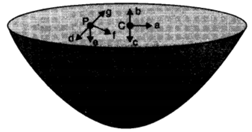
In the following two exercise, chooses the correct answer from among the given ones The gravitational intensity at the centre of a hemispherical shell of uniform mass density has the direction indicated by the arrow (see Fig 7.12) (i) a, (ii) b, (iii) c, (iv) O.
Solution :
Gravitational potential ($V$) is constant at all points in a spherical shell. Hence, the gravitational potential gradient $\left(\frac{dV}{dR}\right)$ is zero everywhere inside the spherical shell. The gravitational potential gradient is equal to the negative of gravitational intensity. Hence, intensity is also zero at all points inside the spherical shell. This indicates that gravitational forces acting at a point in a spherical shell are symmetric.
If the upper half of a spherical shell is cut out (as shown in the given figure), then the net gravitational force acting on a particle located at centre O will be in the downward direction.
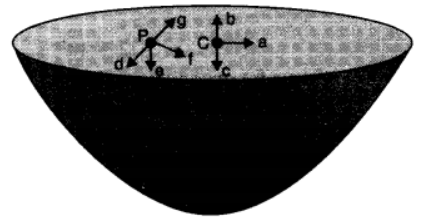
Since gravitational intensity at a point is defined as the gravitational force per unit mass at that point, it will also act in the downward direction. Thus, the gravitational intensity at centre O of the given hemispherical shell has the direction as indicated by arrow c.
Question 7.11.
For the above problem, the direction of the gravitational intensity at an arbitrary point P is indicated by the arrow (i) d, (ii) e, (iii) f, (iv) g.
Solution :
Gravitational potential ($V$) is constant at all points in a spherical shell. Hence, the gravitational potential gradient $\left(\frac{dV}{dR}\right)$ is zero everywhere inside the spherical shell. The gravitational potential gradient is equal to the negative of gravitational intensity. Hence, intensity is also zero at all points inside the spherical shell. This indicates that gravitational forces acting at a point in a spherical shell are symmetric.
If the upper half of a spherical shell is cut out (as shown in the given figure), then the net gravitational force acting on a particle at an arbitrary point P will be in the downward direction.
Since gravitational intensity at a point is defined as the gravitational force per unit mass at that point, it will also act in the downward direction. Thus, the gravitational intensity at an arbitrary point P of the hemispherical shell has the direction as indicated by arrow e.
Hence, the correct answer is (ii).
Question 7.12.
A rocket is fired from the earth towards the sun. At what distance from the earth’s centre is the gravitational force on the rocket zero? Mass of the sun $= 2 \times 10^{30}\text{ kg}$, mass of the earth $= 6 \times 10^{24}\text{ kg}$. Neglect the effect of other planets etc. (orbital radius $= 1.5 \times 10^{11}\text{ m}$).
Solution :
Mass of the Sun, $M_s = 2 \times 10^{30}\text{ kg}$
Mass of the Earth, $M_e = 6 \times 10^{24}\text{ kg}$
Orbital radius, $r = 1.5 \times 10^{11}\text{ m}$
Mass of the rocket $= m$
Let $x$ be the distance from the centre of the Earth where the gravitational force acting on satellite P becomes zero. From Newton’s law of gravitation, we can equate gravitational forces acting on satellite P under the influence of the Sun and the Earth as:
$$\frac{G m M_s}{(r – x)^2} = \frac{G m M_e}{x^2}$$
$$\left(\frac{r – x}{x}\right)^2 = \frac{M_s}{M_e}$$
$$\left(\frac{r – x}{x}\right) = \left(\frac{2 \times 10^{30}}{60 \times 10^{24}}\right)^{1/2} = 577.35$$
$$1.5 \times 10^{11} – x = 577.35x$$
$$578.35x = 1.5 \times 10^{11}$$
$$\therefore x = \frac{1.5 \times 10^{11}}{578.35} = 2.59 \times 10^8\text{ m}.$$
Question 7.13.
How will you ‘weigh the sun’, that is estimate its mass? The mean orbital radius of the earth around the sun is $1.5 \times 10^8\text{ km}$.
Solution :
Orbital radius of the Earth around the Sun, $r = 1.5 \times 10^{11}\text{ m}$
Time taken by the Earth to complete one revolution around the Sun,
$$T = 1\text{ year} = 365.25\text{ days}$$
$$= 365.25 \times 24 \times 60 \times 60\text{ s}$$
Universal gravitational constant, $G = 6.67 \times 10^{-11}\text{ N m}^2\text{ kg}^{-2}$
Thus, mass of the Sun can be calculated using the relation,
$$M = \frac{4\pi^2 r^3}{G T^2}$$
$$= \frac{4 \times (3.14)^2 \times (1.5 \times 10^{11})^3}{6.67 \times 10^{-11} \times (365.25 \times 24 \times 60 \times 60)^2}$$
$$= 2 \times 10^{30}\text{ kg}$$
Hence, the mass of the Sun is $2 \times 10^{30}\text{ kg}$.
Question 7.14.
A Saturn year is $29.5$ times the earth year. How far is the Saturn from the sun if the earth is $1.50 \times 10^8\text{ km}$ away from the sun?
Solution :
Distance of the Earth from the Sun, $r_e = 1.5 \times 10^8\text{ km} = 1.5 \times 10^{11}\text{ m}$
Time period of the Earth $= T_e$
Time period of Saturn, $T_s = 29.5 T_e$
Distance of Saturn from the Sun $= r_s$
From Kepler’s third law of planetary motion, we have
$$\frac{r_s^3}{r_e^3} = \frac{T_s^2}{T_e^2}$$
$$r_s = r_e \left(\frac{T_s}{T_e}\right)^{2/3}$$
$$= 1.5 \times 10^{11} \left(\frac{29.5 T_e}{T_e}\right)^{2/3}$$
$$= 1.5 \times 10^{11} (29.5)^{2/3}$$
$$= 14.32 \times 10^{11}\text{ m}$$
Hence, the distance between Saturn and the Sun is $1.43 \times 10^{12}\text{ m}$.
Question 7.15.
A body weighs $63\text{ N}$ on the surface of the earth. What is the gravitational force on it due to the earth at a height equal to half the radius of the earth?
Solution :
Weight of the body, $W = 63\text{ N}$
Acceleration due to gravity at height $h$ from the Earth’s surface is given by the relation:
$$g’ = \frac{g}{\left(1 + \frac{h}{R_e}\right)^2}$$
Where,
$g = \text{Acceleration due to gravity on the Earth’s surface}$
$R_e = \text{Radius of the Earth}$
For $h = R_e / 2$:
$$g’ = \frac{g}{\left(1 + \frac{R_e}{2R_e}\right)^2} = \frac{g}{\left(1 + \frac{1}{2}\right)^2} = \left(\frac{4}{9}\right)g$$
Weight of a body of mass $m$ at height $h$ is given as:
$$W’ = mg’ = m \times \left(\frac{4}{9}\right)g = \left(\frac{4}{9}\right)mg = \left(\frac{4}{9}\right)W$$
$$= \left(\frac{4}{9}\right) \times 63 = 28\text{ N}.$$
Question 7.16.
Assuming the earth to be a sphere of uniform mass density, how much would a body weigh half way down to the centre of the earth if it weighed $250\text{ N}$ on the surface?
Solution :
Weight of a body of mass $m$ at the Earth’s surface, $W = mg = 250\text{ N}$
Body of mass $m$ is located at depth, $d = \left(\frac{1}{2}\right)R_e$
Where,
$R_e = \text{Radius of the Earth}$
Acceleration due to gravity at depth $g(d)$ is given by the relation:
$$g’ = g\left(1 – \frac{d}{R_e}\right) = g\left(1 – \frac{R_e}{2R_e}\right) = \left(\frac{1}{2}\right)g$$
Weight of the body at depth $d$:
$$W’ = mg’ = m \times \left(\frac{1}{2}\right)g = \left(\frac{1}{2}\right)mg = \left(\frac{1}{2}\right)W$$
$$= \left(\frac{1}{2}\right) \times 250 = 125\text{ N}$$
Question 7.17.
A rocket is fired vertically with a speed of $5\text{ km s}^{-1}$ from the earth’s surface. How far from the earth does the rocket go before returning to the earth? Mass of the earth $= 6.0 \times 10^{24}\text{ kg}$; mean radius of the earth $= 6.4 \times 10^6\text{ m}$; $G = 6.67 \times 10^{-11}\text{ N m}^2\text{ kg}^{-2}$.
Solution :
Velocity of the rocket, $v = 5\text{ km/s} = 5 \times 10^3\text{ m/s}$
Mass of the Earth, $M_e = 6 \times 10^{24}\text{ kg}$
Radius of the Earth, $R_e = 6.4 \times 10^6\text{ m}$
Height reached by rocket mass, $m = h$
At the surface of the Earth, total energy of the rocket = Kinetic energy + Potential energy:
$$= \frac{1}{2}mv^2 + \left(-\frac{GM_e m}{R_e}\right)$$
At highest point $h$, $v = 0$ and Potential energy $= -\frac{GM_e m}{R_e + h}$.
Total energy of the rocket $= 0 + \left[-\frac{GM_e m}{R_e + h}\right] = -\frac{GM_e m}{R_e + h}$
From the law of conservation of energy, we have:
$$\text{Total energy of the rocket at the Earth’s surface} = \text{Total energy at height } h$$
$$\frac{1}{2}mv^2 + \left(-\frac{GM_e m}{R_e}\right) = -\frac{GM_e m}{R_e + h}$$
$$\frac{1}{2}v^2 = GM_e \left(\frac{1}{R_e} – \frac{1}{R_e + h}\right) = GM_e \left(\frac{R_e + h – R_e}{R_e(R_e + h)}\right)$$
$$\frac{1}{2}v^2 = \frac{g R_e h}{R_e + h}$$
Where $g = \frac{GM}{R_e^2} = 9.8\text{ ms}^{-2}$
$$\therefore v^2(R_e + h) = 2gR_e h$$
$$v^2 R_e = h(2gR_e – v^2)$$
$$h = \frac{R_e v^2}{2gR_e – v^2} = \frac{6.4 \times 10^6 \times (5 \times 10^3)^2}{2 \times 9.8 \times 6.4 \times 10^6 – (5 \times 10^3)^2}$$
$$h = 1.6 \times 10^6\text{ m}$$
Height achieved by the rocket with respect to the centre of the Earth $= R_e + h = 6.4 \times 10^6 + 1.6 \times 10^6 = 8 \times 10^6\text{ m}$.
Question 7.18.
The escape speed of a projectile on the earth’s surface is $11.2\text{ km s}^{-1}$. A body is projected out with thrice this speed. What is the speed of the body far away from the earth? Ignore the presence of the sun and other planets.
Solution :
Escape velocity of a projectile from the Earth, $v_{\text{esc}} = 11.2\text{ km/s}$
Projection velocity of the projectile, $v_p = 3v_{\text{esc}}$
Mass of the projectile $= m$
Velocity of the projectile far away from the Earth $= v_f$
Total energy of the projectile on the Earth $= \frac{1}{2}mv_p^2 – \frac{1}{2}mv_{\text{esc}}^2$
Gravitational potential energy of the projectile far away from the Earth is zero.
Total energy of the projectile far away from the Earth $= \frac{1}{2}mv_f^2$
From the law of conservation of energy, we have:
$$\frac{1}{2}mv_p^2 – \frac{1}{2}mv_{\text{esc}}^2 = \frac{1}{2}mv_f^2$$
$$v_f = (v_p^2 – v_{\text{esc}}^2)^{1/2} = [(3v_{\text{esc}})^2 – v_{\text{esc}}^2]^{1/2} = \sqrt{8}v_{\text{esc}}$$
Question 7.19.
A satellite orbits the earth at a height of $400\text{ km}$ above the surface. How much energy must be expended to rocket the satellite out of the earth’s gravitational influence? Mass of the satellite $= 200\text{ kg}$; mass of the earth $= 6.0 \times 10^{24}\text{ kg}$; radius of the earth $= 6.4 \times 10^6\text{ m}$; $G = 6.67 \times 10^{-11}\text{ N m}^2\text{ kg}^{-2}$.
Solution :
Mass of the Earth, $M = 6.0 \times 10^{24}\text{ kg}$
Mass of the satellite, $m = 200\text{ kg}$
Radius of the Earth, $R_e = 6.4 \times 10^6\text{ m}$
Universal gravitational constant, $G = 6.67 \times 10^{-11}\text{ N m}^2\text{ kg}^{-2}$
Height of the satellite, $h = 400\text{ km} = 4 \times 10^5\text{ m} = 0.4 \times 10^6\text{ m}$
Total energy of the satellite at height $h = \frac{1}{2}mv^2 + \left[-\frac{GM_e m}{R_e + h}\right]$
Orbital velocity of the satellite, $v = \left[\frac{GM_e}{R_e + h}\right]^{1/2}$
Total energy of height, $h = \left(\frac{1}{2}\right)\frac{GM_e m}{R_e + h} – \frac{GM_e m}{R_e + h} = -\left(\frac{1}{2}\right)\frac{GM_e m}{R_e + h}$
The negative sign indicates that the satellite is bound to the Earth. This is called bound energy of the satellite.
Energy required to send the satellite out of its orbit $= -(\text{Bound energy})$
$$= \left(\frac{1}{2}\right)\frac{GM_e m}{R_e + h}$$
$$= \frac{\frac{1}{2} \times 6.67 \times 10^{-11} \times 6 \times 10^{24} \times 200}{6.4 \times 10^6 + 0.4 \times 10^6} = 5.9 \times 10^9\text{ J}.$$
Question 7.20.
Two stars each of one solar mass ($= 2 \times 10^{30}\text{ kg}$) are approaching each other for a head on collision. When they are a distance $10^9\text{ km}$, their speeds are negligible. What is the speed with which they collide? The radius of each star is $10^4\text{ km}$. Assume the stars to remain undistorted until they collide. (Use the known value of $G$).
Solution :
Mass of each star, $M = 2 \times 10^{30}\text{ kg}$
Radius of each star, $R = 10^4\text{ km} = 10^7\text{ m}$
Distance between the stars, $r = 10^9\text{ km} = 10^{12}\text{ m}$
For negligible speeds, $v = 0$ total energy of two stars separated at distance $r$
$$= \left[-\frac{GMM}{r}\right] + \left(\frac{1}{2}\right)mv^2 = \left[-\frac{GMM}{r}\right] + 0 \quad \dots\text{(i)}$$
Now, consider the case when the stars are about to collide:
Velocity of the stars $= v$
Distance between the centers of the stars $= 2R$
Total kinetic energy of both stars $= \left(\frac{1}{2}\right)Mv^2 + \left(\frac{1}{2}\right)Mv^2 = Mv^2$
Total potential energy of both stars $= -\frac{GMM}{2R}$
Total energy of the two stars $= Mv^2 – \frac{GMM}{2R} \quad \dots\text{(ii)}$
Using the law of conservation of energy, we can write:
$$Mv^2 – \frac{GMM}{2R} = -\frac{GMM}{r}$$
$$v^2 = -GM \left(\frac{1}{r}\right) + \frac{GM}{2R} = GM \left(-\frac{1}{r} + \frac{1}{2R}\right)$$
$$= 6.67 \times 10^{-11} \times 2 \times 10^{30} \left(-\frac{1}{10^{12}} + \frac{1}{2 \times 10^7}\right) \approx 6.67 \times 10^{12}$$
$$v = (6.67 \times 10^{12})^{1/2} = 2.58 \times 10^6\text{ m/s}.$$
Question 7.21.
Two heavy spheres each of mass $100\text{ kg}$ and radius $0.10\text{ m}$ are placed $1.0\text{ m}$ apart on a horizontal table. What is the gravitational force and potential at the mid point of the line joining the centers of the spheres? Is an object placed at that point in equilibrium? If so, is the equilibrium stable or unstable?
Solution :
Gravitational field at the mid-point of the line joining the centres of the two spheres:
$$= -\frac{GM}{(r/2)^2} (\text{along negative } r) + \frac{GM}{(r/2)^2} (\text{along } r) = 0$$
Gravitational potential at the midpoint of the line joining the centres of the two spheres is:
$$V = -\frac{GM}{r/2} + \left(-\frac{GM}{r/2}\right) = -\frac{4GM}{r} = -\frac{4 \times 6.67 \times 10^{-11} \times 100}{1.0}$$
$$= -2.7 \times 10^{-8}\text{ J/Kg}$$
As the effective force on the body placed at mid-point is zero, so the body is in equilibrium. If the body is displaced a little towards either mass body from its equilibrium position, it will not return back to its initial position of equilibrium. Hence, the body is in **unstable equilibrium**.
Additional Question 1
As you have learnt in the text, a geostationary satellite orbits the earth at a height of nearly $36,000\text{ km}$ from the surface of the earth. What is the potential due to earth’s gravity at the site of this satellite? (Take the potential energy at infinity to be zero). Mass of the earth $= 6.0 \times 10^{24}\text{ kg}$, radius $= 6400\text{ km}$.
Solution :
Mass of the Earth, $M = 6.0 \times 10^{24}\text{ kg}$
Radius of the Earth, $R = 6400\text{ km} = 6.4 \times 10^6\text{ m}$
Height of a geostationary satellite from the surface of the Earth,
$$h = 36000\text{ km} = 3.6 \times 10^7\text{ m}$$
Gravitational potential energy due to Earth’s gravity at height $h$:
$$= -\frac{GM}{R + h}$$
$$= -\frac{6.67 \times 10^{-11} \times 6 \times 10^{24}}{3.6 \times 10^7 + 0.64 \times 10^7}$$
$$= -9.4 \times 10^6\text{ J/kg}.$$
Additional Question 2
A star $2.5$ times the mass of the sun and collapsed to a size of $12\text{ km}$ rotates with a speed of $1.2\text{ rev. per second}$. (Extremely compact stars of this kind are known as neutron stars. Certain stellar objects called pulsars belong to this category). Will an object placed on its equator remain stuck to its surface due to gravity? (Mass of the sun $= 2 \times 10^{30}\text{ kg}$).
Solution :
A body gets stuck to the surface of a star if the inward gravitational force is greater than the outward centrifugal force caused by the rotation of the star.
Gravitational force, $f_g = -\frac{GMm}{R^2}$
Where,
$M = \text{Mass of the star} = 2.5 \times 2 \times 10^{30} = 5 \times 10^{30}\text{ kg}$
$m = \text{Mass of the body}$
$R = \text{Radius of the star} = 12\text{ km} = 1.2 \times 10^4\text{ m}$
$$\therefore f_g = \frac{6.67 \times 10^{-11} \times 5 \times 10^{30} \times m}{(1.2 \times 10^4)^2} = 2.31 \times 10^{11}m\text{ N}$$
Centrifugal force, $f_c = mr\omega^2$
$\omega = \text{Angular speed} = 2\pi\nu$
$\nu = \text{Angular frequency} = 1.2\text{ rev s}^{-1}$
$$f_c = mR(2\pi\nu)^2$$
$$= m \times (1.2 \times 10^4) \times 4 \times (3.14)^2 \times (1.2)^2 = 1.7 \times 10^5 m\text{ N}$$
Since $f_g > f_c$, the body will remain stuck to the surface of the star.
Additional Question 3
A spaceship is stationed on Mars. How much energy must be expended on the spaceship to launch it out of the solar system? Mass of the space ship $= 1000\text{ kg}$; mass of the Sun $= 2 \times 10^{30}\text{ kg}$; mass of mars $= 6.4 \times 10^{23}\text{ kg}$; radius of mars $= 3395\text{ km}$; radius of the orbit of mars $= 2.28 \times 10^8\text{ kg}$ ($2.28 \times 10^{11}\text{ m}$); $G = 6.67 \times 10^{-11}\text{ m}^2\text{ kg}^{-2}$.
Solution :
Mass of the spaceship, $m_s = 1000\text{ kg}$
Mass of the Sun, $M = 2 \times 10^{30}\text{ kg}$
Mass of Mars, $m_m = 6.4 \times 10^{23}\text{ kg}$
Orbital radius of Mars, $R = 2.28 \times 10^{11}\text{ m}$
Radius of Mars, $r = 3395\text{ km} = 3.395 \times 10^6\text{ m}$
Universal gravitational constant, $G = 6.67 \times 10^{-11}\text{ m}^2\text{ kg}^{-2}$
Potential energy of the spaceship due to the gravitational attraction of the Sun $= -\frac{GMm_s}{R}$
Potential energy of the spaceship due to the gravitational attraction of Mars $= -\frac{Gm_m m_s}{r}$
Since the spaceship is stationed on Mars, its velocity and hence, its kinetic energy will be zero.
Total energy of the spaceship $= -\frac{GMm_s}{R} – \frac{Gm_m m_s}{r}$
$$= -Gm_s \left[\left(\frac{M}{R}\right) + \left(\frac{m_m}{r}\right)\right]$$
The negative sign indicates that the system is in bound state.
Energy required for launching the spaceship out of the solar system
$= -(\text{Total energy of the spaceship})$
$$= Gm_s \left[\left(\frac{M}{R}\right) + \left(\frac{m_m}{r}\right)\right]$$
$$= 6.67 \times 10^{-11} \times 10^3 \times \left[\left(\frac{2 \times 10^{30}}{2.28 \times 10^{11}}\right) + \left(\frac{6.4 \times 10^{23}}{3.395 \times 10^6}\right)\right]$$
$$= 596.97 \times 10^9 = 6 \times 10^{11}\text{ J}.$$
Additional Question 4
A rocket is fired ‘vertically’ from the surface of mars with a speed of $2\text{ km s}^{-1}$. If $20\%$ of its initial energy is lost due to Martian atmospheric resistance, how far will the rocket go from the surface of mars before returning to it? Mass of mars $= 6.4 \times 10^{23}\text{ kg}$; radius of mars $= 3395\text{ km}$; $G = 6.67 \times 10^{-11}\text{ N m}^2\text{ kg}^{-2}$.
Solution :
Initial velocity of the rocket, $v = 2\text{ km/s} = 2 \times 10^3\text{ m/s}$
Mass of Mars, $M = 6.4 \times 10^{23}\text{ kg}$
Radius of Mars, $R = 3395\text{ km} = 3.395 \times 10^6\text{ m}$
Universal gravitational constant, $G = 6.67 \times 10^{-11}\text{ N m}^2\text{ kg}^{-2}$
Mass of the rocket $= m$
Initial kinetic energy of the rocket $= \left(\frac{1}{2}\right)mv^2$
Initial potential energy of the rocket $= -\frac{GMm}{R}$
Total initial energy $= \left(\frac{1}{2}\right)mv^2 – \frac{GMm}{R}$
If $20\%$ of initial kinetic energy is lost due to Martian atmospheric resistance, then only $80\%$ of its kinetic energy helps in reaching a height.
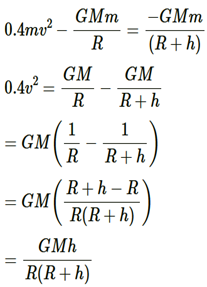
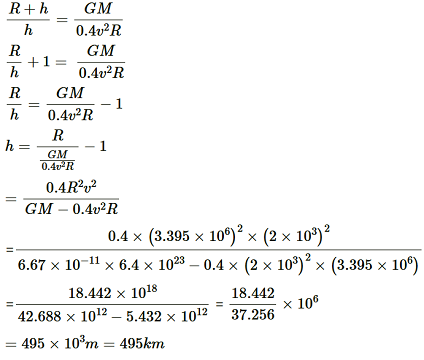
Total initial energy available $= \left(\frac{80}{100}\right) \times \left(\frac{1}{2}\right)mv^2 – \frac{GMm}{R} = 0.4mv^2 – \frac{GMm}{R}$
Maximum height reached by the rocket $= h$
At this height, the velocity and hence, the kinetic energy of the rocket will become zero.
Total energy of the rocket at height $h = -\frac{GMm}{R + h}$
Applying the law of conservation of energy for the rocket, we can write:
Why Class 11 Physics Chapter 7 Matters in NEET and JEE
Class 11 Physics Chapter 7, Gravitation, is important for NEET and JEE because it explains the gravitational force acting between objects and the motion of planets and satellites. Students learn about Newton’s law of universal gravitation, Kepler’s laws of planetary motion, acceleration due to gravity, gravitational potential and gravitational potential energy. These concepts connect mechanics with planetary and satellite motion.
NEET frequently includes direct conceptual and formula-based questions involving gravitational force, acceleration due to gravity, escape velocity and orbital velocity. JEE commonly asks numerical and application-based questions related to the variation of gravity with height and depth, satellite energy, gravitational potential and Kepler’s laws. Students must understand the difference between mass and weight and learn how gravitational quantities vary with distance. A strong command of formulas, graphs and numerical applications helps students solve gravitation questions accurately.
Preparation Tips for Class 11 Physics Chapter 7
Begin by understanding Newton’s law of universal gravitation and the factors affecting gravitational force. Learn the formula:
$$F = \frac{Gm_1 m_2}{r^2}$$
Study Kepler’s three laws of planetary motion carefully. Pay special attention to Kepler’s third law:
$$T^2 \propto r^3$$
Understand acceleration due to gravity and its relation with the mass and radius of a planet:
$$g = \frac{GM}{R^2}$$
Learn how the value of $g$ changes with height and depth. For a small height $h$ above Earth’s surface:
$$g_h \approx g\left(1 – \frac{2h}{R}\right)$$
At a depth $d$ below Earth’s surface:
$$g_d = g\left(1 – \frac{d}{R}\right)$$
Study gravitational potential, potential energy, escape velocity and orbital velocity using the relations:
$$\text{Gravitational potential, } V = -\frac{GM}{r}$$
$$\text{Potential energy, } U = -\frac{GMm}{r}$$
$$\text{Escape velocity, } v_e = \sqrt{\frac{2GM}{R}} = \sqrt{2gR}$$
$$\text{Orbital velocity, } v_o = \sqrt{\frac{GM}{R}} = \sqrt{gR}$$
Understand the total energy of an orbiting satellite and the difference between geostationary and polar satellites. Revise all NCERT derivations, graphs and solved examples regularly. Complete NCERT exercises before attempting NEET and JEE previous-year questions.
FAQs
1. What are the most important topics in Class 11 Physics Chapter 7?
The most important topics include Newton’s law of gravitation, Kepler’s laws, acceleration due to gravity, variation of gravity with height and depth, gravitational potential, potential energy, escape velocity, orbital velocity and satellites.
2. What is Newton’s law of universal gravitation?
Newton’s law states that every object in the universe attracts every other object with a force directly proportional to the product of their masses and inversely proportional to the square of the distance between them:
$$F = \frac{Gm_1 m_2}{r^2}$$
3. What are Kepler’s laws of planetary motion?
Kepler’s laws state that planets move in elliptical orbits, the line joining a planet and the Sun sweeps equal areas in equal intervals of time, and the square of the orbital period is proportional to the cube of the semi-major axis.
4. What is acceleration due to gravity?
Acceleration due to gravity is the acceleration produced in an object because of the gravitational attraction of Earth or another celestial body. Near Earth’s surface, its value is approximately $9.8\text{ m/s}^2$.
5. How does acceleration due to gravity change with height?
The value of acceleration due to gravity decreases as height above Earth’s surface increases. This happens because the distance from the centre of Earth increases.
6. How does acceleration due to gravity change with depth?
The value of acceleration due to gravity decreases as depth below Earth’s surface increases. It becomes zero at the centre of Earth.
7. What is gravitational potential?
Gravitational potential at a point is the work done per unit mass in bringing an object from infinity to that point. It is given by:
$$V = -\frac{GM}{r}$$
8. What is escape velocity?
Escape velocity is the minimum speed required for an object to escape permanently from the gravitational field of a planet without further propulsion:
$$v_e = \sqrt{\frac{2GM}{R}}$$
9. What is orbital velocity?
Orbital velocity is the velocity required by a satellite to remain in a stable circular orbit around a planet:
$$v_o = \sqrt{\frac{GM}{R}}$$
For the same distance from Earth’s centre, escape velocity is $\sqrt{2}$ times the orbital velocity.
10. Is Class 11 Physics Chapter 7 important for NEET and JEE?
Yes. Gravitation is an important chapter for NEET and JEE. Questions are commonly based on Kepler’s laws, variation of gravity, gravitational potential, escape velocity, orbital velocity and satellite motion. Regular formula revision and numerical practice are essential for scoring well.