
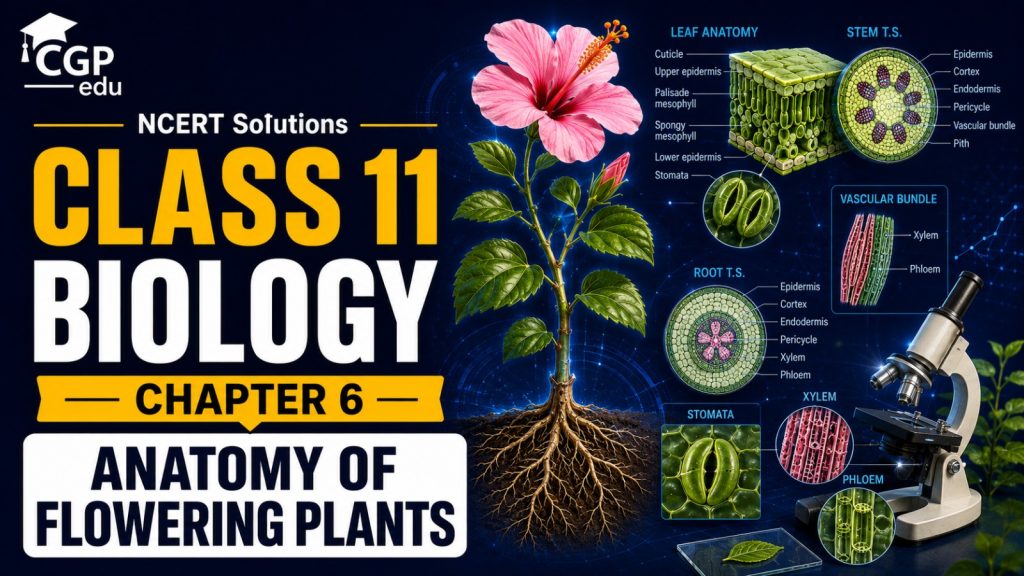
The chapter Anatomy of Flowering Plants introduces students to the internal structure and organisation of flowering plants and explains the arrangement and functions of different plant tissues. It covers meristematic tissues, permanent tissues, simple and complex tissues, and tissue systems, along with their important characteristics and functions.
Students learn about the epidermal, ground, and vascular tissue systems, as well as the internal anatomy of dicot and monocot roots, stems, and leaves. The chapter also explains the structure and arrangement of vascular bundles, xylem and phloem, and the process of secondary growth involving vascular cambium and cork cambium. A clear understanding of this chapter provides a strong foundation for studying plant tissues, internal structure, growth, transport, and structural organisation, making it an important topic for NEET preparation.
Class 11 Biology Chapter 6 Overview
Students learn about meristematic tissues, permanent tissues, simple and complex tissues, epidermal tissue system, ground tissue system, and vascular tissue system. The chapter also covers the internal anatomy of dicot and monocot roots, stems, and leaves, along with the structure and arrangement of vascular bundles. Students are introduced to secondary growth, including the roles of vascular cambium and cork cambium. A clear understanding of Anatomy of Flowering Plants helps students develop a strong foundation in plant tissues, internal structure, growth, transport, and structural organisation, making it an important chapter for NEET preparation.
NCERT Solutions for Class 11 Biology Chapter 6 – Anatomy of Flowering Plants
Question 6.1. State the location and function of different types of meristems.
Answer:
Meristems are tissues responsible for plant growth, and they are classified into three types based on their location and function:
Apical meristem: Found at the tips of roots and shoots, responsible for the growth in length of the plant.
Intercalary meristem: Located at the base of leaves or internodes, helps in the elongation of these parts.
Secondary meristem: Found in the periphery of roots and stems, involved in the thickening of plant parts.
Also Check: The Unit of Life ( Cell – The Unit of Life ) Topics and Solutions
Question 6.2. Cork cambium forms tissues that form the cork. Do you agree with this statement? Explain.
Answer:
Yes, cork cambium (also known as phellogen) is responsible for forming cork tissues. As the plant grows, cork cambium forms new cells. The outer cells develop into the cork (phellem), while the inner cells become the secondary cortex (phelloderm). The cork is impermeable to water, protecting the plant.
Question 6.3. Explain the process of secondary growth in the stems of woody angiosperms with the help of schematic diagrams. What is its significance?
Answer:
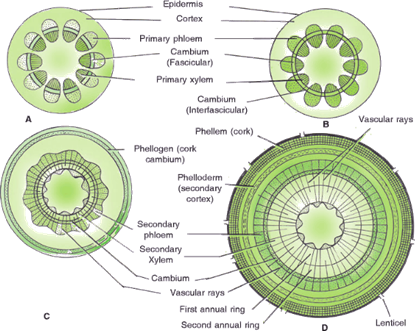
Secondary growth occurs due to the activity of the vascular cambium. It forms secondary xylem and phloem, increasing the girth of the plant. The cambium produces secondary xylem (wood) towards the inside and secondary phloem towards the outside. This growth is significant as it supports the plant structurally and increases its capacity to transport water and nutrients.
Check This Out: Reproductive Health Topics and Solutions
Question 6.4. Draw illustrations to bring out the anatomical difference between:
Answer:
(a) Monocot root and Dicot root:
Monocot root: Vascular bundles are scattered.
Dicot root: Vascular bundles are arranged in a central cylinder.
(b) Monocot stem and Dicot stem:
Monocot stem: Vascular bundles are scattered without a defined arrangement.
Dicot stem: Vascular bundles are arranged in a circle or ring.
Question 6.5. Cut a transverse section of the young stem of a plant from your school garden and observe it under a microscope. How would you ascertain whether it is a monocot stem or a dicot stem?
Answer:
Monocot stems can be identified by scattered vascular bundles, while dicot stems have vascular bundles arranged in a ring. Additionally, dicot stems show an open vascular bundle, while monocot stems have closed bundles.
Read Next: Respiration in Plants Topics and Solutions
Question 6.6. The transverse section of a plant material shows the following anatomical features:
(a) the vascular bundles are conjoint, scattered, and surrounded by sclerenchymatous bundle sheaths.
(b) Phloem parenchyma is absent. What will you identify it as?
Answer:
Based on the features described, this section would belong to a Monocot stem. The scattered, conjoint vascular bundles and absence of phloem parenchyma are typical characteristics of monocots.
Question 6.7. Why are the xylem and phloem called complex tissues?
Answer:
Xylem and phloem are considered complex tissues because they are composed of multiple cell types that work together. Xylem consists of tracheids, vessels, and fibers, while phloem consists of sieve tubes, companion cells, and phloem parenchyma.
Quick Read: Principles of Inheritance and Variation Topics and Solutions
Question 6.8. What is the stomatal apparatus? Explain the structure of stomata with a labelled diagram.
Answer:
The stomatal apparatus controls gas exchange and water loss in plants. It consists of two guard cells that regulate the opening and closing of the stomatal pore. The guard cells have chloroplasts and are responsible for the stomatal function, while surrounding subsidiary cells support the guard cells.
Question 6.9. Name the three basic tissue systems in flowering plants. Give the tissue names under each system.
Answer:
Epidermal tissue system: Includes epidermis and epidermal appendages like guard cells, root hairs, and glandular hairs.
Ground tissue system: Comprised of simple tissues such as parenchyma, collenchyma, and sclerenchyma.
Vascular tissue system: Contains complex tissues like xylem, phloem, and vascular cambium.
Question 6.10. How is the study of plant anatomy useful to us?
Answer:
The study of plant anatomy is useful to us in several ways:
– Understanding Plant Adaptations: By studying plant anatomy, we can understand how plants adapt to different environmental conditions, such as extreme climates, droughts, or high altitudes. This helps in improving plant cultivation practices and managing crops more effectively.
– Identification of Plant Species: Plant anatomy is crucial in identifying different plant species, especially monocots, dicots, and gymnosperms. This knowledge is useful for classification, conservation, and botanical research.
– Crop Improvement: The study of plant anatomy helps in understanding the physiological processes within plants, such as nutrient transport and photosynthesis. This aids in crop breeding and improvement, helping to increase agricultural productivity and food security.
– Commercial Use of Plant Products: Plant fibers, such as jute, flax, and cotton, have significant commercial value. Analyzing the anatomical structure of these fibers helps in understanding their strength and other properties, which is important for industries such as textiles and paper production.
– Medical and Pharmaceutical Applications: The anatomy of plants can help in identifying the presence of useful compounds, like medicinal alkaloids, that can be used in the development of drugs and treatments for various diseases.
Also Check: Photosynthesis in Higher Plants Topics and Solutions
Question 6.11. What is periderm? How does periderm formation take place in the dicot stems?
Answer:
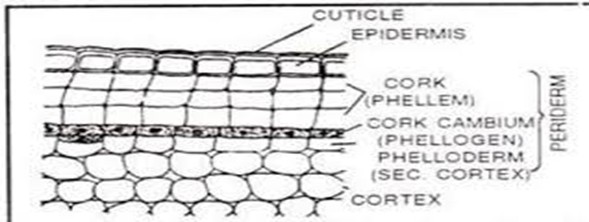
Periderm is the protective tissue that replaces the epidermis in plants during secondary growth. It consists of three main components:
Phellogen (Cork Cambium): A meristematic tissue that produces the other two components of the periderm.
Phellem (Cork): The outermost layer formed from the cells produced by the phellogen. These cells become suberized, making them impermeable to water and providing protection against mechanical injury and pathogen entry.
Phelloderm (Secondary Cortex): The inner layer formed by the phellogen, which consists of parenchyma cells.
Periderm Formation in Dicot Stems: In dicot stems, during secondary growth, the epidermis and cortical tissues are often broken due to the expanding girth of the plant. To replace these layers, a new meristematic tissue called cork cambium (phellogen) is formed from the outer cortex cells. The cork cambium divides and forms new cells on both sides: outer cells differentiate into cork (phellem), which contains suberin, making it water-resistant; inner cells differentiate into phelloderm, which is composed of parenchymatous cells that help in storage and provide structural support.
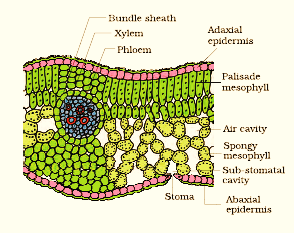
Question 6.12. Describe the internal structure of a dorsiventral leaf with the help of a labelled diagram.
Answer:
A dorsiventral leaf has two distinct surfaces:
Epidermis: The upper epidermis is thicker and has fewer stomata, while the lower epidermis has more stomata.
Mesophyll: The tissue between the two epidermal layers, consisting of palisade parenchyma (tightly packed cells for photosynthesis) and spongy parenchyma (loose cells for gas exchange).
Vascular system: Vascular bundles in the leaf are conjoint and closed, surrounded by bundle sheath cells.
Why Class 11 Biology Chapter 6 Matters in NEET
Class 11 Biology Chapter 6: Anatomy of Flowering Plants is highly important for NEET because it explains the internal structure and organisation of different plant tissues and organs. Students learn important concepts such as meristematic tissues, permanent tissues, simple and complex tissues, tissue systems, internal structure of roots, stems, and leaves, and secondary growth. NEET frequently includes direct NCERT-based questions on meristematic and permanent tissues, xylem and phloem, epidermal tissue system, ground tissue system, vascular bundles, monocot and dicot anatomy, and secondary growth. A thorough understanding of this chapter helps students build a strong foundation in plant anatomy, transport, growth, and structural organisation while improving their performance in the examination.
Preparation Tips for Class 11 Biology Chapter 6
Begin by understanding the basic classification of plant tissues, including meristematic and permanent tissues. Study the characteristics and functions of apical, intercalary, and lateral meristems, along with simple permanent tissues such as parenchyma, collenchyma, and sclerenchyma. Pay special attention to complex tissues, particularly xylem and phloem, and learn the structure and functions of their different components.
Study the three major tissue systems—epidermal, ground, and vascular tissue systems—and understand their arrangement in different plant organs. Pay special attention to the internal anatomy of dicot and monocot roots, stems, and leaves, including the arrangement of vascular bundles and important differences between monocot and dicot structures.
Learn the concepts of secondary growth, vascular cambium, cork cambium, annual rings, heartwood, sapwood, and formation of secondary xylem and phloem. Practise identifying structures from NCERT diagrams, especially transverse sections of roots, stems, and leaves. Prepare comparison tables for quick revision and complete all NCERT diagrams, tables, examples, and exercise questions. Finally, practise NEET previous-year questions regularly and revise important tissues, functions, anatomical features, and differences between monocot and dicot plants to improve accuracy, speed, and confidence.
FAQs
What are the most important topics in Class 11 Biology Chapter 6?
The most important topics include plant tissues, meristematic tissues, permanent tissues, simple and complex tissues, tissue systems, anatomy of roots, stems and leaves, vascular bundles, monocot and dicot anatomy, and secondary growth. These topics are frequently tested in NEET.
What are the main types of plant tissues?
Plant tissues are broadly classified into meristematic tissues and permanent tissues. Meristematic tissues are actively dividing, while permanent tissues generally lose their ability to divide and perform specialised functions.
What are the three types of meristematic tissues?
The three main types are apical meristem, intercalary meristem, and lateral meristem. Apical meristems are responsible for increase in length, intercalary meristems help in growth of internodes, and lateral meristems contribute mainly to secondary growth and increase in girth.
What are simple permanent tissues?
Simple permanent tissues consist of similar types of cells performing similar functions. The main types are parenchyma, collenchyma, and sclerenchyma. They differ in their structure, cell wall characteristics, and functions.
What are complex permanent tissues?
Complex permanent tissues consist of different types of cells that work together to perform a common function. The two major complex tissues are xylem and phloem. Xylem mainly conducts water and minerals, while phloem transports organic food materials.
What is the difference between monocot and dicot anatomy?
Monocot and dicot plants differ in the internal arrangement of their roots, stems, and leaves. Important differences include the arrangement of vascular bundles, presence or absence of cambium, differentiation of ground tissue, and secondary growth. These differences are important for NEET-based questions.
What is secondary growth?
Secondary growth refers to the increase in the girth or thickness of stems and roots due to the activity of lateral meristems, mainly vascular cambium and cork cambium. It results in the formation of secondary xylem, secondary phloem, and periderm.
Is Class 11 Biology Chapter 6 important for NEET?
Yes. Class 11 Biology Chapter 6: Anatomy of Flowering Plants is highly important for NEET because it contains many direct NCERT-based questions on plant tissues, tissue systems, vascular tissues, root and stem anatomy, monocot and dicot differences, leaf anatomy, and secondary growth. Regular revision of NCERT concepts, diagrams, tables, and previous-year questions is essential for scoring well in the examination.